TCM Postpartum Recovery: The 40-Day Healing Blueprint | Demisunshine
Why the Western 6-Week Checkup Fails New Mothers After Birth
The standard six-week postpartum checkup is a joke, a medical pat on the head that completely misses the foundational healing new mothers desperately need. Traditional Chinese Medicine offers a 40-day blueprint that actually rebuilds, not just rubber-stamps, a mother's health.
Kai ZhangMarch 18, 20269 min read
Quick Answer
Traditional Chinese Medicine (TCM) at its core redefines postpartum recovery from a superficial 6-week checkup to a critical 40-day period of deep healing, known as 'The Womb's Winter.' This approach focuses on replenishing vital Qi and Blood, using warming foods and specific herbs to rebuild a mother's foundation and prevent long-term health issues often missed by Western care.
Key Takeaways
The conventional 6-week postpartum checkup is an insufficient framework; TCM advocates a 'Womb's Winter' — a sacred 40-day period for foundational healing and rebuilding.
Postpartum recovery in TCM is about addressing the 'Qi Drain' and Blood depletion, seen as the root cause of long-term fatigue, pain, and emotional imbalances, rather than just symptom management.
Warming, nutrient-dense foods and targeted herbs are not mere dietary recommendations but physiological necessities that actively restore digestive fire, blood production, and overall vitality.
Ignoring the body's need for deep rest and internal replenishment during the first 40 days can lead to persistent issues like 'Wind Invasion Weakness' (puerperal wind syndrome) and chronic fatigue, which Western medicine often struggles to diagnose or treat effectively.
True postpartum healing demands challenging the cultural pressure to 'bounce back' quickly and instead investing in the profound, often uncomfortable, process of deep rebuilding prescribed by TCM.
I’ve seen it countless times. A new mother, beaming with exhaustion, gets her six-week postpartum checkup. The doctor tells her everything looks fine. She’s cleared for exercise. Cleared for sex. Cleared to bounce back to her old self.
But if you listen closely, if you pay attention to the hollow look in her eyes, the tremor in her voice, you hear the truth: fine is a lie. This isn't recovery; it’s a medical discharge, a superficial nod to a body-shattering transformation that Western medicine is woefully unprepared to address beyond the most basic mechanics.
You think that six-week stamp of approval means you’re ready to run a marathon, chase a toddler, or just feel human again. You’re not. You’re treating symptoms, not the root. You’re being told to rebuild a house on quicksand because nobody bothered to tell you your foundation was blasted away. And that, my friend, is where you’re already fucking yourself over.
Traditional Chinese Medicine (TCM) understands something at its core different about postpartum recovery. It’s not a sprint back to normal because your normal has irrevocably changed. My father, a TCM practitioner who spent decades rebuilding women’s health after childbirth, taught me that. He called the first 40 days The Womb's Winter – a period of sacred confinement, deep nourishment, and intentional warming.
It’s a time to restore the body’s essential life forces: Qi and Blood, which have been severely depleted by childbirth. This isn't just an old wives' tale; it's a blueprint for long-term maternal health.
Listen. When a mother faces the aftermath of birth, her core energy — her Qi — is often annihilated. My father would prescribe Huang Qi (Astragalus membranaceus), also known as Milk Vetch Root. This isn't just some dusty root; it’s a powerhouse. It directly strengthens your Spleen and Lungs, literally elevating your Yang Qi and fortifying your external defenses against illness.
Its active compounds, things like saponins and flavonoids, don't just make you feel good; they actively bolster your body's defensive Wei Qi, acting like an internal shield when you feel most vulnerable.
We’re talking about a recommended daily dosage of 9-30g in decoction. It's got a slightly warm nature and sweet flavor, hitting your Lung and Spleen meridians right where they need it. This isn’t a gentle suggestion; it’s a physiological command to rebuild your internal power.
Ancient texts like 《医学心悟》 weren’t guessing. They stated plainly: '产后诸疾,健运脾胃为先,四君四物汤加减最宜' – meaning, for postpartum disorders, prioritizing the Spleen and Stomach is paramount, with variations of Si Jun Zi Tang and Si Wu Tang being ideal. That establishes replenishing Qi and Blood and regulating the Spleen and Stomach as the core healing principles.
So, when someone tells you to do a few pelvic floor exercises, you can see why it misses the entire damn point. It’s like trying to fix a crumbling skyscraper with a band-aid.
The Six-Week Lie You've Been Fed
The Western medical establishment, bless its symptom-managing heart, frames postpartum as a swift transition. Six weeks. That's it. Six weeks to heal a gaping wound, recover from immense blood loss, hormonal upheaval, and the sheer physical trauma of pushing a human out of your body (or having one cut out). It's a convenient timeline for insurance, for getting you back to work, for keeping the wheels of capitalism turning. But it's not a timeline for genuine healing.
The International Journal of Environmental Research and Public Health, in a 2022 review, rightly emphasized that the postpartum period should be treated as a distinct recovery phase requiring medical, nutritional, and emotional support for at least six weeks, and often longer.Longer is the key word here. They’re still tiptoeing around it. TCM doesn't tiptoe. It screams: You are depleted, and you need to rebuild.
This isn't just about the uterus contracting or stitches dissolving. This is about your entire zang-fu organ system being thrown into chaos. It's about your Qi and Blood reserves being at rock bottom. You can’t just power through that. You’ll pay for it later. Every chronic ache, every unexplained fatigue, every burst of anxiety years down the line can often be traced back to this initial period of ignored depletion.
Your Body Isn't Broken, It's Drained: Understanding The Qi Drain
I had a client, Sarah, a vibrant woman who was determined to be that mom who did yoga two weeks postpartum. She drank her kale smoothies (cold, obviously), pushed through her exhaustion, and proudly announced she was feeling normal by week eight.
A year later, she was a wreck.
Crippling fatigue, hair loss in clumps, constant joint pain, and a temper that flared at the smallest things. She'd developed The Qi Drain – a TCM concept for severe Qi and Blood depletion, exacerbated by her frantic attempt to defy her body's need for rest and warmth.
Childbirth is a massive energetic expenditure. It’s like running a marathon, then donating several pints of blood, and then being told to immediately start training for another marathon while surviving on three hours of interrupted sleep. Your Qi (vital energy) and Blood (the material foundation for mind and body) are deeply compromised. Symptoms like overwhelming fatigue, dizziness, brain fog, anxiety, and even postpartum depression aren't just hormones; they are direct manifestations of this depletion.
You might argue that traditional doing-the-month practices have conflicting evidence on their direct link to reduced postpartum depression. Yang X et al. (PLOS ONE, 2023) reviewed 16 quantitative studies, finding only four indicated reduced PPD risk, while ten found no significant association. Why? Because those studies often fail to isolate the most crucial element: sustained, intentional rest and holistic support, not simply adhering to superficial cultural rules like avoiding washing hair.
True recovery isn’t about what you can't do, but what you must do to deeply replenish.
Your Smoothie Is Making You Sicker: The Power of Warming Foods
The modern wellness industry preaches cold, raw, detoxifying foods. You see new moms sipping icy green smoothies and munching on salads, trying to cleanse their bodies. This is precisely the opposite of what your postpartum body needs. Your Spleen Qi, responsible for transforming food into Qi and Blood, is already struggling. Piling on cold, difficult-to-digest foods actively dampens its function, making you even more depleted and fatigued.
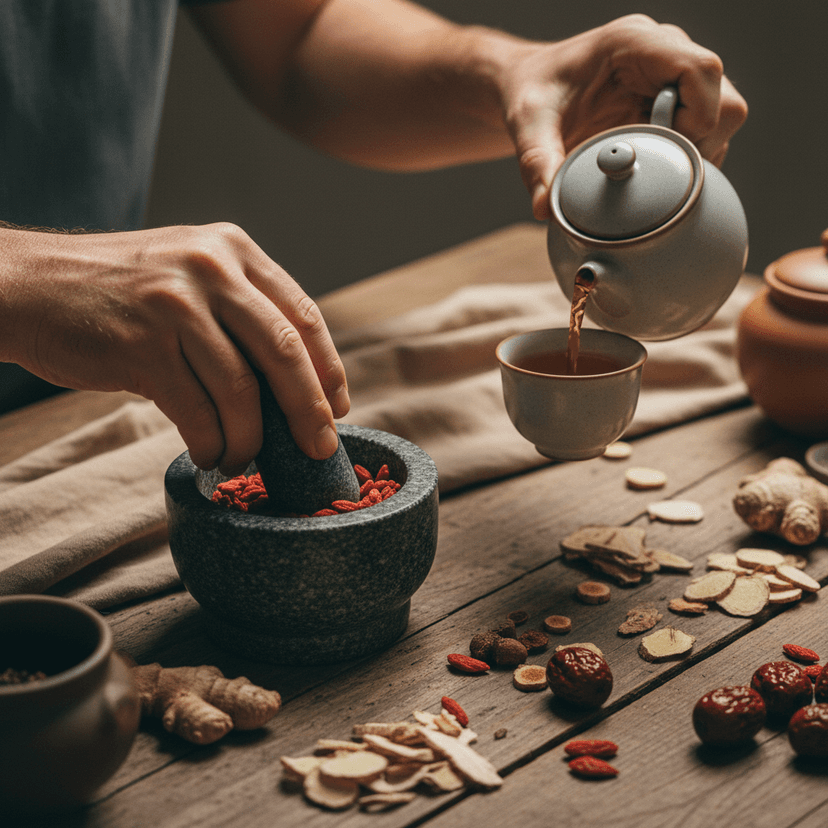
TCM insists on warming, nutrient-dense, easily digestible meals. Think bone broths, ginger tea, congee, slow-cooked meats, red dates, and dried longan. These aren't just comfort foods; they are medicinal. They actively rebuild your Spleen Qi and replenish your Blood, fueling recovery from the inside out.
A 2022 review in Nutrients confirmed that traditional postpartum dietary practices, including these warming, nutrient-dense meals central to Chinese confinement, are associated with improved maternal recovery outcomes and higher breastfeeding success rates. This isn't some quaint cultural quirk; it's a physiological necessity. When you eat, ask yourself: Is this food generating warmth and nourishment, or is it chilling my core and making my Spleen work harder than it already is?
The Ghost of the Wind: Puerperal Wind Syndrome and Modern Pain
Many postpartum mothers complain of persistent body aches, joint pain, headaches, and a general feeling of vulnerability to cold. Western medicine often shrugs, offering pain meds or physical therapy.
TCM calls this Puerperal Wind Syndrome, or as I brand it, Wind Invasion Weakness. In TCM, after childbirth, the body is left open and deficient, making it susceptible to external pathogens like Wind and Cold. This isn't a literal wind; it's an energetic invasion that settles in the meridians, causing pain and discomfort.
You might think this sounds like ancient superstition. But tell that to the woman who can't hold her baby without her wrists aching, or who feels a deep chill in her bones even in a warm room. This is real pain, real dysfunction. And a systematic review by Kwon N-Y et al.
(Healthcare, MDPI, 2023) showed that herbal medicine treatment showed better improvement in clinical efficacy, pain index, and quality of life, with fewer side effects, for puerperal wind syndrome compared to conventional treatment. This wasn't some anecdotal whisper; it was a meta-analysis of 9 RCTs, involving 652 patients. The evidence is there, if you choose to look beyond the pharmaceutical aisle.
Treating Wind Invasion Weakness requires expelling the cold and wind, while simultaneously strengthening the body's internal defenses (Qi and Blood). This involves specific warming herbs, external therapies like moxibustion, and, crucially, avoiding exposure to cold. Yes, that means no cold showers, no blasting AC, no walking barefoot on cold floors. This isn't about cleanliness; it's about closing the energetic gates that childbirth has left open.
Beyond Breastfeeding: The Real Secret to Milk Production and Mood
You’re told to latch, to pump, to drink water, to eat fenugreek. And still, many mothers struggle with milk supply, or worse, find breastfeeding an emotionally draining nightmare.
In TCM, milk production is deeply tied to the health of the Spleen (for transforming food into Blood and Qi, which become milk) and the Liver (for ensuring the smooth flow of milk and emotions). If your Qi and Blood are deficient, or your Liver Qi is stagnant (often from stress and frustration), your milk supply will suffer, and your mood will plummet.
This isn't just theory. Clinical research backs it up. Liu Huiyan et al. (《北京中医药》, 2024) found that Cai Lianxiang’s '益气血滋乳通络法' (Qi-Invigorating, Blood-Nourishing, Lactation-Promoting, Channel-Unblocking Method) for postpartum hypogalactia achieved a total effective rate of 92%, significantly outperforming the control group’s 76%. Another study from Jinhua People's Hospital (2024) showed that '健脾疏肝通乳方' (Spleen-Strengthening, Liver-Soothing, Lactation-Promoting Formula) combined with medicated diets improved milk secretion by a staggering 40% in mothers with Qi and Blood deficiency.
The point is, this isn't just about getting enough calories; it's about bioavailability and energetic balance.
You can pump all you want, but if the internal world of your body is a barren, stagnant wasteland, the milk won't flow, and your spirit will drain. It’s a vicious cycle. Addressing the Qi and Blood deficiency, along with ensuring the smooth flow of Liver Qi (which regulates emotions and the release of milk), is the only path to both abundant milk and a stable, peaceful mind.
Your First 24 Hours: Take Back Control
Look, I’m not asking you to overhaul your life tomorrow. But if you’re ready to start building that foundation, here’s where you start. This isn't optional; it's essential. Do this, and you're already doing more for your long-term health than most women after birth:
No ice. Seriously. For the next 24 hours, drink only room temperature or warm water and herbal teas. Chill your core now, and you’ll pay for it later.
Make a simple congee. Rice, water, a slice or two of ginger. Cook it until it breaks down into a comforting, easily digestible porridge. That’s your medicine. You can add some protein later, but start simple.
Lie down for 20 minutes. No phone. No TV. Just you and your breath. Close your eyes. Your body just did something insane; it deserves a break. That’s it. Start there. No excuses.
Reclaiming Your Future Self: The 40-Day Investment
Here's what it comes down to: You have a choice. You can buy into the Western myth of the six-week bounce back, push yourself to exhaustion, and wonder why you feel like a shell of your former self for years. Or you can embrace The Womb's Winter, this sacred 40-day window, not as a period of restriction, but as a foundational investment in your future health, your energy, and your emotional well-being.
This means prioritizing deep rest over productivity. It means choosing warming, nourishing foods over quick, cold fixes. It means seeking out support to ensure you’re not doing it all alone. It means understanding that every cell in your body just went through a war, and it needs time, warmth, and specific nutrients to not just recover, but to rebuild, stronger than before. You are not just recovering; you are transforming into a new being.
The question isn't how quickly you can return to who you were, but how deeply you can build the foundation for who you are becoming.
Because the greatest strength isn't found in pushing through pain. It’s found in the courage to surrender to the body’s innate wisdom, to honor the process, and to heal from the bone out.
Contributing Writer at Demisunshine. Kai has been around Chinese herbs and food therapy for as long as he can remember — first at his grandmother's kitchen table, later in his own. He writes the practical pieces: what to actually do with what you've read, with concrete examples and short sentences.
Get TCM Wellness Tips
Weekly articles on herbal remedies, nutrition, and holistic health — delivered to your inbox.