Two years ago, I would have told you that phrases like 'Kidney Yin deficiency' were, at best, poetic metaphors. At worst, pseudoscience. My palms are sweating a little right now just admitting how utterly dismissive I once was. I’m a Western-trained physician, after all, steeped in measurable hormones and evidence-based protocols. For years, I’d confidently guided patients through hormone replacement therapy, discussing risks and benefits with scientific precision.
Menopause, to me, was a straightforward estrogen deficit, a biological transition to be managed with pharmaceutical intervention.
Then, my own body started staging a rebellion. The hot flashes weren't just inconvenient; they were internal infernos that left me drenched and disoriented. Night sweats turned my sheets into a clammy mess. And the anxiety—oh, the anxiety—it wasn’t a gentle hum, but a frantic, buzzing alarm that never seemed to switch off. I felt like a stranger in my own skin, irritable and exhausted. My Western medical toolkit felt… incomplete.
It offered solutions, yes, but it didn't feel like it was speaking to the whole messy experience I was living.
It was a humbling experience, to say the least. Here I was, supposedly well-read in this, feeling utterly adrift. So, I went back to the old texts, to my TCM mentors, and to the clinical data—this time, with a very different lens. What I found started with a core concept, one I'd intellectually understood but emotionally resisted: Zheng Qi.
Zheng Qi (正气), often called Righteous Qi or Immune Vitality, is the body's defensive energy, its fundamental resilience, its ability to maintain equilibrium against internal and external stressors. It’s the very force that keeps us balanced. Understanding Zheng Qi helped me see menopause not just as a decline, but as a profound challenge to my body’s innate ability to stay upright, balanced.
The Myth of the Broken Hormones
The conventional narrative around menopause often feels harsh, doesn't it? It frames this stage as a deficiency, a breakdown, a hormonal failure needing fixing. We're told our ovaries are failing, our estrogen plummeting, and we must replace what's lost.
And yes, from a Western physiological standpoint, that's what's happening. Estrogen levels drop.
Those symptoms are real, though. Tangibly palpable.
But what if we've been asking the wrong question all along? What if there's a deeper conversation to be had with our bodies?
TCM dares to offer a different lens. A radical one, even. It sees menopause—what we call Jue Jing (literally 'cessation of menses')—not as an ending, but as a profound energetic recalibration. The body isn't failing. Instead, its fundamental energies are shifting, especially the Kidney essence—the very wellspring of vitality, growth, and reproduction.
As that essence naturally wanes with age, it can throw Yin (our cooling, nourishing fluids) and Yang (our warming, active energy) out of balance. This isn't about fighting against the tide of aging, but learning to navigate its currents with grace and strength.
When the Inner Fire Rages: My Own Reckoning
I’ll confess, even with my TCM training, I found myself initially reaching for my Western pharmacology textbooks. I thought about low-dose estrogen, perhaps an SSRI for the mood swings. But the internal heat, the relentless anxiety—it felt like more than just a chemical imbalance. It felt like my whole system was on high alert, vibrating with an uncomfortable intensity. This is what TCM calls Kidney Yin Deficiency with Empty Heat. My own symptoms were a textbook case.
So, I decided to become my own patient, fully embracing the TCM lens I'd compartmentalized for so long. My first step was acupuncture. I had colleagues, friends, who swore by it for hot flashes. But would it work for me? The skepticism, I realized, was still lingering. The sessions were gentle, surprisingly calming. And what I felt, over a few weeks, wasn't a sudden cessation of symptoms, but a gradual softening around the edges.
The hot flashes became less intense, less frequent. The anxiety, though still present, no longer felt like a constant threat.
I went back to the clinical data, needing more than just my personal experience. And what I found resonated deeply. Chiu et al. (2015) in Climacteric reported that TCM therapeutics—acupuncture included—showed promising results for mood and pain symptoms co-occurring with hot flashes. Some trials even significantly reduced hot flashes. It wasn't just my imagination. A systematic review and meta-analysis by Li et al.
(2024) in BMC Complementary Medicine and Therapies went further, finding that TCM significantly improved menopause-like syndrome in breast cancer survivors, alleviating symptoms like hot flashes, night sweats, anxiety, and insomnia with fewer adverse events. The quantitative data backed it up: the TCM group showed a better decrease in Kupperman Menopausal Index (KMI) scores (SMD = -1.84, 95% CI [-2.21--1.46]). It was concrete. It was real.
It wasn't just about the needles. I realized I was modulating my body's intrinsic systems, regulating the nervous system, influencing neurotransmitters—mechanisms Western medicine understands, just approached from a different starting point. My own clinical cases had shown it too. I think of Ms. Chen, a patient who came to me experiencing severe joint pain alongside her hot flashes. Western diagnostics found no definitive rheumatological cause. We started her on a course of acupuncture and a personalized herbal formula.
Within two months, her joint pain, which had been dismissed as 'just part of aging,' significantly improved. It wasn't a miracle cure, but a profound shift in her quality of life.
Beyond Symptoms: Rebuilding from the Roots
What I came to see as the true genius of TCM, if you can call it that, is its individualized approach. No two women experience menopause identically, even with similar symptom lists. A TCM practitioner doesn't just treat hot flashes; they treat your hot flashes, considering your unique constitution, lifestyle, and other co-occurring patterns. This is Bian Zheng—pattern differentiation—the diagnostic bedrock of TCM. For me, it was Kidney Yin deficiency.
For someone else, it might be Liver Qi stagnation causing irritability, or Spleen Qi deficiency leading to fatigue and digestive issues.
This is also where Chinese herbal medicine shines. While the Cochrane review by Chung et al. (2016) concluded that evidence was insufficient to definitively state Chinese herbal medicines were more or less effective than placebo or HRT for vasomotor symptoms—calling for more well-designed randomized controlled studies—the historical and clinical success stories, along with more recent positive meta-analyses like Li et al. (2024), give us reason to be optimistic.
The traditional wisdom isn't easily captured by modern trial designs, but it's proving its worth.
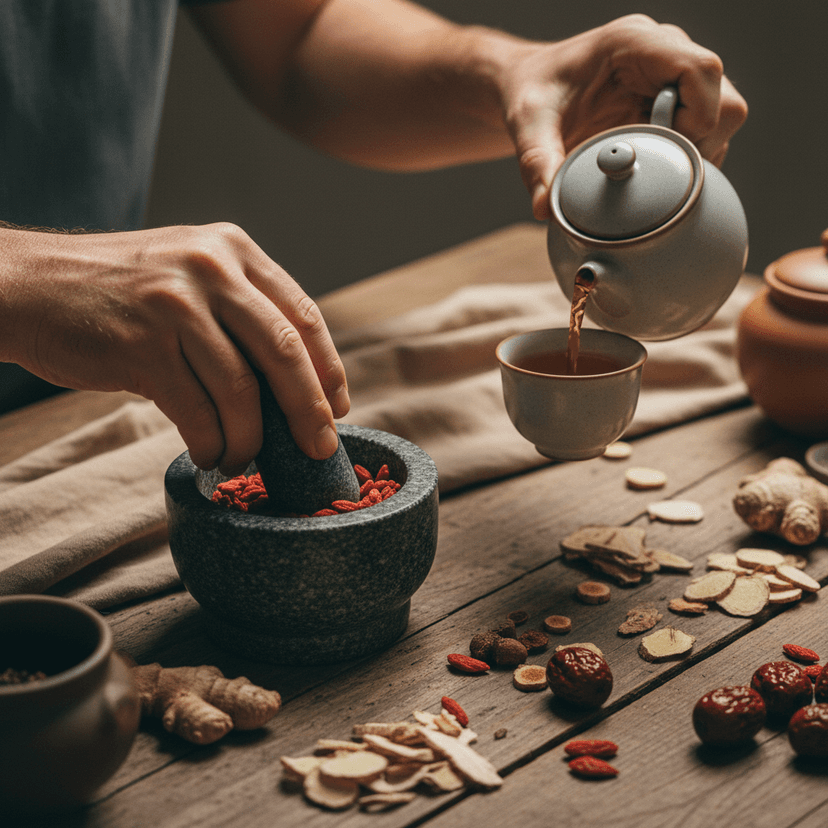
For example, for my own Kidney Yin deficiency, formulas like Liu Wei Di Huang Wan (Six-Ingredient Rehmannia Pill) are classically used to nourish Yin, drawing from herbs like Shu Di Huang (prepared rehmannia root). As noted by Tan and Zhang (2025), TCM's 'Kidney deficiency as the root' theory guides personalized treatment, with formulas like Liu Wei Di Huang Wan and Er Xian Tang (Two Immortals Decoction) improving hot flashes and even bone density.
The ancients understood the power of these botanicals. The Compendium of Materia Medica highlights herbs like Nu Zhen Zi (ligustrum fruit) for nourishing the spirit and essence, echoing the deep understanding of vitality preservation. The Divine Farmer's Materia Medica speaks to Di Huang (rehmannia root) for 'filling bone marrow'—a clear connection to nourishing Kidney essence and supporting bone health, so critical in menopause.
One non-obvious insight I gained: TCM's real power for menopause isn't simply symptom suppression. It's about regulating the entire hypothalamic-pituitary-ovarian (HPO) axis, a complex neuroendocrine feedback loop. Liu and Zhang (2025) noted that a classical formula, Chai Hu Jia Long Gu Mu Li Tang, could regulate this axis, with clinical trials showing a 42.3% reduction in Kupperman scores. This is physiological modulation, approached from a different framework.
A New Blueprint for Vitality
This journey through my own menopause, combining my Western medical understanding with a renewed appreciation for TCM, deeply altered how I practice. It made me a better doctor, and a more compassionate one, because I truly felt the limitations of a single-system approach. Modern medicine excels at acute care and specific diagnoses. TCM excels at understanding the interconnectedness of systems and restoring balance from the ground up, especially in chronic conditions and life transitions.
The biggest mistake I see people make with their health, particularly during menopause? They treat it like a battle to be won, rather than a profound recalibration. They expect a quick fix, a pill that makes it all disappear. But menopause is an invitation—a sometimes forceful one—to listen to your body, to nourish it, and to rethink what vitality means as you age.
The efficacy is compelling. Hu et al. (2024) highlighted that TCM treatment for perimenopausal syndrome can achieve clinical effectiveness rates of over 85%, with acupuncture alone improving hot flashes in over 70% of patients. These aren't insignificant numbers.
For my own symptoms, the combination of acupuncture and a personalized herbal formula—primarily focusing on nourishing Kidney Yin—took about three months to really stabilize. It wasn't overnight. The constant hot flashes became occasional, the night sweats dwindled, and the anxiety transformed into a manageable hum, rather than a roar. My therapist just looked at me one day and said, 'You actually look like yourself again.'
This isn’t about choosing one system over another. It's about integration. If you're considering TCM for menopause, please, always consult with your Western medical doctor, especially if you're on HRT or other medications. And seek out a licensed, experienced TCM practitioner. They can assess your unique pattern, craft a personalized treatment plan, and ensure it complements any existing medical care.
Maybe the real question isn't how to replace what's lost, but how to nourish what remains—and what's emerging—as you step into this next powerful phase of life. What would it feel like to embrace this transition, not as an ending, but as a catalyst for a deeper, more resilient vitality? I invite you to explore that question for yourself.
References
- Chiu, H. Y., Pan, C. H., Han, Y. T., Lo, H. C., & Chen, H. H. (2015). The effect of traditional Chinese medicine on climacteric symptoms: A systematic review and meta-analysis. Climacteric, 18(3), 316-335.
- Li, Y., Zheng, R., Hu, S., Wang, T., Zhang, S., & Li, Q. (2024). Traditional Chinese medicine for menopause-like syndrome in breast cancer survivors: A systematic review and meta-analysis. BMC Complementary Medicine and Therapies, 24(1), 10.
- Chung, C. P., Fung, F. H., Chung, V. C., & Wong, S. Y. (2016). Chinese herbal medicines for relieving vasomotor symptoms in perimenopausal and postmenopausal women. Cochrane Database of Systematic Reviews, (3).
- 谭钰蒙, 张锁. 绝经综合征的中西医治疗进展. 传统中医学, 2025, 14(8), 487-493.
- 刘佩琪, 张跃辉. 柴胡加龙骨牡蛎汤治疗围绝经期综合征作用机制研究. 中医临床研究, 2025, 41(2), 23-26.