Menopause Hot Flashes & TCM: Understanding Your Yin | Demisunshine
Beyond the Heat: What Your Hot Flashes Really Say About Your Yin
Hot flashes are often dismissed as simple estrogen deficiency, but Traditional Chinese Medicine (TCM) reveals a deeper story: a critical imbalance of your body's cooling Yin energy. Discover how ancient wisdom and modern science converge to offer a personalized path to understanding and allevia
Maya ChenMarch 17, 202610 min read
Quick Answer
Hot flashes during menopause, from a Traditional Chinese Medicine perspective, are a key indicator of Kidney Yin deficiency—a fundamental imbalance where the body's cooling, nourishing essence is depleted. This leads to a relative excess of internal heat. Addressing this requires a personalized approach involving specific herbal formulas, acupuncture, and dietary and lifestyle adjustments, often showing promising results by restoring the body's delicate Yin-Yang balance.
Key Takeaways
Hot flashes in TCM signify a deeper Kidney Yin deficiency, a decline in cooling energy that requires a holistic, personalized approach beyond hormone replacement.
While some acupuncture studies show mixed results, TCM's strength lies in its individualized diagnosis, tailoring treatments based on specific patterns like Liver-Kidney Yin deficiency or Heart-Kidney non-interaction.
Nourishing Yin through diet with foods like black beans and goji berries, coupled with lifestyle adjustments, forms a critical foundation for managing menopausal symptoms effectively.
Modern research is beginning to validate TCM principles by exploring mechanisms like the KNDy pathway, suggesting that traditional herbal formulas may modulate neuroendocrine functions to alleviate hot flashes.
The journey through menopause, or 'Second Spring,' is an opportunity for profound self-understanding and rebalancing, helping you address root causes rather than just symptoms.
Hey everybody. I remember staring at the cohort data, a spreadsheet of anonymized patient records stretching across two monitors. Each row detailed a woman's menopausal journey: symptoms, treatments, outcomes. I was deep into my residency, fresh from Beijing University of Chinese Medicine, grappling with how to effectively bridge ancient TCM diagnostics with the Western functional medicine lens I was developing. I was looking for patterns in how different interventions impacted hot flashes, trying to quantify the subjective experience of heat.
What jumped out at me wasn't just what worked, but how often we were getting the diagnosis right from a TCM perspective on the first pass.
Most of these women had been told their hot flashes were simply a result of declining estrogen, a normal part of menopause, and often, that Hormone Replacement Therapy (HRT) was their primary, if not only, effective solution. And for many, HRT does help. But my data, and my patients’ stories, painted a much more nuanced picture.
They revealed that what we call a hot flash in Western medicine is, in Traditional Chinese Medicine, a profound message from your body, often signaling a specific imbalance: Kidney Yin deficiency.
This isn't just semantics. Understanding this distinction can completely change your approach to menopause. Kidney Yin deficiency in Traditional Chinese Medicine refers to a depletion of the body's fundamental cooling, moistening, and nourishing substances. Think of Yin as the deep, dark, restorative waters of a well, essential for quenching fire and maintaining calm. When this Yin essence, often associated with the reproductive and adrenal systems in Western terms, declines, a relative excess of Yang (heat, activity, dryness) emerges.
It's like the well drying up, leaving the sun to scorch the earth. This explains why symptoms aren't just heat, but often include night sweats, dry skin, anxiety, and restless sleep.
The Patient Who Taught Me About the “Inner Fire”
I remember Sarah, a vibrant woman in her early fifties, who came to me utterly exasperated. Her hot flashes were relentless, disrupting meetings, drenching her at night. Her Western doctor had offered HRT, but she was hesitant due to family history. “I just feel like I’m burning from the inside out, Dr. Chen,” she told me, fanning herself furiously. “Like there’s a furnace in my stomach.”
Her story wasn't unique. My clinical observations, echoed by research, confirm this deep connection.
Consider a cohort study of 23 postmenopausal women with hot flashes conducted at Kaiser Permanente Medical Centers.
Researchers like Zell, Hirata, and Ettinger (2000) found that Kidney Yin deficiency was the most frequent TCM diagnosis. A staggering 81% of diagnoses pointed directly to this specific pattern. This mirrored what I was seeing in my own practice, time and time again. Their bodies weren't just low on estrogen; they were fundamentally dry and overheated.
We often get caught up in the what – hot flashes. But the real power lies in understanding the why. What if your body isn't just failing to produce hormones, but is actually struggling with a systemic imbalance that leads to those symptoms? That’s the reframing I offer my patients.
The Delicate Dance of Yin and Yang: Your Body's Inner Thermostat
Imagine your body like a car. Yin is the coolant, the brakes, the deep reserves of oil. Yang is the engine, the accelerator, the fuel. For optimal performance, you need both in balance. In menopause, or as we call it in TCM, the Second Spring – a period of profound transformation and new beginnings – the body's Yin naturally begins to decline. This isn't inherently bad; it's a part of life's rhythm.
The challenge arises when this decline is exacerbated by lifestyle, diet, stress, or other factors, leading to a significant relative excess of Yang.
That's when you get the heat: hot flashes, night sweats, a quick temper, anxiety, even dry eyes or skin. The engine is running hot, and there's not enough coolant to keep it in check. This Yin-Yang disharmony is what TCM seeks to rebalance, not just by adding hormones, but by nourishing the depleted Yin and gently guiding down the excessive Yang.
This holistic perspective is where TCM genuinely excels, looking at the interconnectedness of symptoms that Western medicine might treat as isolated issues.
What are your hot flashes telling you? They are not just an inconvenience; they are a clear sign from your body that its internal thermostat, the delicate balance of Yin and Yang, is out of whack. And understanding this is the first step toward regaining control.
TCM vs. Western Views: A Quick Comparison
Let's put this into perspective:
Western Medicine: Primarily views hot flashes as a direct consequence of estrogen withdrawal affecting the thermoregulatory center in the brain. Treatment often focuses on hormone replacement to alleviate symptoms.
Traditional Chinese Medicine: Interprets hot flashes as a symptom of a deeper Kidney Yin deficiency, where the body's cooling Yin energy is depleted, leading to a relative excess of heat (Yang). Treatment aims to nourish Yin and clear heat, restoring overall balance.
The beauty is, these aren't mutually exclusive. They offer different yet complementary lenses through which to understand a complex physiological transition.
Beyond the Needle: The Nuance of Personalized Healing
One of the biggest misconceptions I encounter is the idea that TCM treatments are a one-size-fits-all solution. Is acupuncture effective for menopausal hot flashes? You’ll see studies with mixed results. For example, a randomized, sham-controlled trial by MacPherson and colleagues (2016) published in Annals of Internal Medicine found that standardized Chinese medicine acupuncture for Kidney Yin deficiency was not superior to non-insertive sham acupuncture in reducing hot flashes. The mean hot flash scores at the end of treatment were 15.
36 for acupuncture versus 15.04 for sham, with a P-value of 0.77 – showing no significant difference. This kind of data can be disheartening for those seeking natural alternatives.
But here's the thing about TCM: it's rarely about a single intervention. It’s about a deeply personalized diagnosis based on a comprehensive assessment of your specific pattern, not just your symptoms. Two women with hot flashes might receive entirely different treatments because their underlying imbalances (their TCM patterns) are different.
I recall another patient, Elena, who initially tried acupuncture with another practitioner for her hot flashes and felt little relief. When she came to me, her tongue was red with a thin yellow coat, her pulse was rapid and thready – classic signs of Liver and Kidney Yin deficiency with Empty Heat. Her hot flashes were accompanied by significant irritability and headaches, pointing to a Liver component that the previous treatment hadn't fully addressed.
We adjusted her protocol to include specific herbs to calm the Liver and nourish both Liver and Kidney Yin.
Acupuncture isn't just about sticking needles in; herbal medicine isn't simply about swallowing a capsule. The real power lies in understanding why that point or herb, and which combination, for your unique presentation. Researchers at institutions like the NIH's National Center for Complementary and Integrative Health (NCCIH), including Dr. Helene Langevin, are actively exploring the complex mechanisms of acupuncture and its effects on the body's systems, hinting at the intricate pathways TCM has recognized for millennia.
What Chinese herbs help with hot flashes and night sweats? Many formulas address Yin deficiency. For example, Heyan Kuntai capsule (HYKT), a Chinese-patented medicine, has shown remarkable efficacy. A randomized, double-blind study by Wang et al. (2018) found HYKT to be as effective as estradiol valerate in alleviating hot flashes, with 92.3% reduction in hot flashes with HYKT compared to 96.5% with estradiol valerate (p > 0.05, indicating no significant statistical difference).
This is powerful evidence for those seeking non-hormonal options.
Another formula, 清心滋肾汤 (Qingxin Zishen Tang), is being studied for its neuroendocrine mechanisms. Recent research (2024) suggests it improves hot flashes and sweating by down-regulating Kisspeptin (K) and Neurokinin B (NKB) levels, while up-regulating Dynorphin (Dyn) levels. This points to a fascinating interplay with the KNDy pathway, a group of neurons in the hypothalamus now recognized for their critical role in thermoregulation and menopausal symptoms.
It’s a beautiful example of how modern science is beginning to validate the deep wisdom encoded in TCM formulas.
And then there’s 当归六黄汤 (Danggui Liuhuang Tang), a classical formula often used for night sweats and empty heat. The 《本草纲目》 (Compendium of Materia Medica) highlights ingredients like 地黄 (Rehmannia glutinosa) for nourishing Yin blood, and 黄芩 (Scutellaria baicalensis) for clearing heat. Modern clinical observations (2023) show an effective rate of 89.7% in improving sweating with 当归六黄汤, suggesting it regulates autonomic nerve function by addressing Liver and Kidney Yin deficiency.
These aren't just old wives' tales; they are sophisticated botanical interventions with demonstrable effects.
Danggui Liuhuang Tang: A Look at Its Properties
This classic formula is a powerful example of TCM's targeted approach. Its core function is to enrich Yin, clear heat, and stop sweating, specifically targeting conditions like night sweats and five-palm heat (heat in the palms, soles, and chest).
Traditional Actions: Nourishes Yin, clears heat, secures the exterior to stop sweating. The three 'yellows' (黄芩, 黄连, 黄柏) clear heat, while the 'two dihuang's (生地黄, 熟地黄) and 当归 nourish Yin and blood.
Dosage (Typical Decoction): Individualized by practitioner; generally 9-15g of each herb in decoction, taken daily.
Safety Considerations: Generally safe when prescribed by a qualified practitioner. Contraindicated in cases of Yang deficiency or cold conditions. Always consult your practitioner for proper diagnosis and dosage.
Nourishing Your Yin: Daily Choices for Lasting Coolness
The truth is, while herbs and acupuncture are powerful tools, the foundation of nourishing your Yin lies in your daily choices. I often tell my patients, “You can’t out-herb a poor diet.” For 阴虚火旺 (Yin deficiency with Empty Heat) – the most common pattern for hot flashes – diet and lifestyle are non-negotiable.
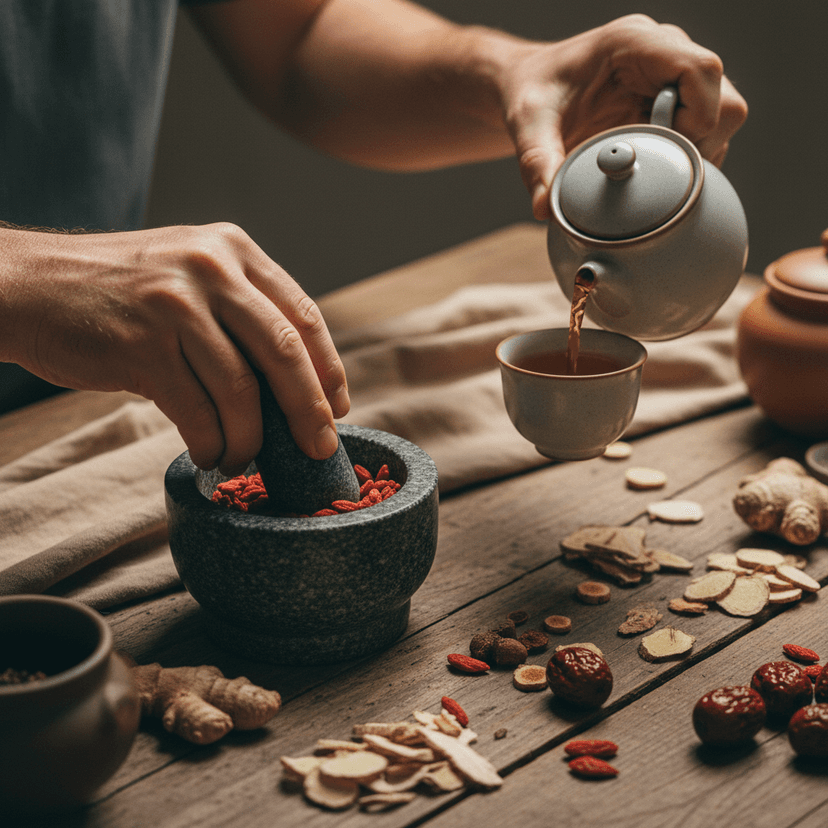
What foods should you eat (or avoid) for menopausal hot flashes according to TCM? Think cooling, moistening, and subtly sweet foods. The 《神农本草经》 (Shennong Ben CaoJing) and later texts emphasize foods that build essence. Incorporate black beans, dark leafy greens, sesame seeds, goji berries, and fish. These foods are considered Yin-nourishing. Avoid anything that generates more heat or dryness: excessive coffee, alcohol, spicy foods, deep-fried dishes, and sugary snacks.
Lifestyle matters, too. Chronic stress is a huge Yin depleter. Prioritize adequate sleep. Gentle movement like Tai Chi or Qigong can help circulate energy without overheating the body. Dr. Andrew Weil at the University of Arizona, a pioneer in integrative medicine, often emphasizes the importance of mindful living and stress reduction for overall health, a principle deeply aligned with TCM's emphasis on balancing the spirit (Shen) and emotions.
One patient, David (yes, men can experience similar heat patterns!), found immense relief from night sweats simply by incorporating a bowl of black bean and goji berry soup into his evening routine and committing to a 20-minute evening meditation. The changes were subtle at first, but cumulative. Within two months, his sleep improved dramatically, and his night sweats were almost gone. It wasn't just the food; it was the entire shift in his daily rhythm that supported his depleted Yin.
Kidney Yin deficiency is linked to hot flashes primarily because the Kidney system, in TCM, governs vital essences, including those related to reproduction and longevity. As these essences naturally decline with age, the cooling capacity of the body diminishes, allowing internal heat to rise unchecked and manifest as the sudden, intense warmth we know as a hot flash.
The Unfolding Journey of Your Second Spring
My journey through integrative medicine has been one of constant learning, a continuous weaving together of ancient threads with modern scientific understanding. The spreadsheet data, the patient stories, the nuances of clinical trials – they all reinforce a singular, profound truth: your body is always communicating with you.
Hot flashes? They're more than an annoyance. More than just a hormonal shift. They are your body's urgent whisper, sometimes a shout, telling you about a deeper imbalance, a thirst for nourishment and cooling that has gone unaddressed. The question isn't just how do I stop this heat, but what is my body genuinely needing?
As I reflect on the past 15 years, I'm struck by how much we've learned, yet how much remains to be discovered. The elegance of TCM, with its precise pattern differentiation, continues to offer pathways to healing that Western science is only just beginning to map. We're still uncovering the full spectrum of how these ancient herbal formulas interact with our neuroendocrine systems, how acupuncture modulates pain and inflammation. The integration is ongoing, complex, and deeply personal for each patient.
Perhaps the real achievement isn't finding a single cure, but in helping each person understand their unique constitution, to listen to their body’s language, and to move through their Second Spring with wisdom and grace. That, I believe, is the best path to wellness.
Contributing Writer at Demisunshine. Maya has spent much of her adult life around the practice of integrative medicine and herbal traditions. Her writing reflects a long familiarity with how women's health, body constitution, and emotional wellbeing intersect — and her pieces tend to acknowledge that the messy parts of healing rarely fit a neat formula.
Get TCM Wellness Tips
Weekly articles on herbal remedies, nutrition, and holistic health — delivered to your inbox.