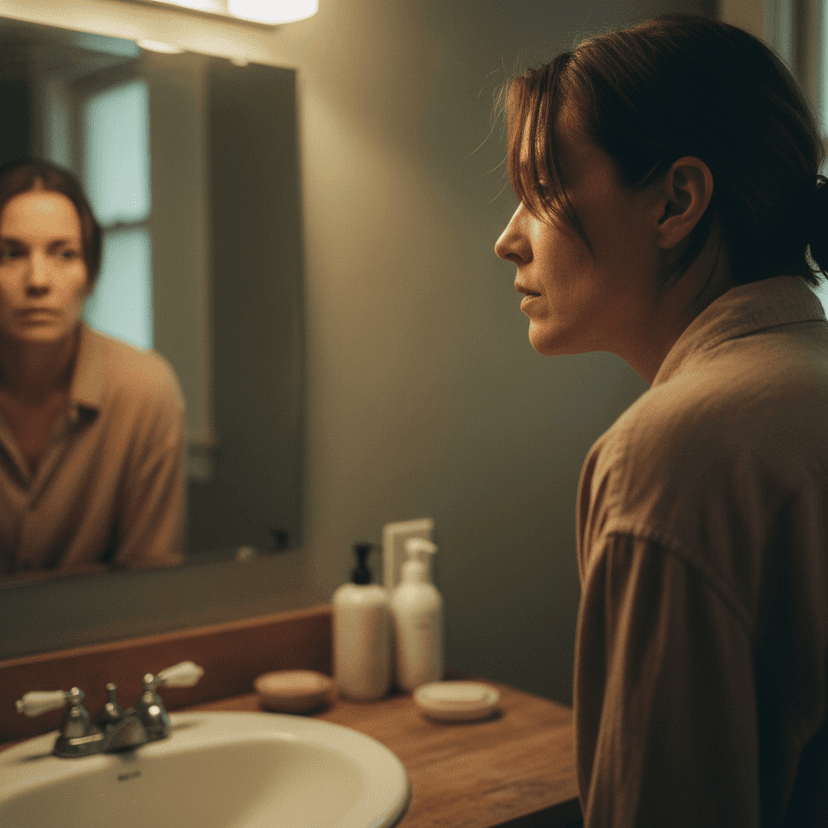
Your Skin's Hidden Language: What TCM Sees in Acne and Eczema
Beyond treating symptoms, Traditional Chinese Medicine views your skin as a direct mirror of your internal health. Discover how ancient wisdom deciphers persistent acne, eczema, and dryness as vital messages from within, guiding a holistic path to wellness.
James WuMarch 17, 20268 min read
Quick Answer
Traditional Chinese Medicine (TCM) interprets skin conditions like acne, eczema, and dryness as vital messages from within, reflecting deeper imbalances in the body's organ systems and energetic flow. This ancient wisdom offers a holistic framework for understanding and addressing chronic skin issues, aiming to restore internal harmony rather than merely treating external symptoms.
Key Takeaways
Traditional Chinese Medicine views skin conditions like acne and eczema as external manifestations of internal imbalances, not as isolated dermatological issues. This holistic view connects skin health directly to the function of internal organs and energetic patterns.
TCM diagnostics extend beyond surface symptoms, using tools like tongue and pulse analysis, alongside detailed symptom interviews, to identify specific patterns such as 'damp-heat' or 'Spleen deficiency' that drive skin issues.
Modern research, including systematic reviews (Tan et al., 2013; Jia et al., 2023), supports the efficacy of Chinese herbal medicine for conditions like atopic dermatitis, showing improvements in symptoms like itching and erythema, though more rigorous studies are needed.
Integrating TCM principles into daily life, even without immediate access to a practitioner, can start with self-observation: noticing patterns between diet, stress, and skin flare-ups. A detailed symptom journal is an actionable first step towards understanding your body's unique signals.
Dear person who just spent $200 on supplements that aren't doing anything — this one's for you. And no, we're not going to start by telling you to drink more water.
It was a blustery Tuesday morning in February 2018 when I first met Sarah Chen. She sat across from me in a bustling café near Seattle’s Pike Place Market, her face a canvas of frustration. Red, inflamed cysts clustered around her jawline and chin, stubborn relics of a decade-long battle with hormonal acne. She was the kind of person who had meticulously documented every dietary change, every new serum, every prescription.
Accutane, Doxycycline, spironolactone — she’d cycled through them all, each offering a brief truce before the inevitable resurgence. Her dermatologist, a brilliant woman trained at Stanford, had offered the standard Western explanation: sebum overproduction, bacterial proliferation, inflammation. Sarah understood the science. She just couldn't solve the puzzle.
But something wasn't quite right. The Western medical lens, precise and powerful in its focus on pathology, hadn't yet connected Sarah’s relentless breakouts to the chronic bloating, the unpredictable mood swings, the persistent fatigue that plagued her even more than her complexion. What if her skin was not merely a surface to be treated, but a direct, visible language spoken by her internal health?
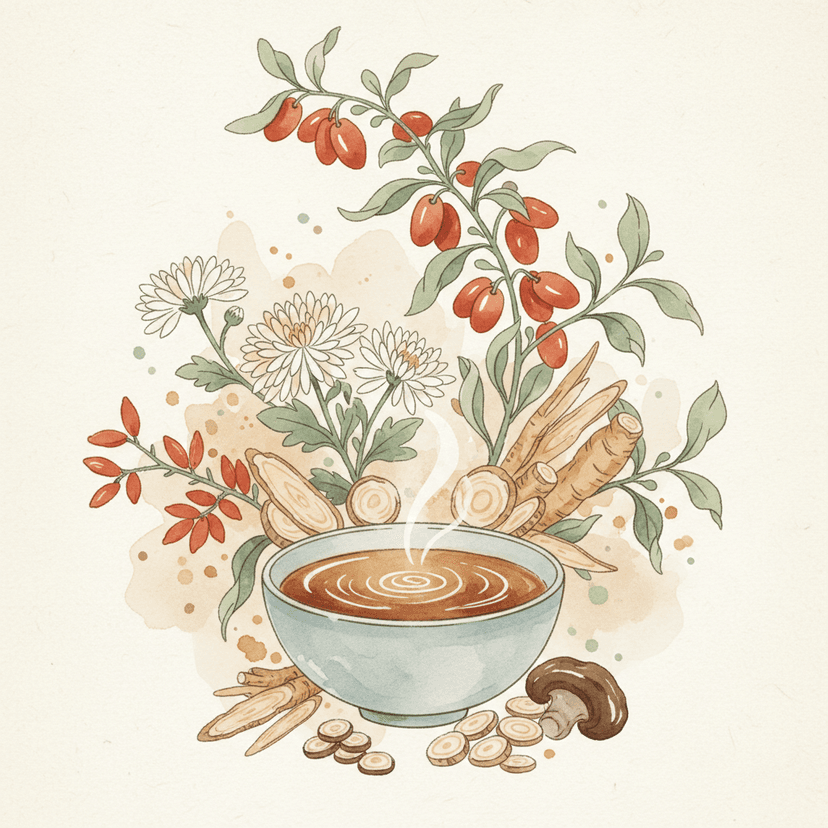
Traditional Chinese Medicine (TCM) offers a provocative answer. For centuries, its practitioners have viewed the skin not as an isolated organ, but as a mirror reflecting the complex interaction of internal energies and organ systems. When we talk about ingredients in this context, we're talking about substances like Coptis Chinensis (Huang Lian), a bitter and cold herb used in Traditional Chinese Medicine for clearing heat and drying dampness.
Its key active compounds include berberine, known for its antimicrobial and anti-inflammatory properties. This herb shows how TCM targets internal imbalances to resolve external symptoms.
The Skin's Ancient Language of Distress
In Western dermatology, the conversation often begins and ends with the skin itself. A rash is a rash. Dryness is a lack of moisture. Acne is clogged pores and bacteria. These are observable facts, undeniable.
But what if the persistent dryness on your elbows isn't just a lack of moisturizer, but a whisper from your internal health? What if that stubborn patch of eczema isn't just an allergic reaction, but a cry from a deeper imbalance? We're talking about a different way of seeing.
TCM operates on a different logic. It sees the body as an interconnected ecosystem where everything influences everything else. The skin, or 表 (biao) — the exterior — is a direct reflection of the 里 (li) — the interior. This is a foundational concept, not just a poetic metaphor; it’s how diagnosis happens.
When a TCM practitioner like Dr. Olivia Hsu Friedman, a respected voice in TCM Dermatology, examines a patient, she's not just looking at the lesion. She's observing the tongue's coating, feeling the pulse's rhythm, listening intently to descriptions of digestion, sleep, and emotional state. These are all clues. A comprehensive internal detective story.
The classical text Huangdi Neijing (Yellow Emperor's Inner Canon), specifically the Su Wen chapter, declares: '诸湿肿满,皆属于脾' — 'All dampness and swelling belong to the Spleen.' This ancient axiom, laid down millennia ago, underpins the TCM understanding of conditions like eczema, suggesting that the root of persistent moisture-related skin issues often lies with a weakened digestive system, known as the Spleen in TCM.
It’s a pattern Dr. Friedman has seen countless times: patients with chronic, weeping eczema, who also complain of bloating, loose stools, and a general feeling of heaviness. The connection, invisible to many, is clear as day through the TCM lens.
Decoding the Map on Your Face
Consider the acne that erupts on the forehead versus the persistent cysts along the jawline. For a Western dermatologist, these might be treated similarly, perhaps with a topical retinoid or an oral antibiotic. But in TCM, the location itself is a diagnostic clue, a concept known as face mapping.
The kind of person who constantly battles breakouts on their forehead might be told in TCM that their Heart or Liver is experiencing heat or stagnation, perhaps linked to stress, poor sleep, or an inflammatory diet. Conversely, the individual with chronic, deep cystic acne around the chin and jawline often points to imbalances in the Spleen, Stomach, or Kidney meridians, which are intimately connected to hormonal regulation.
This subtle difference dictates an entirely different treatment approach, moving beyond surface-level creams to address the underlying internal disharmony.
Now, Real Talk: Face mapping is an intriguing concept, widely discussed in wellness circles, but it’s not a standalone diagnostic tool. It's a piece of the puzzle, one observation among many that a skilled practitioner integrates with pulse, tongue, and detailed symptom analysis. Relying solely on face mapping for self-diagnosis can be misleading; the true power lies in its integration within a comprehensive TCM assessment.
This integrated approach isn't just anecdotal. A clinical observation by Zhu Fenfang and colleagues (2025), published in 中医学 (Journal of Traditional Chinese Medicine), found that an internal and external synergistic therapy for acne classified as 'damp-heat stagnation' (湿热瘀阻型痤疮) achieved a total effective rate of 94.1% in the observation group, compared to 76.6% in the control group. The objective extends beyond clearing a zit; it's about rebalancing the internal system that allowed the zit to form in the first place.
Dampness, Heat, and the Modern Skin Barrier
The terms dampness and heat are foundational to TCM dermatology. Dampness refers to a heavy, sticky, lingering pathological factor that often manifests as weeping lesions, oozing, or a general feeling of sluggishness. Think of a swamp. Heat is exactly what it sounds like: inflammation, redness, burning sensations. Many chronic skin conditions, from eczema to acne, are diagnosed as a combination of these patterns, such as damp-heat.
What TCM calls dampness might be a complex interplay of immune dysregulation, lymphatic congestion, and gut permeability in modern biological terms. The question isn't which came first, but how these ancient observations offer a different, perhaps more intuitive, way to categorize and treat a constellation of symptoms.
Luo Chen and colleagues (2024), also in 中医学, specifically explored the theory '诸湿肿满皆属于脾' (all dampness and swelling belong to the Spleen) in treating eczema of the 'Spleen deficiency with dampness accumulation' (脾虚湿蕴) type, affirming its efficacy.
The concept of 玄府 (xuan fu), derived from the Su Wen chapter of Huangdi Neijing (which describes it as '汗空', or sweat pores), offers another insight. When these 'mysterious orifices' are blocked due to internal imbalances, it can lead to conditions like acne, where pores become congested and inflammation flares. The therapeutic goal then becomes 'opening the 玄府' to restore flow and balance.
For Spleen deficiency and dampness, common herbal combinations are often prescribed. Wang Hanzhu and team (2025) identified key herbal pairs in their data mining analysis on treating eczema from the Spleen perspective, highlighting the combination of Bai Zhu, Fu Ling, and Ze Xie. These herbs are key for strengthening the Spleen and resolving dampness:
Actions: Promotes urination, leaches out dampness, strengthens Spleen.
The recommended daily dosage of these herbs depends entirely on the individual's specific diagnosis and constitution, always prescribed by a licensed practitioner. They are rarely taken in isolation.
A Decisive Shift: Beyond the Surface
My reporting discovery came during an interview with a seasoned TCM practitioner in San Francisco. He recounted a patient, an artist in her late 30s, who had struggled with chronic, debilitating eczema for years. Western treatments provided temporary relief, but the moment she stopped the corticosteroids, the fierce itching and redness returned. He didn't just look at her skin; he asked about her creative blocks, her recent breakup, her preference for ice water even in winter.
It surprised me how deeply interconnected he saw every aspect of her life with her skin condition.
This holistic approach is where TCM fundamentally diverges from conventional Western dermatology. Consider the diagnostic methods:
Treatment: Herbal medicine (internal/external), acupuncture, dietary therapy, lifestyle adjustments.
This difference isn't about one being better than the other; different lenses offer complementary insights. These insights are increasingly supported by modern scientific scrutiny. A systematic review by Tan, Zhang, Chen, Xue, and Lenon (2013) in the Journal of the American Academy of Dermatology found that Chinese herbal medicine significantly improved symptom severity of atopic dermatitis. While acknowledging limitations in study quality, three placebo-controlled trials included in their review showed significant efficacy.
More recently, an updated systematic review and meta-analysis by Jia et al. (2023) concluded that TCM herbs effectively treat Atopic Dermatitis, showing improvements in itching, erythema, surface damage, and sleep, and potentially reducing corticosteroid use.
The Unanswered Questions and the Path Forward
The real question might not be, Does TCM work? but rather, How does TCM offer a different, complementary lens to understand chronic skin conditions, especially where Western approaches fall short? TCM's individualized nature, where formulas are tailored to a patient's unique pattern, often clashes with the standardized, double-blind placebo-controlled trial designs favored by Western science. This isn't an insurmountable problem, but it is complex, requiring innovative research methodologies.
For those dealing with persistent skin issues, the path can be daunting. The biggest mistake I see with herbal supplements? People treat them like vitamins — pop a pill and forget about it. TCM isn't a magic bullet; it's a sustained, personalized approach to rebalance your entire system. The reality of finding a qualified TCM practitioner in Western contexts can be daunting, requiring careful vetting and research into their credentials and specialty in dermatology.
But you can start now. Next time your skin flares, try an experiment. Keep a detailed symptom journal, noting not just the severity of your breakouts or dryness, but also your diet, your sleep quality, your stress levels, and even your mood. Observe. Look for patterns. Are your chin breakouts worse after a week of late nights and spicy food? Does your eczema calm when you prioritize rest and bitter greens?
This simple act of self-observation, a foundational practice in TCM, helps you decipher your own body’s hidden language, even before you step into a practitioner's office.
It’s a different way of seeing.
Sarah Chen, years after our first meeting, no longer battles the same aggressive jawline acne. Her journey wasn't a simple switch from Western to Eastern medicine, but a gradual integration. She learned to recognize the subtle cues her body was giving her—that mid-afternoon energy slump wasn’t just fatigue, but a signal from her Spleen. That stubborn chin acne wasn't just hormonal, but a deeper damp-heat accumulation.
Her skin, once a source of endless frustration, became a trusted informant, whispering secrets from within. And in listening, she found not just clearer skin, but a profound understanding of her own intricate, interconnected self.
Guest Writer at Demisunshine. James writes from a long-standing curiosity about wellness traditions, with a journalist's habit of pushing back when something sounds too good to be true. He's the contributor readers turn to for the contrarian take — the piece that asks 'wait, does this actually hold up?'
Get TCM Wellness Tips
Weekly articles on herbal remedies, nutrition, and holistic health — delivered to your inbox.