TCM Secrets: Dark Circles & Puffy Eyes Explained by Dr. Chen | Demisunshine
5 TCM Secrets Your Dermatologist Misses About Dark Circles
Dark circles and puffy eyes are more than just cosmetic issues. Dr. Maya Chen reveals how Traditional Chinese Medicine (TCM) connects these common concerns to deeper organ imbalances, offering insights Western functional medicine is now beginning to validate.
Maya ChenMarch 18, 20268 min read
Quick Answer
Dark circles and puffy eyes are often symptomatic of internal imbalances like Spleen Qi deficiency, Kidney essence depletion, or Blood Stasis, rather than just cosmetic issues. Traditional Chinese Medicine offers a holistic perspective, linking these symptoms to organ health and providing effective treatments like Gua Sha, acupressure, and herbal medicine to address the root causes and improve overall vitality.
Key Takeaways
Dark circles and puffy eyes are not merely cosmetic; they are often diagnostic signals of deeper systemic imbalances within the body's Spleen, Kidney, or circulatory systems according to TCM.
Targeted TCM therapies like facial Gua Sha and acupoint massage have shown significant efficacy in improving under-eye concerns by enhancing local circulation and lymphatic drainage.
Integrating ancient TCM wisdom with Western functional medicine insights allows for a more comprehensive and personalized approach to achieving healthier, brighter eyes.
Empower yourself by listening to your body's subtle cues; persistent eye concerns are often invitations to explore your overall health and lifestyle, not just to purchase another eye cream.
In 2008, only a handful of dermatologists considered diet or stress as primary drivers for persistent under-eye concerns. Today, that conversation has shifted dramatically, with functional medicine acknowledging systemic connections between gut health, stress, and skin appearance. What changed between then and now is a growing recognition that true beauty often reflects internal balance, a truth Traditional Chinese Medicine has understood for millennia.
For fifteen years, I've had the privilege of walking with patients, bridging the ancient wisdom of Beijing University of Chinese Medicine with the rigorous science of Western functional medicine. Those stubborn dark circles and puffy eyes? What I often hear is, 'I've tried every cream, every serum, nothing works.' And I get it. The mainstream approach can be incredibly frustrating.
But what if I told you that your dermatologist, while brilliant, might be looking at the wrong map? The skin around your eyes isn't just a surface; it's a dynamic reflection of your body's deeper processes. In TCM, we see these signs not as isolated cosmetic flaws, but as direct communications from your internal organs, your 'Zang-Fu' network.
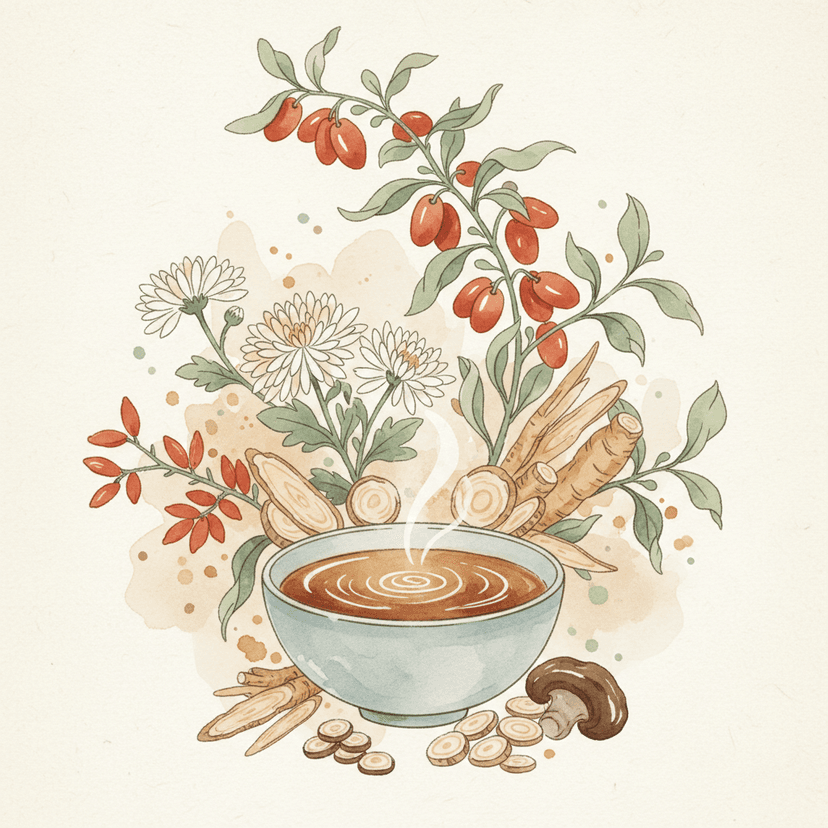
For instance, Danshen (Salvia miltiorrhiza), also known as Red Sage Root, is a Blood-invigorating herb used in Traditional Chinese Medicine for promoting blood circulation, dispersing blood stasis, and clearing heat. Its key active compounds include tanshinones and salvianolic acid. We'll talk more about how this connects to eye health later.
1. The Root of the Matter: It's Not Just Skin Deep
When someone walks into my clinic complaining of chronic puffiness under their eyes, especially coupled with a general feeling of sluggishness or digestive upset, my mind immediately goes to the Spleen.
In TCM, the Spleen isn't just an anatomical organ; it's a crucial energetic system responsible for transforming food into Qi and Blood, and for managing fluid metabolism. A weak Spleen struggles to transport and transform fluids properly, leading to an accumulation of Dampness in the body. Where does that Dampness collect? Often, it's the delicate tissue around the eyes. Puffy eyes, sometimes with a sallow complexion, are classic signs of Spleen Qi Deficiency.
Think of it like a clogged drain. If your Spleen isn't draining fluids efficiently, they back up. In Western functional medicine, we might connect this to lymphatic congestion, gut dysbiosis, or even food sensitivities causing systemic inflammation. Sarah, a 35-year-old patient, spent years trying expensive eye creams. Her eyes were always puffy, her skin dull.
But when we focused on healing her gut and supporting her Spleen Qi—introducing warming, nourishing foods and eliminating cold, raw items—the puffiness visibly reduced within weeks. Her 'bags' weren't just under her eyes; they were a symptom of her entire digestive system needing attention.
Research Spotlight: The Gut-Skin Axis
Researchers like Dr. Brent Bauer at the Mayo Clinic have consistently highlighted the profound connection between lifestyle, diet, and overall health, emphasizing how systemic factors influence everything, including skin appearance. It's not a radical idea anymore that what's happening in your gut can show up on your face. The gut-skin axis is a well-established concept in modern dermatology, echoing TCM's ancient understanding of the Spleen's role.
Precise Clinical Takeaway: Dark circles and puffiness often signal underlying digestive imbalance and lymphatic congestion, which can be effectively addressed by supporting Spleen Qi through dietary and lifestyle adjustments, not just topical solutions.
2. Your Kidney's Whisper: The 'Dark' Side of Exhaustion
Beyond puffiness, if your dark circles are a deeper, almost grayish or blackish hue, especially if they're accompanied by chronic fatigue, a dull ache in your lower back, or a general sense of being 'burnt out,' TCM asks about your Kidneys. In our tradition, the Kidneys are the fundamental reservoir of Jing (essence) and the source of your body's vital energy.
When Kidney essence is depleted—often from chronic stress, overwork, inadequate sleep, or the natural aging process—it can manifest around the eyes.
The Huang Di Nei Jing, or The Yellow Emperor’s Classic of Internal Medicine, tells us: '五脏六腑之精气,皆上注于目而为之精' – meaning, 'the essence of all Zang-Fu organs flows up to the eyes to make them clear.' This ancient text directly links eye health to the vitality of your internal organs, particularly the Kidneys, underscoring that our eyes are not just sensory organs but windows to our deepest energetic reserves.
In Western terms, this might correlate with adrenal fatigue, HPA axis dysfunction, or chronic systemic inflammation taxing the body. Mark, a CEO I treated, had persistent, deep-set dark circles despite getting 7-8 hours of sleep. He felt constantly drained, his libido was low, and he’d lost his 'spark.' We focused on nourishing his Kidney Yin—through targeted herbs, meditation, and a commitment to earlier bedtimes. His energy returned, and the dark circles, once a permanent fixture, began to fade.
It wasn't about more sleep; it was about quality restoration.
Precise Clinical Takeaway: Persistent dark circles, especially if accompanied by systemic fatigue, back pain, or other signs of energetic depletion, often point to underlying Kidney deficiency that requires deep nourishment and lifestyle adjustments rather than just superficial remedies.
3. Stagnation: The Traffic Jam Under Your Eyes
Have you ever noticed dark circles with a distinct purplish or bluish tint? That’s often a tell-tale sign of Blood Stasis in TCM. It means the blood isn't flowing smoothly in the tiny capillaries around your eyes; it's getting stuck, like a traffic jam. This can be caused by a variety of factors: emotional stress, lack of physical activity, or even a pre-existing deficiency that leaves the body unable to properly circulate blood.
From a Western perspective, we're talking about poor microcirculation, fragile capillaries, or venous congestion. When blood stagnates, oxygen delivery decreases, and waste products accumulate, leading to that characteristic dark discoloration. The ancient text Mu Jing Da Cheng (Great Compendium of Eye Classics) describes this perfectly: '上下外睑煤黑,有如淡墨沈於舊棉纸' – 'the upper and lower outer eyelids are black like diluted ink soaked into old cotton paper.' It's a vivid description of what we still see today.
Traditional therapies really shine here. A recent study by Wu Xiaohan et al. (2023) published in the Chinese Journal of Dermatology of Integrated Traditional Chinese and Western Medicine investigated facial Gua Sha combined with an herbal mask for periorbital hyperpigmentation (dark circles). They reported a remarkable 95% total effective rate in the treatment group, compared to 75% in the control group.
Gua Sha, a gentle scraping technique, works by intentionally creating microtrauma to increase local circulation, break up stagnation, and promote healing. It's like clearing that traffic jam in your capillaries. And it works. I've seen it firsthand in my practice.
And remember Danshen, that Blood-invigorating herb I mentioned earlier? It's a classic for this pattern.
Danshen (Salvia miltiorrhiza) Quick Facts:
Dosage: 9-15g in decoction (always consult a qualified practitioner).
Nature & Flavor: Slightly cold, bitter.
Meridians: Heart, Liver.
It works internally to move blood, which can lead to significant improvement for persistent purplish circles caused by stagnation.
Precise Clinical Takeaway: Persistent dark circles with a purplish hue strongly indicate local Blood Stasis, which can be effectively addressed by therapies that promote microcirculation, such as Gua Sha, and by internal herbal support like Danshen.
4. The Gentle Touch: Gua Sha and Acupressure for Brighter Eyes
While internal imbalances are key, external therapies offer powerful, immediate support. Facial Gua Sha and targeted acupressure around the eyes are some of my favorite tools. From a TCM perspective, these techniques move Qi and Blood, clear stagnation, and promote the flow of vital energy to the delicate eye area. From a Western view, we're talking about enhancing lymphatic drainage, stimulating microcirculation, and even potentially boosting collagen production through gentle tissue manipulation.
A study by Zhao Lu (2010), published in Massage and Rehabilitation Medicine, explored the efficacy of acupoint needle (杵针) combined with eye massage for dark circles in young women aged 18-30. The treatment group showed an impressive 88.9% total effective rate, with 12 out of 18 patients experiencing significant improvement. This isn't just anecdotal; it’s clinical evidence of what a targeted approach can achieve.
For home practice, a simple, gentle eye massage can make a huge difference. Using your ring finger, apply light pressure to points like Jingming (BL1) at the inner corner of your eye, Sibai (ST2) directly below the pupil on the infraorbital ridge, and Zanzhu (BL2) at the inner end of the eyebrow. Perform small, circular motions for about 30 seconds on each point. Do this daily, maybe with a nourishing eye balm.
It’s a simple, actionable step you can take today.
Precise Clinical Takeaway: Gentle, consistent external therapies like targeted acupressure and facial Gua Sha significantly improve local circulation and lymphatic flow around the eyes, offering a direct, non-invasive approach to reducing both dark circles and puffiness.
5. Reframing the Problem: Beyond the Eye Cream
Let's be clear: For too long, the conversation around dark circles and puffy eyes has been dominated by the cosmetic industry. Eye creams, concealers, even invasive procedures. And while some offer temporary relief, they rarely address the why. The core assumption has been that it's a superficial skin problem, a genetic predisposition, or simply a sign of a late night. But what if that premise is fundamentally flawed?
I’ve seen countless patients, just like you, who felt defeated after trying everything. The biggest mistake I see people make with these persistent concerns? They treat them like isolated imperfections, rather than meaningful messages from the body. That’s a missed opportunity for genuine health.
Maybe the real question isn't which eye cream to buy, but what underlying messages your body is trying to send you. The eye area, in TCM, is a profound diagnostic map, reflecting the health of your Liver, Kidneys, and Spleen—the very organs responsible for your vitality, detoxification, and fluid balance. This is a non-obvious insight that surprises even health enthusiasts.
Integrative medicine, championed by figures like Dr. Andrew Weil at the University of Arizona and Dr. Helene Langevin at NIH NCCIH, actively seeks to bridge these gaps. They push for a holistic understanding, where the body is an interconnected system, not a collection of separate parts to be treated in isolation. It’s the very essence of what I practice.
So, the next time you look in the mirror and see those dark circles or puffiness staring back, consider it an invitation. An invitation to look beyond the surface, to listen to your body's ancient wisdom, and to ask a better question: What is my body trying to tell me about my internal balance? That's where lasting change, and true radiance, genuinely begins.
Precise Clinical Takeaway: Genuinely addressing dark circles and puffy eyes requires moving beyond superficial treatments to understand and rebalance the body's internal systems, integrating ancient wisdom with modern science to interpret these symptoms as vital diagnostic cues.
Contributing Writer at Demisunshine. Maya has spent much of her adult life around the practice of integrative medicine and herbal traditions. Her writing reflects a long familiarity with how women's health, body constitution, and emotional wellbeing intersect — and her pieces tend to acknowledge that the messy parts of healing rarely fit a neat formula.
Get TCM Wellness Tips
Weekly articles on herbal remedies, nutrition, and holistic health — delivered to your inbox.