Globally, over 47.5 million people grapple with dementia, with 7.7 million new cases emerging each year, according to a 2022 review by Yang et al. That's a significant number, and it makes you pause, perhaps even feel a slight clenching in your chest, wondering about your own cognitive future. But what if the conventional narrative about inevitable cognitive decline isn't the whole story?
Traditional Chinese Medicine (TCM) offers a perspective that challenges this notion, suggesting that lifelong cognitive vitality isn't just possible, but deeply rooted in how we nurture our whole selves. It’s a comprehensive approach, where the brain isn’t an isolated organ but an integrated part of a larger, interconnected system.
When we talk about “cultivating your mental clarity,” it’s not about consuming the herb Salvia officinalis (common sage) directly for cognitive enhancement — though sage is likely safe in food amounts and used for various ailments. However, some species contain thujone, which can be toxic in large doses or prolonged use, and it may be unsafe during pregnancy due to potential harmful effects. If you're considering using sage while pregnant, consult your healthcare provider.
Instead, our focus is on cultivating the wisdom within, the intrinsic capacity for mental sharpness that TCM believes we all possess. So, how do we do that?
1. Rethinking the 'Aging Brain': It's Not Just Wear and Tear
We often hear that as we age, our cognitive functions are just destined to decline. It's a narrative many of us have absorbed, perhaps even felt settling in ourselves.
Our memory falters, our focus wanes, and 'brain fog' becomes a familiar companion. But what if that's not the complete picture? What if there's a different story to tell?
TCM offers a more nuanced understanding. From this ancient perspective, cognitive health isn't simply a matter of time passing. It's about the delicate balance of our vital energies—Qi, Blood, Yin, and Yang—and the health of our internal organ systems. When these are in harmony, the brain – what TCM beautifully calls the 'Sea of Marrow' – is nourished and vibrant.
I've always found that imagery so evocative; it really helps you picture the brain as something that needs rich, deep sustenance.
This reframes the entire conversation. Instead of just managing symptoms, we're looking at the root causes of imbalance. What we perceive as 'age-related' cognitive decline might, from a TCM perspective, be a manifestation of Kidney Essence deficiency, or perhaps Spleen Qi deficiency leading to dampness, or even Heart-Shen disturbance. It's a much better question than simply asking, 'What pill can I take for my memory?'
For instance, a systematic review and meta-analysis by Wang et al. (2025), encompassing 23 studies and 2,035 participants, found that traditional Chinese herbal compounds showed good clinical efficacy and maintenance effects in treating Alzheimer's Disease. They observed a higher effective rate (relative risk ratio = 1.19) and superiority in certain cognitive scores compared to Western medicine, with no significant difference in adverse reactions. It makes me think about how much potential lies in a comprehensive, root-cause approach.
2. The Kidney's Deep Wisdom: Fueling Your Brain's Essence
In TCM, the Kidneys are often considered the energetic foundation of life. They store Jing, or Essence, which is the fundamental substance that supports growth, development, and reproduction. Crucially, Kidney Essence also nourishes the brain—the 'Sea of Marrow.' When Kidney Essence is robust, our memory is sharp, our concentration strong, and our overall vitality high. When it's depleted, we might experience memory lapses, difficulty focusing, and a general sense of mental fogginess.
Think of it like the battery life of your phone. Your Jing is your fundamental charge, and if it's constantly running low, you'll definitely notice performance issues. From a Western perspective, this might align with discussions around neuroplasticity or the health of neuronal connections, and that's fascinating. But for me, TCM's lens, looking at the underlying energetic reserves fueling these processes, offers such a wonderfully holistic way to consider our internal resources.
It truly resonates with how I grew up understanding our bodies.
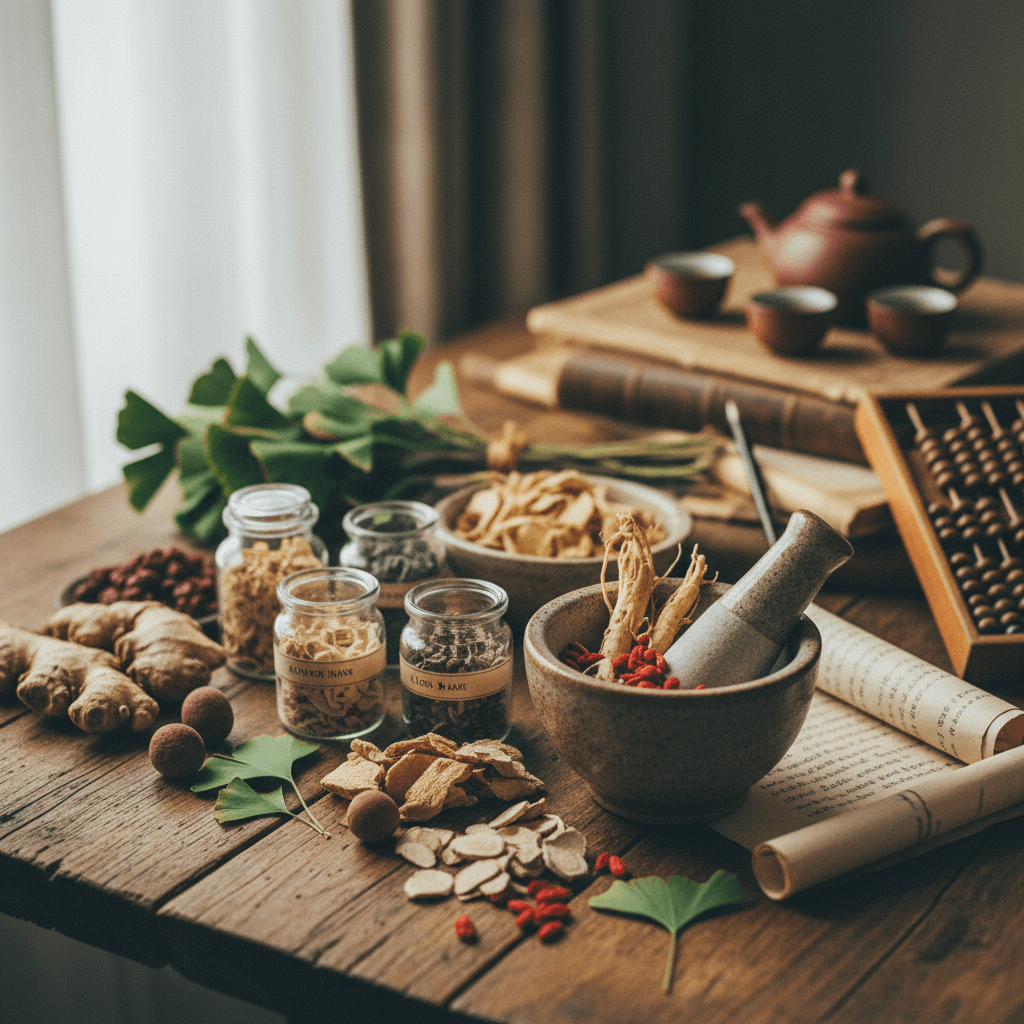
Classical texts like 《本草纲目》 (Compendium of Materia Medica) describe Rehmannia glutinosa (Shu Di Huang) as filling the bone marrow, growing muscles, generating blood, and supplementing the deficiencies of the five zang organs. I remember my grandmother often included this herb in nourishing soups, speaking of its ability to strengthen the body from within. This traditional usage supports the TCM principle of nourishing Kidney Essence as a core strategy for preventing and treating cognitive decline.
TCM practitioners commonly observe combinations like Shu Di Huang and Cornus officinalis (Shan Zhu Yu) as high-frequency core components in formulas for mild cognitive impairment, highlighting their role in nourishing Liver and Kidney and replenishing Essence. This common usage is supported by clinical literature describing their presence in a significant percentage of analyzed formulas.
3. Clearing the Mental Mists: Unpacking 'Brain Fog'
That frustrating sensation of 'brain fog' – feeling mentally sluggish, having trouble recalling words, or just a general lack of clarity – is something many of us experience. While a lack of sleep or too much screen time certainly contribute, TCM often links this feeling to specific internal imbalances. Think of 'Phlegm Misting the Mind' or 'Spleen Qi Deficiency with Dampness' – vivid descriptions of what's happening energetically.
The Spleen in TCM is responsible for transforming food and drink into Qi and Blood, and for managing fluid metabolism. If the Spleen Qi is weak, it can't perform these functions effectively, leading to an accumulation of dampness and eventually phlegm. This 'phlegm' isn't just mucus; it's a pathological substance that can obstruct the clear orifices of the mind, causing fogginess, poor concentration, and even dizziness.
What does this mean for you? If you're struggling with brain fog, you might find that stimulating your brain directly isn't the whole answer. It could be that strengthening your digestive system, reducing damp-forming foods (like excessive dairy or refined sugars), and helping your body process fluids more efficiently makes a real difference. TCM practitioners commonly observe significant improvements in mental clarity when these underlying Spleen and Dampness issues are addressed. It's a powerful shift in perspective.
4. Herbal Allies: Beyond the Commonplace Stimulants
While many people reach for caffeine or popular Western supplements like Ginkgo Biloba for focus, TCM offers a vast pharmacopeia of herbs tailored to specific patterns of imbalance. These herbs aren't just single-purpose fixes; they're chosen to nourish, clear, or invigorate according to your unique constitution.
For instance, Polygala tenuifolia (Yuan Zhi) and Acorus tatarinowii (Shi Chang Pu) are frequently used together. 《神农本草经》 (Shennong's Classic of Materia Medica) notes Yuan Zhi for "benefiting the nine orifices" and Shi Chang Pu for "opening the heart orifices and brightening the nine orifices," both referring to their ability to clear the mind and enhance cognitive function. These descriptions aren't just poetic; they explain how these herbs help improve mental clarity and memory.
Spotlight on a Core Cognitive Herb: Polygala tenuifolia (Yuan Zhi)
Polygala tenuifolia, also known as Yuan Zhi or Thinleaf Milkwort Root, is a commonly used herb in Traditional Chinese Medicine for calming the Shen (mind-spirit), expelling phlegm, and improving memory. Its key active compounds include saponins (polygalasaponins) and xanthones.
Research into the mechanisms of TCM prescriptions, Chinese herbal medicines, and bioactive components derived from TCM, such as those found in Yuan Zhi, shows they can affect adult neurogenesis and improve cognition, alleviate mood, and restore brain function in animal models, particularly for neurological diseases like Alzheimer's Disease, stroke, and traumatic brain injury, as noted by Hu et al. in Frontiers in Pharmacology (2023). It's fascinating to see modern science illuminate what ancient texts have observed for centuries.
Here's how TCM approaches it:
Dosage: Typically 3-9g in decoction, though specific formulas will vary.
Nature & Flavor: Bitter, pungent, slightly warm.
Meridians: Heart, Lung.
Safety: Remember, Yuan Zhi is contraindicated in cases of excess fire from Yin deficiency or gastric irritation. Always consult a knowledgeable TCM practitioner, especially if taking medications, as herbal interactions are possible.
Costs for bulk herbs like Yuan Zhi can range from $15-$30 per ounce, varying by quality and supplier, making a formula typically more affordable than many long-term pharmaceutical options for cognitive support.
A traditional Chinese herbal dietary formula, including Poria cocos (Fu Ling), Alpiniae Oxyphyllae Fructus (Yi Zhi Ren), Nelumbinis plumula (Lian Zi Xin), Chinese Yam (Shan Yao), and Jineijin (Chicken Gizzard Lining), improved the ability of daily life and physical function in elderly patients with mild cognitive impairment, according to a 2024 study by Hsu et al. involving 60 elderly patients. This outcome underscores the beneficial effects of carefully combined ingredients.
5. The Mind-Body Symphony: Movement, Stillness, and Emotions
TCM doesn't just focus on internal remedies; it deeply values lifestyle as medicine. Activities like Tai Chi and Qi Gong aren't just gentle exercises; they are profound mind-body practices that cultivate Qi, improve circulation, and calm the spirit. This cultivation, in turn, nourishes the brain.
Consider the impact of stress, for example. In Western medicine, chronic stress elevates cortisol, which can damage brain cells over time. In TCM, prolonged stress often leads to Liver Qi stagnation, which can then impact the Heart (affecting Shen/mind) and Spleen (affecting digestion and leading to dampness). The emotional side of healing rarely fits a neat formula, and TCM acknowledges that. It’s messy.
Sometimes, it’s about finding small moments of stillness in a chaotic day—a few deep breaths, a quiet cup of herbal tea—to break the cycle of stagnation.
Associate Professor Dennis Chang at the National Institute of Complementary Medicine, Western Sydney University, often speaks about how these practices do more than just reduce physical tension; they rebalance the energetic flow that directly impacts cognitive function. The ability to find calm amidst chaos is, in itself, a form of cognitive training. I find that so empowering.
6. Acupuncture's Precision: Targeting the Brain's Energy Pathways
Acupuncture, a cornerstone of TCM, involves inserting fine needles into specific points along the body's meridians, or energy pathways. For cognitive vitality, practitioners target points that stimulate brain function, regulate Qi and Blood flow to the head, and balance organ systems connected to mental clarity.
Acupuncture's benefit extends beyond pain relief; it aims to re-establish proper communication within the body. When Qi and Blood flow smoothly to the brain, its functions are supported. If there's stagnation or deficiency, acupuncture works to correct that. A compelling example comes from a 2022 overview of systematic reviews by He et al., which analyzed 14 systematic reviews, involving 263 randomized controlled trials and 19,224 participants. The finding?
Acupuncture combined with cognitive rehabilitation or Western medicine is more effective than either alone in improving cognitive function in patients with post-stroke cognitive impairment (PSCI). This outcome truly highlights the power of integrating different approaches.
The intricate network of meridians running throughout the body, connecting distant points to the brain, is truly something to marvel at. Imagine your body as a complex electrical grid. When a circuit is overloaded or disconnected, the whole system suffers. Acupuncture acts like a skilled electrician, identifying and repairing those energetic disruptions. Pretty neat, right?
7. The Future is Integrated: Blending Ancient Wisdom with Modern Science
Perhaps the most exciting development in cognitive health currently is the growing recognition that ancient wisdom and modern science don't have to be mutually exclusive. In fact, they can be wonderfully complementary. We're seeing more rigorous studies, often from institutions like the NIH National Center for Complementary and Integrative Health (NCCIH) under researchers like Helene Langevin, exploring how TCM interventions can work alongside Western medicine.
This integration, I believe, is where the real magic happens. It's not about forcing a choice between one path or the other, but understanding how they can reinforce each other. For instance, while a Western physician might prescribe medication for memory, a TCM approach could simultaneously work to strengthen the Kidneys, clear Phlegm, and improve circulation, potentially enhancing the overall outcome and reducing side effects.
It’s like having two powerful tools working in tandem, each addressing different facets of the same complex problem. How cool is that?
It makes me wonder if we've been asking the wrong questions. Instead of simply asking, 'Which herb should I take?' or 'Which treatment should I choose?', perhaps the real inquiry is whether we've been approaching wellness through an overly fragmented lens. True cognitive vitality, I've come to believe, flourishes when we embrace the profound interconnectedness that TCM has championed for millennia.
So, what does this mean for you, today? It means you have paths to explore right now. Begin by noticing your body's signals: Is your digestion sluggish? Do you find yourself easily stressed? These seemingly small details are actually critical clues in TCM, pointing to deeper patterns. Maybe you could start by incorporating more warming, easy-to-digest foods into your meals, or try a simple Qi Gong breathing exercise for just five minutes each day.
These aren't just fleeting wellness fads; they're ancient, time-tested practices that can genuinely help you nourish your brain from the inside out, guiding you toward lasting cognitive vitality. It's about listening to your body's own wisdom.
References
- He et al. — Acupuncture for Post-Stroke Cognitive Impairment: An Overview of Systematic Reviews, 2022
- 《神农本草经》
- 《本草纲目》