Male Hair Loss & Kidney Health: A TCM Perspective | Demisunshine
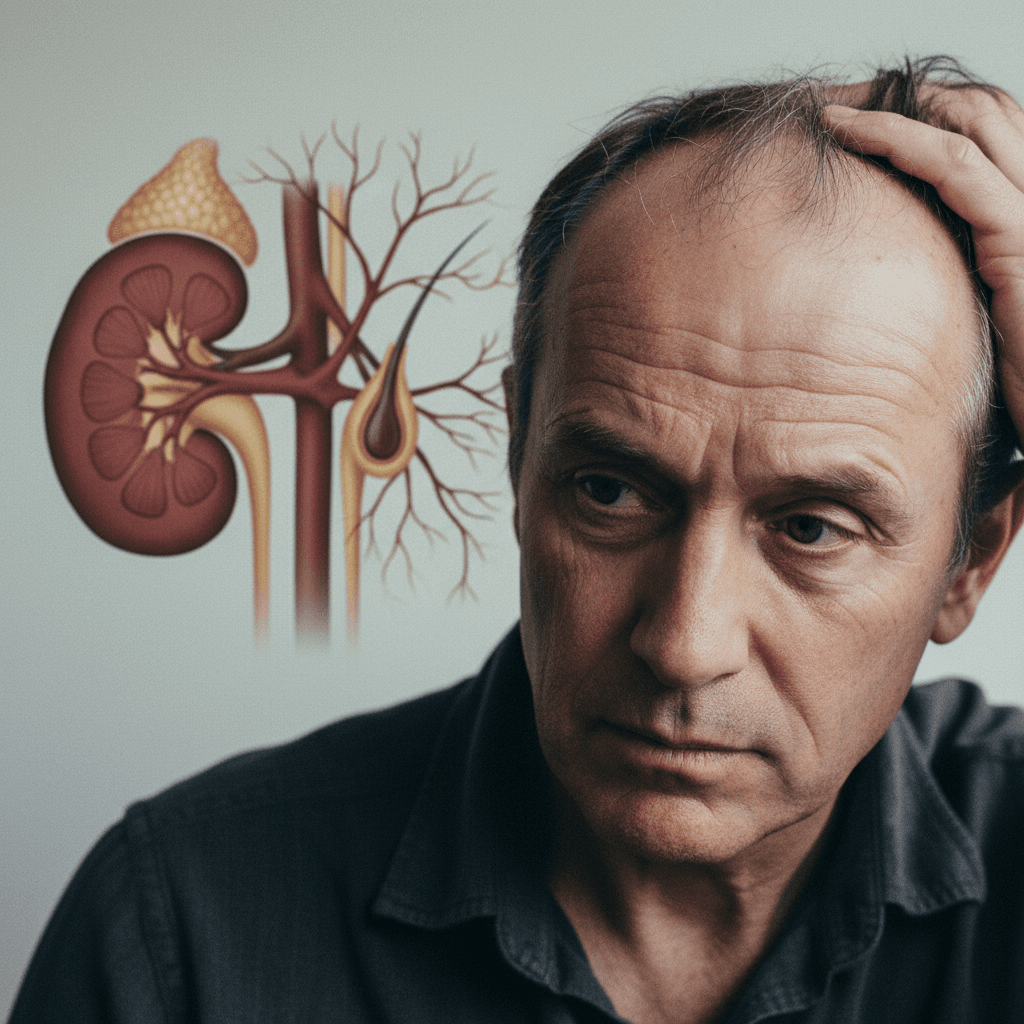
Hair Loss in Men: The Kidney Link Western Medicine Misses
While modern science focuses on hormones and genetics, Traditional Chinese Medicine reveals a profound connection between male hair loss and kidney health, a perspective often overlooked.
Maya ChenMarch 18, 20267 min read
Quick Answer
Traditional Chinese Medicine (TCM) offers a unique perspective on male hair loss, linking it intrinsically to the health of the Kidneys and their stored 'essence' (Jing). Unlike Western approaches focused on hormones and genetics, TCM aims to nourish these vital organs through herbs, diet, and lifestyle, addressing the foundational energy for hair growth and overall vitality.
Key Takeaways
Traditional Chinese Medicine (TCM) identifies a profound link between kidney health and male hair loss, a perspective often missed by Western diagnostics that focus on genetics and hormones.
The TCM concept of 'Kidney essence' (Jing) governs growth and vitality, with hair being its external manifestation. Depletion of Jing, whether congenital or acquired through lifestyle, is a primary cause of thinning hair.
Herbs like Polygonum multiflorum (He Shou Wu) offer a bridge between ancient wisdom and modern science, with research showing it can inhibit 5α reductase and improve scalp microcirculation.
Holistic approaches integrating diet, stress management, and specific herbal formulas can address the root causes of hair loss from a kidney perspective, offering a path to deeper, sustainable wellness beyond topical fixes.
Today, I'm tackling a topic that often challenges conventional thinking about male hair loss. Over 400 ancient Chinese medical texts consistently identify kidney health as the primary factor in hair loss, while modern Western medicine barely mentions it.
It’s a stark contrast, isn't it? Western medicine points to genetics, hormones like DHT, and maybe stress. And while those factors are certainly part of the picture, Traditional Chinese Medicine (TCM) offers a profound, often overlooked, perspective: the vital connection between your deepest essence, your Kidney energy, and the strength of your hair. What if the secret to a fuller head of hair lies not just in topical treatments or prescriptions, but in nourishing your body's foundational vitality?
I remember Michael, a 38-year-old software engineer, who came to my clinic feeling defeated. He’d tried everything for his receding hairline and thinning crown: minoxidil, finasteride, special shampoos. Each offered a glimmer of hope, then a slow, demoralizing decline. His Western doctors had told him it was genetic, an inevitable part of aging, and that his only options were drugs or a hair transplant. He felt stuck, frustrated, and deeply self-conscious.
Michael’s blood tests were normal, his hormones within range. From a conventional standpoint, there wasn't much else to do. But when I looked at Michael through the lens of TCM, a different story emerged. He was often fatigued, especially in the afternoons. His lower back ached after long hours at his desk. He felt cold easily, his libido wasn't what it used to be, and he often woke up to use the bathroom at night.
These weren't isolated symptoms; they were pieces of a puzzle pointing directly to a pattern of what we call Kidney essence deficiency in TCM.
The Essence of Vitality: Why Your Kidneys Matter for Hair
In TCM, the Kidneys are far more than just the organs that filter blood. They are considered the root of life, storing our fundamental Jing, or essence.
This Jing is the inherited vital substance that governs growth, reproduction, and regeneration throughout our lives.
This Jing is what gives us our constitution, our resilience, and yes, the strength and luster of our hair. As the ancient Chinese medical text, Huang Di Nei Jing, states, the Kidney “governs growth and stores essence (jing), with hair being its external manifestation.”
This profound connection between Kidney Jing and hair health isn't merely a poetic idea; it's a foundational principle rooted in centuries of observation. Researchers like H.Y. Li and colleagues, who investigated over 400 Chinese medical books, consistently found Kidney qi deficiency and Kidney essence deficiency identified as the main syndromes for various hair problems. They noted that Kidney qi is intimately associated with hair production and growth.
This principle extends beyond male pattern baldness; it extends to premature graying, brittle hair, and even certain types of alopecia.
So, what does this actually mean for you? It means that if your foundational energy — your Kidney Jing — is depleted, your body simply doesn’t have the resources to sustain robust hair growth. Think of your Jing like the battery life on your phone. If it’s constantly running low, you’ll notice performance issues. For your body, one of those issues is often thinning hair.
Western medicine, with its focus on isolated pathways, often overlooks this systemic view. It’s excellent at identifying the downstream effects, like the role of dihydrotestosterone (DHT) in androgenetic alopecia. But the question I always ask is: Why is DHT becoming such an issue in the first place? Why are the hair follicles becoming more sensitive or the hormonal balance shifting? TCM suggests the answer often lies upstream, in the Kidney system.
Bridging Ancient Wisdom and Modern Science
It's not about picking sides. My goal is always integration. We can appreciate the insights of both. For Michael, his conventional treatments were like trying to patch a leaky roof without fixing the foundation. The results were temporary because the deeper imbalance wasn't being addressed. My approach was to help him rebuild that foundation.
Research Spotlight: He Shou Wu and the Kidney Connection
One of the foundational herbs in TCM for nourishing Kidney essence and promoting hair growth is Polygonum multiflorum, commonly known as He Shou Wu. This wisdom isn't confined to ancient texts; modern integrative medicine research is beginning to validate its traditional uses. Researchers have explored Polygonum multiflorum's mechanisms, noting its ability to inhibit 5α reductase – the enzyme responsible for converting testosterone to DHT. It also appears to reduce DHT levels, protect hair follicle cells, and improve scalp microcirculation.
This offers a powerful bridge between ancient wisdom and modern science for addressing androgenetic alopecia (AGA).
Other herbs, often used in conjunction, include Rehmannia glutinosa, Ligustrum lucidum, and Eclipta prostrata. Research has noted that the internal use of these herbs nourishes the liver and kidneys, promoting the growth of dark hair. They are often combined with Angelica sinensis and Rehmannia glutinosa to supplement qi and blood, which are also vital for hair health, as 《本草纲目》 reminds us: 'Hair is the surplus of blood.'
This holistic approach has real-world impact. Professor Zhang Hong's team in 2024 showed that treating alopecia areata (斑秃) based on the 'Kidney damage and Liver stagnation' theory significantly improved hair loss, achieving a clinical total effective rate of 89.7%. Ma Zijun and Liu Yongjun, for instance, in their work on chronic alopecia, have emphasized that tonifying Kidney essence (补肾填精) is key, with previous studies showing that patients can experience new vellus hair growth after three months of Kidney-tonifying treatment.
That's a significant success rate, especially when compared to the often-modest improvements seen with Western monotherapies.
Reclaiming Your Essence: Actionable Steps for Hair Health
Michael's path to recovery started with understanding. We weren’t just treating his hair; we were nourishing his entire system. This meant a multi-pronged approach that anyone can start exploring today.
First, dietary adjustments. In TCM, black foods are often associated with Kidney health. Think black sesame seeds, walnuts, black beans, blackberries. These aren't magic bullets, but they provide concentrated nutrients that support the body's vital essence. I also encouraged Michael to reduce excessive cold and raw foods, which can dampen digestive fire and indirectly strain Kidney energy over time.
Second, stress management. Chronic stress is a notorious Jing-depleter. It burns through our reserves. For Michael, a high-stress job meant constantly being in 'fight or flight.' We introduced simple mindfulness practices, deep breathing exercises, and ensured he was prioritizing quality sleep. Even 10 minutes of quiet reflection daily can make a difference.
Brent Bauer at Mayo Clinic and Helene Langevin at NIH NCCIH have both done extensive work validating the physiological impact of mind-body practices on overall health, aligning perfectly with TCM's understanding of stress and vitality.
Third, specific herbal support. I prescribed a personalized herbal formula, with He Shou Wu as a core ingredient, tailored to his specific Kidney deficiency pattern. (Remember, TCM isn't one-size-fits-all.) This is where the individualized approach truly shines. For example, Huang Jia and Cheng Hongbin’s team demonstrated in 2024 that their 'San Huang Gu Ben Tang' formula, targeting Liver-Kidney deficiency in seborrheic alopecia, achieved a 91.3% effective rate in the treatment group, significantly outperforming the Western medicine control group's 73.9%.
So, what can you do today?
It means challenging the notion that hair loss is simply a cosmetic issue or an inevitable genetic curse. It means looking deeper. It means recognizing that your body is an interconnected system, and that symptoms like hair loss are often signals from deeper imbalances.
Michael's Journey: A Renewed Vitality
Over six months, Michael committed to the plan. He took his herbs diligently, adjusted his diet, and made stress management a non-negotiable part of his day. Slowly, subtly at first, things began to shift. His afternoon fatigue lessened. The lower back ache softened. His sleep improved, and he found himself feeling more resilient, less drained by the demands of his work.
And his hair? After about three months, he noticed less hair shedding in the shower. A few more months, and new, fine hairs started to appear along his hairline. They weren't the thick, dark hairs of his youth yet, but they were there, a tangible sign of his body rebuilding. By our last check-in, the thinning had visibly slowed, and the new growth was becoming stronger.
He hadn’t suddenly sprouted a full mane like a 20-year-old, but his hair was certainly thicker, healthier, and he felt a profound sense of taking control because he had addressed the root cause. He understood his body in a way he never had before.
Michael’s story isn’t unique. It shows the power of looking beyond the obvious, of asking deeper questions, and of trusting in the body's innate capacity for healing when given the right support. The real question isn't whether your hair loss is genetic or hormonal, but whether you've fully explored the foundational vitality that gives rise to all aspects of your health.
Maybe, just maybe, the secret to a fuller head of hair and a more vibrant life has been waiting for you in the wisdom of your Kidneys all along.
Contributing Writer at Demisunshine. Maya has spent much of her adult life around the practice of integrative medicine and herbal traditions. Her writing reflects a long familiarity with how women's health, body constitution, and emotional wellbeing intersect — and her pieces tend to acknowledge that the messy parts of healing rarely fit a neat formula.
Get TCM Wellness Tips
Weekly articles on herbal remedies, nutrition, and holistic health — delivered to your inbox.