TCM for Desk Job Back Pain & Low Energy | Demisunshine
Why Your Desk Job Back Pain Isn't Just a Posture Problem
The modern office worker often finds themselves trapped in a cycle of desk-induced back pain and persistent low energy. While ergonomic chairs and coffee might offer temporary fixes, Traditional Chinese Medicine (TCM) offers a holistic 'rescue plan' that goes beyond symptoms, addressing the roo
James WuMarch 18, 20269 min read
Quick Answer
For desk job ailments like chronic back pain and low energy, Traditional Chinese Medicine (TCM) offers a holistic approach that goes beyond symptomatic relief. It addresses underlying imbalances such as Kidney Qi deficiency and Qi stagnation through therapies like acupuncture, herbal medicine, and mind-body exercises, providing a comprehensive 'rescue plan' for modern office workers.
Key Takeaways
TCM views desk-related back pain and fatigue not merely as ergonomic failures, but as deeper imbalances like Kidney Qi deficiency or Qi stagnation, requiring a holistic approach.
Acupuncture, acupressure, and cupping offer moderate evidence for immediate pain and disability relief in chronic low back pain, as shown by studies like Yuan QL et al. (2015).
Mind-body exercises like Qigong and Tai Chi are effective in reducing fatigue, depression, and anxiety for individuals with chronic fatigue, potentially offering a preventative strategy for office workers.
Chinese herbal medicine, with its diverse formulas, shows promise in treating chronic fatigue syndrome, though its application for general office worker fatigue needs practitioner guidance.
True relief and prevention involve integrating TCM modalities with modern lifestyle adjustments, challenging the simplistic notion that a single solution can address complex, interconnected symptoms.
Dear person who just spent a small fortune on an ergonomic chair that promised to solve everything, only to find your lower back still screams by 3 PM and your brain feels like a damp sponge — this one's for you. And no, we’re not going to start by telling you to drink more water.
It was a crisp Tuesday morning in September 2023, high above Beijing’s Haidian District. Li Wei, a software engineer at ByteDance, stared at his lines of code, the bright glow of his monitor reflecting off his glasses. He was the kind of person who meticulously optimized every aspect of his life: his standing desk adjusted to the millimeter, his keyboard a custom mechanical marvel, his lunch a carefully balanced Bento box.
Yet, a dull, persistent ache radiated from his lumbar spine, a constant companion that had settled in years ago. By the time the afternoon sun streamed through his office window, a profound exhaustion would cling to him, heavy and inescapable. He’d tried everything Western medicine offered: physical therapy, anti-inflammatories, even a session with a sports medicine specialist at Peking Union Medical College Hospital. Temporary relief, perhaps. But the fundamental discomfort remained.
What Li Wei was experiencing, what so many modern office workers grapple with – it's often not just about poor posture or overworked muscles. This is a deeper story, a narrative told in the subtle language of Traditional Chinese Medicine. Here, Qi Stagnation, a common TCM diagnosis, describes the impeded flow of vital energy and blood, often manifesting as pain, stiffness, and emotional frustration.
Another key concept, Kidney Qi deficiency, speaks to a fundamental depletion of the body's core energy reserves, leading to low back pain, fatigue, and even poor memory. We're not just talking about symptoms here; we're talking about the underlying pattern.
Myth #1: Your Back Pain is Just a Glute Weakness Problem
The prevailing wisdom in many Western circles is that persistent low back pain, particularly for those tethered to a desk, boils down to weak core muscles, tight hip flexors, or maybe a disc issue. The solution often involves endless planks and stretches, or perhaps a trip to a chiropractor.
These approaches can certainly offer symptomatic relief. But they often miss the complex interactions that TCM has always observed. The pain might lessen, yes, but the underlying vulnerability, the tendency for it to return, persists.
I remember a conversation with Dr. Mei Lin, a TCM practitioner in San Francisco’s Chinatown, her clinic filled with the faint scent of dried herbs. She once told me, “They come in, telling me about their MRI results, their PT exercises. And I ask them about their sleep, their stress, their diet. They look at me like I’m speaking a different language.
But the back is not just a collection of bones and muscles; it’s a reflection of the Kidney system. If the Kidney is weak, the back suffers.
This perspective challenges the purely mechanical view. Prolonged sitting, the kind of sedentary lifestyle that defines modern office work, doesn't just strain ligaments; it’s seen in TCM as depleting the Kidney Qi. The Kidneys, in TCM, govern the bones, marrow, and the lower back. They are the body’s energetic battery, its fundamental reserve. When depleted, pain and weakness emerge.
Indeed, research has begun to quantify the impact of prolonged sitting. A study by Liao Yuanpeng and colleagues in Occupational Health and Emergency Rescue in 2020 found that sitting for over 45 minutes can decrease blood flow velocity by 32% and reduce muscle oxygenation by 27%. These physiological changes align with TCM’s concept of Qi and Blood stagnation, a precursor to pain.
What's Actually True
While core strength is important, the underlying issue of desk-job back pain involves addressing the body's energetic balance. Acupuncture, acupressure, and cupping offer more than just muscle relaxation. A meta-analysis by Yuan QL, Guo TM, Liu L, et al. in 2015, published in the Journal of Alternative and Complementary Medicine, found moderate evidence for acupuncture’s effectiveness over sham-acupuncture in reducing pain for chronic low back pain, with a standardized mean difference of -0.47.
This suggests a systemic, not just localized, effect.
For Li Wei, a TCM practitioner might recommend not just specific stretches, but also herbs like Du Zhong (Eucommia ulmoides) and Niu Xi (Achyranthes bidentata), both cited in the Bencao Gangmu for strengthening the Kidneys and invigorating the channels. The classic text notes Du Zhong “cures Kidney weakness and lumbar rigidity,” while Niu Xi “treats atrophy and flaccidity, weakness of the lower back and knees, and strengthens sinews and bones.”
Look, this isn't about ignoring anatomy. It's about seeing it in a broader context.
Myth #2: Your Low Energy Just Needs More Caffeine or Sleep
The modern answer to fatigue is often straightforward: chug another coffee, pull an all-nighter to catch up on sleep, or maybe invest in some B12 supplements. And for acute tiredness, these might offer a temporary jolt. But for the pervasive, chronic lethargy that plagues many desk workers, a kind of bone-deep weariness that no amount of sleep seems to fix, this approach falls short. It’s like trying to fill a bucket with a hole in it.
You keep pouring, but the level never quite rises.
For TCM, such fatigue is rarely a standalone symptom. It’s a signal, an alarm bell from your body’s deepest reserves. Often, it points to Spleen Qi deficiency – a system responsible for transforming food into Qi and Blood – or, again, to a deeper Kidney Qi deficiency. The constant mental strain of office work, the prolonged periods of focus, the stress of deadlines, all consume Qi. Our bodies are not designed for this relentless, static intensity.
In my reporting, I once shadowed a doctor at Shanghai University of Traditional Chinese Medicine. He described chronic fatigue in his young patients — often tech workers — as a phenomenon of “burning the candle at both ends, and then some.” Western diagnostics might label it Chronic Fatigue Syndrome (CFS), but the TCM practitioner would delve into specific patterns: Qi deficiency with dampness, or Kidney Yin deficiency, each guiding a tailored herbal formula.
What's Actually True
True energy restoration involves nurturing the body’s fundamental capacity to generate and circulate Qi. Chinese herbal medicine, far from a stimulant, works to rebalance these internal systems. A comprehensive systematic review and meta-analysis by Qin Y, Li J, Zhang Y, et al., published in BMC Complementary Medicine Therapies in 2022, identified 84 randomized controlled trials involving 6,944 participants.
They concluded that Chinese herbal medicine appears to be effective and safe in treating chronic fatigue syndrome, though caution is advised due to study quality. The sheer volume of formulas explored, 69 different kinds, speaks to the nuanced approach.
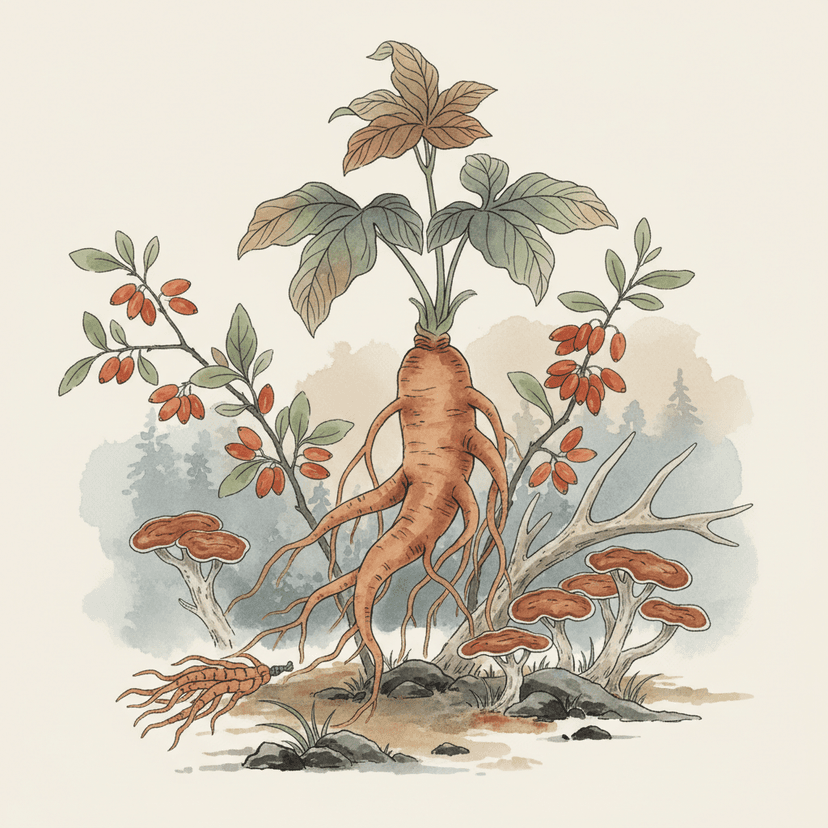
One common herb for fatigue, particularly Qi deficiency, is Huang Qi (Astragalus membranaceus). It’s a Qi tonic herb used in Traditional Chinese Medicine for bolstering immunity, improving energy, and strengthening the Spleen and Lungs. Its key active compounds include polysaccharides, saponins, and flavonoids.
Huang Qi strengthens immunity primarily by enhancing T-cell function and boosting macrophage activity. The recommended daily dosage typically ranges from 9-30g in decoction, though this varies greatly depending on individual diagnosis and formula.
Here are its core properties:
Huang Qi (Astragalus membranaceus)
Dosage: 9-30g in decoction; often included in larger formulas.
Myth #3: Ergonomics and Occasional Stretches are Enough
We’ve been told that if we just adjust our monitor height, get a standing desk converter, and remember to stretch our wrists occasionally, we’ll be fine. And yes, ergonomic adjustments are crucial for preventing acute strain. But the notion that these isolated actions can counteract eight to ten hours of static, intense mental labor, day in and day out, is fundamentally flawed. It's like patching a leaky roof with a band-aid.
The problem is systemic, and the solutions must be too.
The very act of prolonged sitting, the fixed gaze at a screen, the repetitive movements, all contribute to what TCM calls Qi and Blood stagnation. This isn't just a metaphor for discomfort. It’s a physiological reality. When circulation is impeded, nutrients don't reach tissues efficiently, and metabolic waste accumulates. The Bladder Meridian, which runs down the entire back of the body, including the lumbar region, is particularly vulnerable.
The Huangdi Neijing, in the Lingshu·Jingmai chapter, explicitly states that the Bladder Meridian is responsible for “diseases of the sinews... pain in the neck, back, waist, buttocks, popliteal fossa, calves, and feet.” Ignoring this pathway is like trying to fix a traffic jam by only looking at the cars, not the road itself.
What's Actually True
A comprehensive rescue plan for the modern office worker integrates continuous, mindful movement with targeted TCM modalities. Building resilience. That's the real goal, not just reacting to pain. Traditional Chinese mind-body exercises (TCME), such as Qigong and Tai Chi, offer a powerful antidote. A 2023 systematic review and meta-analysis by Li Y, Wang Y, Li Y, et al.
, published in Frontiers in Public Health, found that TCME probably reduces the severity of fatigue, depression, and anxiety in patients with chronic fatigue syndrome compared to passive controls, with a moderate certainty of evidence.
These aren't just gentle exercises. They are deliberate movements that cultivate Qi, improve circulation, and strengthen the body from within. Imagine Li Wei, instead of just stretching his hamstrings, practicing a short Qigong sequence during his break, consciously guiding his breath and intention. This subtle shift in energy management can make all the difference.
Beyond structured exercises, simple daily interventions matter. Chen Shengxiong and Zhou Wenyu, writing in Occupational Health and Emergency Rescue in 2022, demonstrated that core muscle group training can significantly improve non-specific low back pain in office clerks. Their abdominal muscle training group saw a 68.5% improvement rate in ODI scores over six months, outperforming lumbar muscle training. This Western-validated approach synergizes with TCM’s emphasis on strengthening the Kidneys and reinforcing the lumbar region.
I’ve seen practitioners recommend micro-breaks for bladder meridian stretches — simple forward folds or side bends that gently open the meridian lines along the back. It takes minutes. The impact? Cumulative.
The Bigger Picture: Reclaiming Your Vitality
The real question isn't whether your desk job gives you a bad back or low energy. The question is whether we've been asking the right questions about our health in the first place. For Li Wei, and for countless others, the journey to sustained relief isn’t about finding a single magic pill or a perfectly calibrated chair. It’s about understanding the deeper currents of the body, the flow of Qi, the strength of the Kidneys, the harmony of the Spleen.
TCM offers a framework that sees the chronic dull ache and the afternoon slump not as isolated malfunctions, but as interconnected signals. They are the body’s way of saying, “I am out of balance. My reserves are low. My energy is stuck.” This perspective doesn't dismiss the value of Western diagnostics or ergonomic advancements; it enriches them, providing a complementary lens through which to view and address complex, modern ailments.
To genuinely rescue the modern office worker from the grip of back pain and persistent fatigue, we must move beyond simplistic fixes. We must cultivate daily practices that nurture our core energy, ensure the smooth flow of Qi, and prevent stagnation before it takes root. It’s a dynamic, ongoing process. A constant negotiation with the demands of our digital lives.
It’s not about curing a disease; it’s about tending to a garden, ensuring its soil is rich and its energy flows freely.
Can stress and burnout cause back pain and fatigue according to TCM?
Absolutely. In TCM, prolonged stress and burnout are significant factors in depleting Kidney Qi and causing Liver Qi stagnation, both of which can directly manifest as chronic low back pain, muscle tension, and profound fatigue that coffee simply cannot touch.
What acupressure points can I use for back pain and low energy at my desk?
For low back pain, try gently massaging Mingmen (Du 4), located on the lower back directly opposite the navel, to tonify Kidney Qi. For low energy, Sanyinjiao (Sp 6), found on the inner ankle four finger-widths above the ankle bone, helps nourish Qi and Blood. Press firmly for 30-60 seconds on each point, breathing deeply.
Guest Writer at Demisunshine. James writes from a long-standing curiosity about wellness traditions, with a journalist's habit of pushing back when something sounds too good to be true. He's the contributor readers turn to for the contrarian take — the piece that asks 'wait, does this actually hold up?'
Get TCM Wellness Tips
Weekly articles on herbal remedies, nutrition, and holistic health — delivered to your inbox.