Kimchi, Miso & Gut Health: What TCM Teaches Us | Demisunshine
About Kimchi and Miso, Most Wellness Enthusiasts Get This Wrong
For millennia, TCM saw the gut as the root of vitality. Modern science now quantifies its microbiome's true power. Yet, in our rush to embrace fermented foods like kimchi and miso, many overlook a crucial ancient insight: it's not just about adding beneficial bacteria, but cultivating the right
James WuMarch 18, 20267 min read
Quick Answer
Traditional fermented foods like kimchi and miso, long valued in Eastern health practices, offer gut health benefits that go beyond simple probiotic action. Both modern science and Traditional Chinese Medicine (TCM) emphasize their role in modulating gut microbiota, fortifying the intestinal barrier, and cultivating a balanced internal environment, crucial for digestive and overall systemic health.
Key Takeaways
Fermented foods like kimchi and miso are more than just probiotic sources; they are complex agents that, from a TCM perspective, help cultivate a balanced 'internal environment' crucial for digestive harmony and overall vitality.
Scientific studies confirm that kimchi and miso fortify the gut barrier, reduce inflammation by modulating cytokines, and can positively alter gut microbiota composition, supporting their traditional use in managing metabolic health.
The wisdom of TCM, particularly concepts like 'Spleen governing transformation and transportation,' offers a profound framework for understanding how fermented foods work beyond Western microbiological models, emphasizing personalized consumption based on individual constitution.
While beneficial, fermented foods require careful consideration of individual tolerance, especially regarding histamine levels and the sodium content, as overconsumption or unsuitability for certain body types can lead to adverse reactions.
Traditional fermentation, as highlighted by ancient texts like 'Bencao Gangmu,' can transform the properties of ingredients, making them more therapeutic and demonstrating a sophisticated understanding of food as medicine long before modern science.
I'll be honest with you: the first time I heard a wellness influencer declare that all you needed for a healthy gut was a daily shot of fermented cabbage juice, I felt a familiar pang. It was the same feeling I got when my grandmother, a woman whose entire medical philosophy centered on warmth and balance, would listen patiently to my explanations of “probiotics” as if I were describing a new kind of exotic bird.
Her remedies, steeped in centuries of observation, were never about isolated compounds or single-strain bacteria. They were about context. About the whole picture. About the qi of the food, the season, the person.
It was 2023, in a brightly lit lab at Western Sydney University, that I saw this collision of worlds play out in real time. Dr. Eun-Jung Lee, a microbiologist who had traded Seoul’s bustling markets for rows of sterile petri dishes, leaned over a microscope. Her research focused on the intricate dance of microbes within fermented foods, particularly kimchi.
She was the kind of scientist who spoke in precise measurements and peer-reviewed citations, but her eyes held a spark whenever she mentioned her halmeoni (grandmother) making kimchi in vast earthenware pots.
Dr. Lee and her team were meticulously dissecting the biochemical pathways, the specific bacterial strains, the cytokine modulations. They were quantifying the effects of kimchi on gut barrier function, on inflammation markers, even on obesity in animal models, publishing some of their findings in journals like Integrative Medicine Research in 2025. Her work showed how kimchi, rich in Lactobacillus kimchii, demonstrated anti-obesity, anti-inflammatory, and lipid-lowering properties.
They observed how it helped fortify the gut barrier and downregulate pro-inflammatory cytokines such as TNF-α and IL-6, while upregulating anti-inflammatory mediators like IL-10 and TGF-β. This was hard science validating ancient wisdom.
But the data told a more complex story than a simple good bacteria in, good health out equation.
The Internal Garden: Where TCM Met the Microbiome
For millennia, Traditional Chinese Medicine has regarded the gut — specifically the Spleen and Stomach systems — as the very bedrock of health.
It’s not just a digestive tract. It’s a central furnace, responsible for transformation and transportation (运化, or yun hua).
This concept, that food and drink must be processed and then distributed throughout the body, finds a striking parallel in modern understanding of the gut microbiome. The millions of bacteria, fungi, and viruses residing within us are not merely passengers; they are active participants in this transformation, influencing everything from nutrient absorption to immune regulation.
The gut microbiota, this bustling inner ecosystem, is increasingly seen as a biomarker for formula-pattern correspondence (方-证相应, or fang-zheng xiang-ying) in TCM, mediating the efficacy of Chinese herbal medicines, as noted by researchers like Shen Junxi, Fang Leyao, and Tan Zhoujin in 2024. Specific bacterial groups, such as Lachnospiraceae NK4A136, have been linked to the regulation of intestinal barrier function by Chinese medicine. This is about cultivating the garden itself, not just introducing new tenants.
The idea of an internal environment matters. It challenges the common, often simplistic, notion that gut health is solely about consuming probiotics. Traditional fermented foods, seen through a TCM lens, tell a richer story.
Kimchi: A Symphony of Transformation
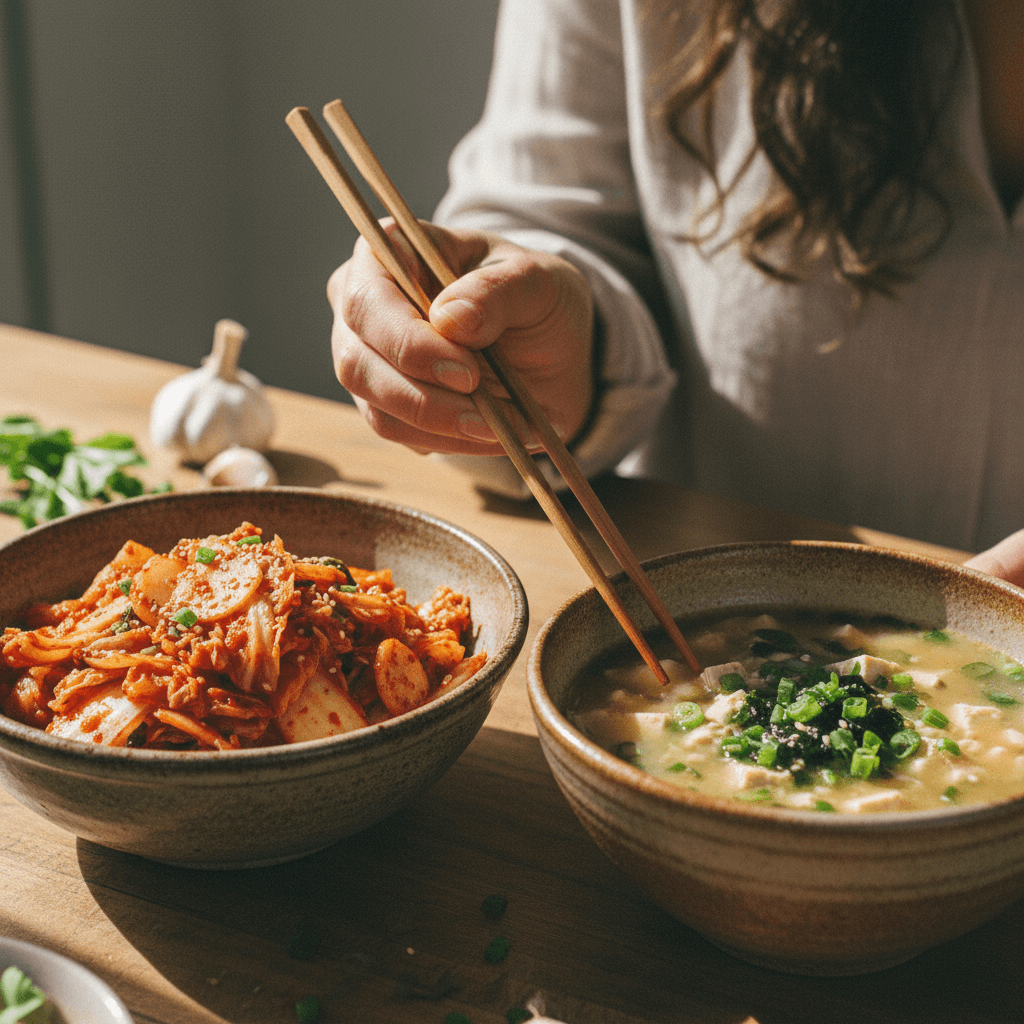
Kimchi, the vibrant staple of Korean cuisine, is far more than just fermented cabbage. It's a complex ecosystem of ingredients, each contributing to its unique health profile. Cabbage, radishes, garlic, ginger, chili flakes – these are not random additions. They are carefully chosen components, many of which have their own historical significance in traditional medicine.
Take garlic, for instance. The Compendium of Materia Medica (本草纲目, Bencao Gangmu) notes that garlic is warm in nature, enters the Spleen, Stomach, and Kidney meridians, resolves carbuncles, and detoxifies. Crucially, it also states that after fermentation, its pungent, hot nature diminishes, while its Spleen-strengthening effect increases. This observation, centuries old, hinted at modern findings about how fermentation enhances bioavailability and transforms bioactive compounds.
A 2024 study in the Journal of Functional Foods illustrated this by showing how kimchi intake modestly mitigated high-fat diet-induced weight gain in rats. More significantly, it significantly changed gut microbiota composition, steroid hormones, bile acids, and metabolic profiles. This is systemic modulation, not just a simple probiotic effect. The fermentation process, driven by core functional bacteria like lactic acid bacteria and yeasts (as highlighted by Liu Xin et al.
in 2024), creates a unique symphony of flavor and function, with over 47 key flavor compounds identified in some kimchi varieties, like the fruity notes from trans-2-nonenal in fermented chili.
Miso: The Earthy Depths of Fermented Soy
Then there’s miso, the rich, savory paste that forms the backbone of Japanese cuisine. Made from fermented soybeans, often with rice or barley, and salt, miso embodies another facet of traditional fermentation. Soybeans (Glycine max) themselves are nutrient-dense, containing significant amounts of isoflavones like genistein and daidzein. But fermentation unlocks and transforms these compounds, enhancing their digestibility and therapeutic potential.
Consider Dan Dou Chi, a prepared soybean product in TCM, often translated as Fermented Soybean. Dan Dou Chi is sweet, slightly bitter, and acrid, entering the Lung and Stomach meridians. It's known for releasing the exterior and harmonizing the Middle Jiao, which corresponds to the digestive center.
This ancient understanding of fermented soy's action on internal harmony mirrors modern findings directly.
The Integrative Medicine Research review of 2025 also highlighted miso's ability to fortify the gut barrier and modulate inflammatory responses, similar to kimchi. It isn't about a single magic bullet. It's about a finely tuned orchestra of bioactive compounds and microbial metabolites.
A Word of Caution on Soy
While beneficial, it’s critical to remember that soy, even fermented, carries considerations. Some individuals are hypersensitive or allergic to soy, and common side effects can include bloating, constipation, diarrhea, and nausea. More seriously, soy products with high tyramine (like some tofu or soy sauce) can interact with monoamine oxidase inhibitors (MAOIs), a class of antidepressants, potentially causing dangerously high blood pressure. Soy may also interact with tamoxifen, aromatase inhibitors, and CYP450 substrates, affecting drug metabolism.
Always consult a healthcare provider if you are taking medications or have specific health conditions before significantly increasing soy intake.
Beyond Probiotics: Cultivating the Internal Terrain
The prevailing Western narrative around fermented foods often fixates on probiotics – the direct introduction of beneficial bacteria. But what if that view is too narrow? What if the real genius of these traditional foods lies not just in what you add,
The ancient wisdom of cultivating an internal environment truly shines here. Fermented foods, whether it's kimchi, miso, or even fermented Traditional Chinese Medicines, don't just add bacteria. They actively terraform the gut. They modulate the existing microbiota, encourage the production of beneficial metabolites like Short-Chain Fatty Acids (SCFAs), protect the intestinal barrier, and regulate immune function. This comprehensive impact came to light in a 2026 review in Frontiers in Microbiology, focusing on fermented TCMs improving Type 2 Diabetes Mellitus.
The Chinese scholars Liu Xin and colleagues (2024) specifically noted that lactic acid bacteria and yeasts are the core functional microbial communities in traditional fermented vegetables. They identified 12 dominant genera of lactic acid bacteria in paocai (Chinese pickled vegetables), and found halophilic archaea making up 35% of salt-fermented vegetables. These aren't just isolated strains; they are communities working in concert, shaped by generations of traditional fermentation processes. They don't just deliver; they facilitate. They create the conditions for healing.
The Edge of Wellness: When Ancient Wisdom Meets Modern Caution
And that brings us to a crucial point often overlooked in the rush for health trends: individual tolerance. I see this all the time: a new 'superfood' hits the mainstream, stripped of its context, reduced to a single bullet point benefit. People jump in with both feet.
But what if your gut environment isn't ready for a sudden influx of highly active fermented foods? What if your body constitution, as understood by TCM, is already prone to excess heat, and you’re consuming warming kimchi daily? Or perhaps you’re sensitive to histamines, which are naturally present in many fermented foods. Symptoms like bloating, brain fog, headaches, or even skin rashes can signal a histamine overload, turning a supposed superfood into a source of discomfort.
That's not to say fermented foods are inherently bad. It's a call for discernment. From a TCM perspective, the nature (cold, cool, neutral, warm, hot) and flavor (sweet, sour, salty, bitter, pungent) of a food, and how it interacts with an individual's unique constitution, is paramount. Kimchi, with its chili and ginger, is generally considered warming. Miso, depending on the fermentation, can be neutral to slightly warming.
Too much of a warming food for someone with an already 'hot' constitution might exacerbate imbalances, regardless of its probiotic content.
And sodium. Yes, about that. Traditional fermentation often involves significant salt. While essential for the process, excessive sodium intake is a well-documented concern for cardiovascular health. That's a practical consideration for daily consumption.
The Enduring Mystery
Back in her lab, Dr. Lee might still be chasing the precise mechanisms, the exact molecular pathways, that make kimchi so powerful. But the mystery, the enduring power, isn't just in the isolated Lactobacillus kimchii or the anti-inflammatory cytokines. It's in the holistic interaction, the cultivation of an internal environment where life thrives. Her grandmother, with her intuitive understanding of the body's rhythms and the transformative power of time and salt, knew this all along.
The future of gut health, it seems, lies not just in discovering new bacteria, but in rediscovering the ancient wisdom of how to nurture the garden within.
Guest Writer at Demisunshine. James writes from a long-standing curiosity about wellness traditions, with a journalist's habit of pushing back when something sounds too good to be true. He's the contributor readers turn to for the contrarian take — the piece that asks 'wait, does this actually hold up?'
Get TCM Wellness Tips
Weekly articles on herbal remedies, nutrition, and holistic health — delivered to your inbox.