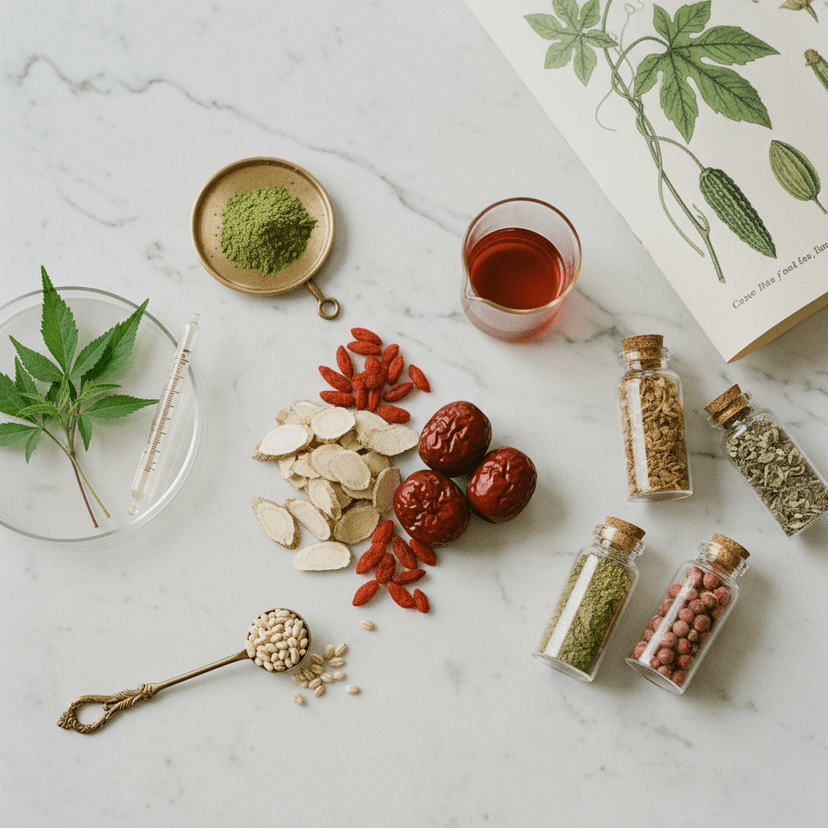
The latest health trend, fueled by direct-to-consumer continuous glucose monitors (CGMs), has many of us hyper-focused on every tiny fluctuation in our blood sugar. It’s easy to get lost in the numbers, to feel like every post-meal spike is a personal failure, but a meta-analysis of 58 randomized trials, involving over 7,000 participants, revealed something significant: Traditional Chinese Medicine (TCM) interventions significantly improved fasting glucose, HbA1c, and insulin resistance in diabetes treatment (Tang et al., 2025).
This points to moving beyond just managing symptoms, urging us to look at the underlying dynamics.
This data point immediately makes me curious about what TCM understands about metabolic health that might be missing from our modern, number-driven conversation. What if those spikes aren't just isolated events, but echoes of a deeper story the body is trying to tell? What if our relentless focus on individual foods is obscuring a more fundamental imbalance?
Take Elena, for instance. She’s a 43-year-old marketing executive, driven and meticulous. She’d recently started wearing a CGM, convinced it was the key to finding optimal health. Every morning, she’d scrutinize her app, a knot tightening in her stomach with each perceived "spike" after breakfast.
A banana? Spike. Even oatmeal sometimes. She started cutting out more and more, feeling increasingly restricted and anxious.
Yet the numbers still seemed to have a mind of their own. Her energy, ironically, was plummeting. Her digestion felt sluggish. She felt heavier than usual, not just on the scale, but in her very being.
Elena's Spikes: A Symptom, Not the Story
Elena’s experience isn't unique. Many people, myself included, have been drawn into the allure of real-time data, believing it holds all the answers.
The CGM is a powerful tool, no doubt. But it offers a snapshot, a symptom. It doesn’t necessarily reveal the underlying metabolic context, the deeper patterns that TCM has observed for centuries.
For Elena, her fatigue, sluggish digestion, and feeling of heaviness would immediately suggest a pattern of Dampness in TCM. In Traditional Chinese Medicine, Dampness is a pathological accumulation of fluids and sticky substances that can impede the flow of Qi (life force energy) and Blood.
It's more than just feeling 'damp' or retaining water; its key internal manifestations can include fatigue, brain fog, a feeling of heaviness in the limbs, and impaired metabolic function, often linked to imbalances in the Spleen system, which in TCM is responsible for transformation and transportation of nutrients.
This idea of Dampness might sound unfamiliar in a Western context, but think of it as a kind of internal sluggishness, a systemic congestion that hinders efficient energy production and waste removal. It's a bit like having a perpetually humid house — everything feels heavy, things don't dry out, and mold might start to grow. Your body's internal environment can feel similar, and I've certainly felt that 'humid house' sensation myself after too many cold, rich foods.
The Unseen Influences: Beyond Food on Your Plate
Elena's narrative wasn't just about what she ate. Her demanding job meant long hours, often working late into the night. Her sleep was inconsistent, typically 5-6 hours, punctuated by waking up thinking about her to-do list. She rarely exercised beyond a brisk walk to the subway, and her stress levels were perpetually high. She was a master of efficiency, but not of relaxation.
This is where TCM offers a powerful perspective, recognizing that metabolic health isn't solely dictated by caloric intake or macronutrient ratios. Factors like stress, sleep, and emotional balance play a significant, often underestimated, part. In TCM, Elena’s constant stress would be seen as affecting her Liver Qi, leading to stagnation. The Liver, in TCM, is responsible for the smooth flow of Qi throughout the body, including digestion and emotional regulation.
When it gets stuck, it can wreak havoc on other organs, especially the Spleen, which is vital for transforming food into energy and managing Dampness.
Modern science certainly echoes this. Researchers at institutions like NIH NCCIH, including Helene Langevin, have explored the intricate connections between stress, inflammation, and metabolic function. Chronic stress elevates cortisol, which directly impacts blood sugar. Poor sleep impairs insulin sensitivity. These aren't separate issues; they're all woven into the same interwoven experience of our well-being.
A study involving 122 trials and encompassing 11,252 participants highlighted this very point: Dampness-eliminating Chinese herbal medicine, when combined with lifestyle interventions, significantly improved fasting plasma glucose, diastolic blood pressure, and body mass index in metabolic conditions (Lan et al., 2026). Here, herbs are part of a synergistic effect, working to address the whole person.
Rebalancing the Inner Landscape
Rather than fixating on individual foods, a TCM approach for Elena would focus on restoring harmony within her body. This means nourishing her Spleen Qi to resolve Dampness and ensuring her Liver Qi flows smoothly to manage stress. It's about strengthening the body's innate ability to process and transform, not just restrict.
TCM practitioners commonly observe that when the Spleen is strengthened, and Dampness is resolved, the body becomes more efficient at handling glucose. Clinical literature describes a multi-targeted approach: personalized herbal formulas, acupuncture to stimulate specific meridians, and dietary therapy focused on warm, easily digestible foods that support the Spleen and reduce Dampness.
Take, for example, the widely studied compound Berberine, a Chinese herb. Modern research, including a study by Zhang and Ring (2025), found that Berberine can lower HbA1c and fasting glucose comparably to metformin, a common Western medication. This shows how traditional botanical wisdom often has measurable, science-backed effects on metabolic parameters.
What struck me when reading this paper was how it also emphasized integrative programs. Zhang and Ring (2025) found that integrative TCM programs — combining herbs, acupuncture, and exercise — demonstrated superior glycemic outcomes and metabolic profiles compared to single therapies or lifestyle advice alone for diabetes self-management. It’s not about one magic bullet; it's about a thoughtful synergy of approaches. So, for Elena, it wasn't just about avoiding a banana; it was about transforming her entire way of being.
But how do you even begin to do that when you’re a busy executive?
Elena's Path to Inner Harmony
Elena's journey wasn't about radical deprivation. It was about gentle, consistent shifts. Instead of rushing through breakfast with a cold smoothie, she began opting for warm, cooked grains and vegetables. She started prioritizing a small, intentional walk during her lunch break, not to burn calories, but to simply move her Qi and step away from her screen.
This is a piece of advice that often contradicts the 'more intense is better' wellness wisdom: sometimes, the most effective thing you can do is slow down and create space.
She also committed to a non-negotiable bedtime, even if it meant leaving work unfinished occasionally. This felt almost rebellious for her. She found that the persistent brain fog and sluggishness slowly began to lift, and with them, her anxiety around her CGM readings started to diminish. She realized a common sentiment I've heard echoed in wellness circles, and one I deeply relate to: "I just want to feel normal again, but every 'fix' feels like more work."
Her TCM practitioner (a contact from a family friend, not someone I’ve ever worked with personally) explained that by supporting her Spleen and smoothing her Liver, her body's inherent wisdom began to re-emerge. Her digestion improved, her energy stabilized, and the glucose spikes became less frequent and less dramatic, not because she was rigidly controlling them, but because her internal systems were better balanced. It wasn't about perfection; it was about consistency and kindness to her body.
Beyond Reactive Fixing: Your Holistic Path Forward
Elena's story offers an important reminder: our metabolic health is a reflection of our entire being. While CGMs offer valuable insights into our unique responses to food, they’re just one piece of a much larger, more intricate puzzle. The goal isn't just to flatten every spike; it's to cultivate an internal environment where spikes are less likely to occur in the first place because the body is functioning optimally.
Traditional Chinese Medicine offers a deep way to understand this metabolic story. It asks why those glucose fluctuations are happening, connecting them to patterns like Dampness, Qi Deficiency, or Liver Stagnation that are often exacerbated by modern stressors and lifestyle choices. This holistic perspective allows for sustainable, deep-seated change.
Ultimately, the real question isn't how to avoid a glucose spike, but how to listen to what our body is trying to communicate through them, and respond with curiosity and care, rather than fear and restriction.
Three Concrete Steps for Your Metabolic Health
- Prioritize warm, cooked meals, especially for breakfast, to support your Spleen's digestive function and mitigate the accumulation of Dampness.
- Integrate regular, gentle movement like walking or stretching into your day to ensure smooth Qi flow and reduce the impact of stress on your blood sugar.
- Commit to consistent sleep (7-8 hours) as a foundational step for improving insulin sensitivity and allowing your body to repair and regulate metabolic hormones naturally.
References
- Tang, Y., Li, X., Zhang, Y., et al. — TCM demonstrated significant improvements in fasting glucose, HbA1c, and insulin resistance in diabetes treatment (2025)
- Lan, Y., Liang, Y., Li, S., et al. — Dampness-eliminating Chinese herbal medicine (CHM), when combined with lifestyle interventions, improved fasting plasma glucose (FPG), diastolic blood pressure (DBP), and body mass index (BMI) in metabolic conditions (2026)
- Li, Y., Zhang, Y., Wang, C., et al. — TCM can ameliorate insulin resistance in newly diagnosed type 2 diabetic patients and is safe and effective (2009)