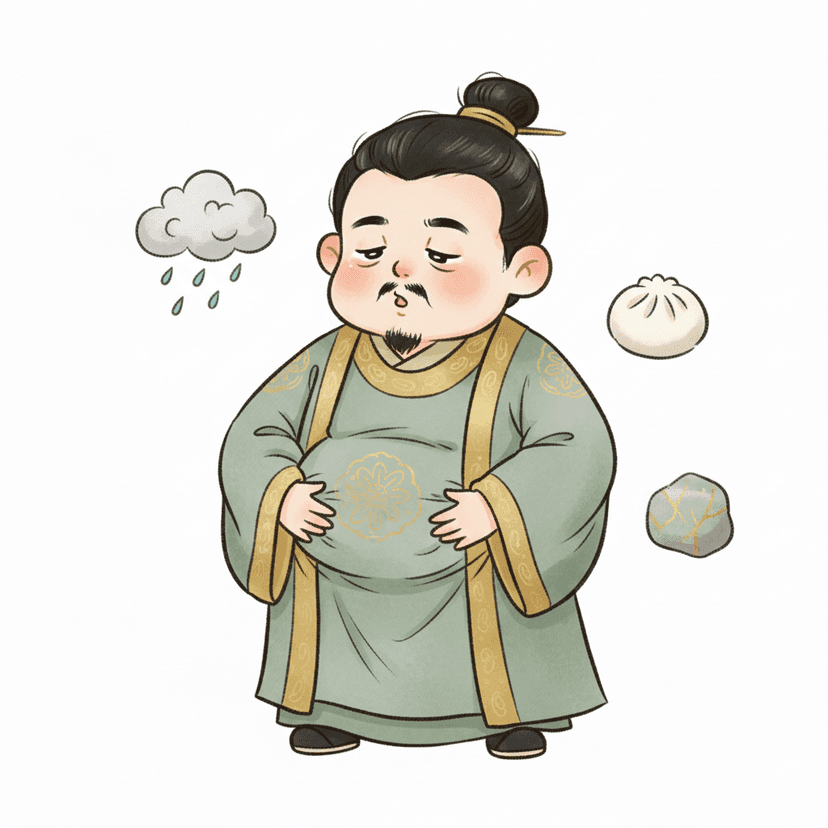
Hauptmerkmale
Übergewicht oder Adipositas
Fettige Haut und fettiges Gesicht
Übermäßige Schleimbildung
Schweres, träges Körpergefühl
Engegefühl in der Brust
Süßlicher oder klebriger Geschmack im Mund
Häufige Symptome
- •Gewichtszunahme, die schwer rückgängig zu machen ist
- •Geistige Trägheit (Brain Fog)
- •Übermäßige Schleimproduktion
- •Blähungen
- •Müdigkeit nach dem Essen
- •Weicher Stuhl
Ernährungsempfehlungen
✓Leichte, leicht verdauliche Lebensmittel
✓Feuchtigkeitsauflösende Lebensmittel: Gerste, Mungbohnen, Mais, Sellerie
✓Moderate Portionsgrößen
✓Milchprodukte, Zucker und fettige Speisen meiden
✓Grüner Tee, Pu-Erh-Tee
Zu vermeidende Lebensmittel
✗Milchprodukte
✗Zucker und Süßigkeiten
✗Fettige, frittierte Speisen
✗Übermäßiger Alkohol
✗Kalte Getränke
Lebensstil-Tipps
Regelmäßige intensive Bewegung (Schwitzen ist förderlich)
Feuchte Umgebungen meiden
Kein Mittagsschlaf
Wohnräume trocken und gut belüftet halten
Gleichmäßige Essenszeiten einhalten
Empfohlene Kräuter
Saisonale Empfehlungen
Regenperioden und feuchtes Wetter verschlechtern die Symptome. Trockene, warme Jahreszeiten sind besser verträglich.
Expertenmeinung
Die Schleim-Feuchtigkeits-Konstitution in der Traditionellen Chinesischen Medizin (TCM) ist durch einen Überschuss an Schleim und Feuchtigkeit im Körper gekennzeichnet. Dieses Ungleichgewicht betrifft in erster Linie Milz und Magen, die für die Umwandlung und den Transport von Flüssigkeiten und Nährstoffen zuständig sind. Wenn diese Organe geschwächt sind, können sie Flüssigkeiten nicht mehr richtig metabolisieren, was zur Ansammlung von Feuchtigkeit und Schleim führt. Symptome umfassen ein Schweregefühl im Körper, einen klebrigen Zungenbelag und eine Neigung zu Übergewicht.
In der westlichen Medizin korreliert die Schleim-Feuchtigkeits-Konstitution häufig mit Erkrankungen wie dem metabolischen Syndrom, Adipositas und Hyperlipidämie. Neuere Forschungen haben gezeigt, dass Personen mit dieser Konstitution möglicherweise erhöhte Triglyzeridspiegel und ein niedrigeres HDL-Cholesterin aufweisen, was zu einem kardiovaskulären Risiko beiträgt. Studien legen auch nahe, dass chronische Entzündungen und Insulinresistenz häufig vorkommen, was mit dem TCM-Konzept übereinstimmt, dass Feuchtigkeit und Schleim den Qi- und Blutfluss behindern.
Klinisch gesehen umfasst der beste Behandlungsansatz bei der Schleim-Feuchtigkeits-Konstitution eine Kombination aus Ernährungsumstellungen, pflanzlicher Medizin und Lebensstiländerungen. Eine kohlenhydratarme, ballaststoffreiche Ernährung wird empfohlen, um Feuchtigkeit zu reduzieren. Kräuter wie Poria (Fuling) und Zitrusschale (Chenpi) können helfen, Schleim aufzulösen und die Milz zu stärken. Regelmäßige moderate körperliche Bewegung, wie Spaziergänge oder Tai Chi, ist vorteilhaft. Häufige Fehler umfassen übermäßigen Verzehr von süßen und fetthaltigen Lebensmitteln, die Feuchtigkeit verstärken, sowie die Vernachlässigung regelmäßiger körperlicher Aktivität.
Häufig gestellte Fragen
Wie wird die Schleim-Feuchtigkeits-Konstitution in der TCM diagnostiziert?
Die Diagnose erfolgt durch Beurteilung von Symptomen wie einem Schweregefühl im Körper, einem klebrigen Zungenbelag und einem schlüpfrigen Puls. Ein TCM-Praktiker berücksichtigt zudem Lebensstilfaktoren, Ernährungsgewohnheiten und das äußere Erscheinungsbild, um diese Konstitution zu identifizieren.
Welche Lebensmittel sollte ich bei einer Schleim-Feuchtigkeits-Konstitution meiden?
Vermeiden Sie süße, fettige und frittierte Speisen sowie kalte und rohe Lebensmittel. Diese können Feuchtigkeit und Schleimbildung verstärken. Schränken Sie Milchprodukte, raffinierten Zucker und übermäßigen Alkoholkonsum ein.
Welche Übungen eignen sich am besten für eine Schleim-Feuchtigkeits-Konstitution?
Moderate Bewegungsformen wie Spaziergänge, Tai Chi und Yoga sind ideal. Diese Aktivitäten helfen, Qi zu zirkulieren und Feuchtigkeit aufzulösen, ohne den Körper zu überanstrengen. Vermeiden Sie hochintensive Trainingseinheiten, die Energie erschöpfen und Feuchtigkeit verstärken können.
Welche Kräuter sind bei Schleim-Feuchtigkeit am wirksamsten?
Kräuter wie Poria (Fuling), Zitrusschale (Chenpi) und Pinellia (Banxia) werden häufig eingesetzt. Sie helfen, Schleim aufzulösen, die Milz zu stärken und die Verdauung zu verbessern. Konsultieren Sie einen TCM-Praktiker für personalisierte Kräuterrezepturen.
Welche Lebensstiländerungen helfen bei der Bewältigung von Schleim-Feuchtigkeit?
Halten Sie einen regelmäßigen Schlafrhythmus ein, bewältigen Sie Stress durch Praktiken wie Meditation, und vermeiden Sie sitzende Verhaltensweisen. Regelmäßige körperliche Aktivität und eine ausgewogene Ernährung sind für die Bewältigung dieser Konstitution entscheidend.
Wie beeinflussen Jahreszeitenwechsel die Schleim-Feuchtigkeits-Konstitution?
Feuchtigkeit tritt vermehrt in feuchten und regenreichen Jahreszeiten auf, wie etwa im Spätsommer und frühen Herbst. In diesen Zeiten ist es wichtig, sich auf Lebensmittel und Aktivitäten zu konzentrieren, die Feuchtigkeit auflösen und die Milz stärken.
Welche westlichen Erkrankungen sind mit Schleim-Feuchtigkeit assoziiert?
Erkrankungen wie das metabolische Syndrom, Adipositas, Hyperlipidämie und Insulinresistenz werden häufig mit Schleim-Feuchtigkeit in Verbindung gebracht. Diese Erkrankungen weisen ähnliche Symptome und zugrunde liegende Ungleichgewichte auf.
Wie lange dauert es, bis sich bei Schleim-Feuchtigkeits-Symptomen Verbesserungen zeigen?
Verbesserungen können variieren, aber viele Menschen bemerken bereits nach wenigen Wochen Veränderungen, wenn sie Ernährungs- und Lebensstiländerungen umsetzen. Konsequenz ist entscheidend, und signifikante Verbesserungen können mehrere Monate in Anspruch nehmen.
Was sind häufige Missverständnisse bezüglich der Schleim-Feuchtigkeits-Konstitution?
Ein verbreitetes Missverständnis ist, dass Gewichtsverlust allein Schleim-Feuchtigkeit beseitigt. Obwohl Gewichtsmanagement wichtig ist, ist es ebenso entscheidend, die zugrunde liegende Feuchtigkeit und Schleimbildung durch Ernährung und Lebensstil zu behandeln.
Wann sollte ich bei Schleim-Feuchtigkeit professionelle Hilfe in Anspruch nehmen?
Suchen Sie professionelle Hilfe auf, wenn Symptome trotz Lebensstiländerungen anhalten oder wenn Sie an zugrunde liegenden Erkrankungen wie Diabetes oder Herzerkrankungen leiden. Ein TCM-Praktiker kann eine personalisierte Behandlung anbieten und Ihren Fortschritt überwachen.
Denken Sie, das könnte Ihr Typ sein?
Diese Informationen dienen nur zu Bildungszwecken. Die Konstitutionsbewertung sollte von einem qualifizierten TCM-Praktiker durchgeführt werden.