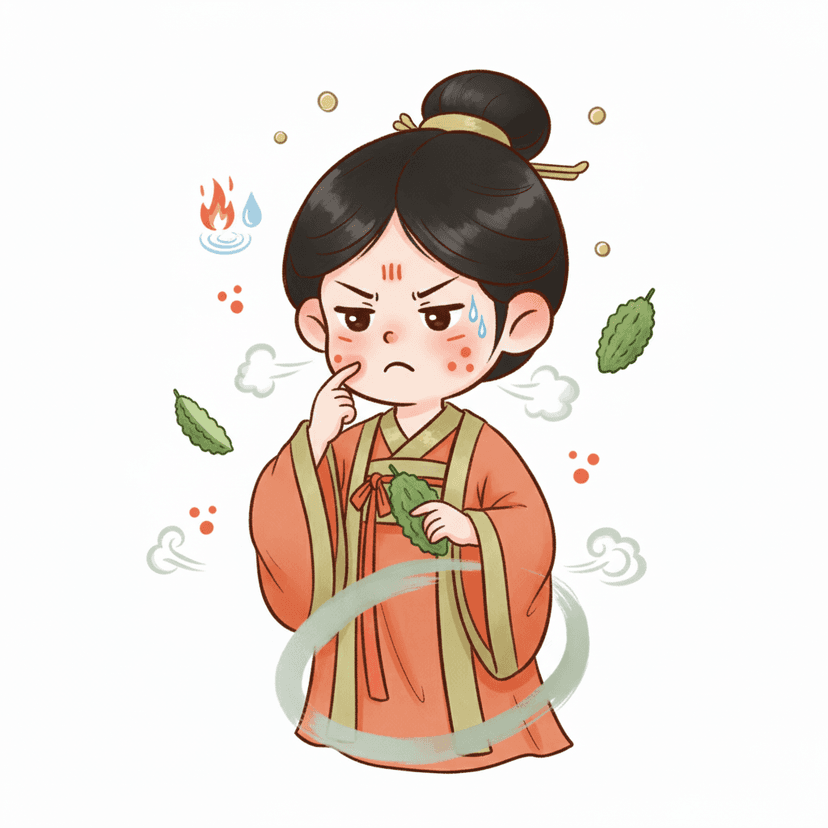
Hauptmerkmale
Fettige, zu Akne neigende Haut
Bitterer oder saurer Geschmack im Mund
Körpergeruch
Gelblicher Teint
Reizbare Gemütsart
Schwere Gliedmaßen
Häufige Symptome
- •Akne und Hautausbrüche
- •Harnwegsinfektionen
- •Verdauungsbeschwerden
- •Mundgeruch
- •Gelb belegter Zungenbelag
- •Klebriger, übelriechender Stuhl
Ernährungsempfehlungen
✓Kühlende, bittere Lebensmittel: Bittergurke, Mungbohnen, Gurke, Blattsalat
✓Leichte, schonende Kochmethoden
✓Ausreichend Wasser trinken
✓Alkohol, scharfe und fettige Speisen meiden
✓Grüner Tee und Chrysanthementee
Zu vermeidende Lebensmittel
✗Alkohol
✗Scharfe Speisen
✗Frittierte Speisen
✗Fettreiche, schwere Fleischgerichte
✗Zucker
Lebensstil-Tipps
Regelmäßige Bewegung zum Abbau von Hitze
Feuchte, heiße Umgebungen meiden
Haut sauber halten
Nicht zu spät aufbleiben
Stress und Frustration reduzieren
Empfohlene Kräuter
Saisonale Empfehlungen
Sommer und feuchte Jahreszeiten sind am belastendsten. Die herbstliche Kühle bringt Linderung.
Expertenmeinung
In der Traditionellen Chinesischen Medizin (TCM) ist die Feuchtigkeits-Hitze-Konstitution durch eine Ansammlung von Feuchtigkeit und Hitze im Körper gekennzeichnet, die in erster Linie Milz und Leber betrifft. Dieses Ungleichgewicht kann zu Symptomen wie schweren Gliedmaßen, fettiger Haut, gelblichem Urin und einem gelben, fettig-klebrigen Zungenbelag führen. Die Milz, die für die Umwandlung und den Transport von Flüssigkeiten zuständig ist, wird überfordert, was zu Feuchtigkeit führt, während die Leber, die den Qi-Fluss reguliert, gestaut wird und Hitze erzeugt.
In der westlichen Medizin korrelieren Erkrankungen wie das metabolische Syndrom, die nichtalkoholische Fettlebererkrankung (NAFLD) und bestimmte Hauterkrankungen wie Akne und Ekzem mit der Feuchtigkeits-Hitze-Konstitution. Neuere Forschungen haben gezeigt, dass chronische Entzündungen und oxidativer Stress, die bei diesen Erkrankungen häufig auftreten, mit der Feuchtigkeits-Hitze-Pathologie in Verbindung gebracht werden können. Beispielsweise stellte eine im 'Journal of Ethnopharmacology' veröffentlichte Studie fest, dass Kräuter, die traditionell zur Beseitigung von Feuchtigkeits-Hitze eingesetzt werden, wie Forsythia suspensa und Lonicera japonica, entzündungshemmende und antioxidative Eigenschaften besitzen.
Klinisch gesehen beinhaltet der beste Behandlungsansatz bei Feuchtigkeits-Hitze eine Kombination aus Ernährungsumstellungen, pflanzlicher Medizin und Lebensstiländerungen. Patienten sollten feuchtigkeitserzeugende Lebensmittel wie Milchprodukte, Zucker und frittierte Speisen meiden und stattdessen eine gemüse- und vollkornreiche Ernährung bevorzugen. Kräuterrezepturen wie Long Dan Xie Gan Tang (Enzian-Dekokt) sind wirksam zur Beseitigung von Feuchtigkeits-Hitze. Häufige Fehler umfassen den übermäßigen Einsatz kühlender Kräuter ohne Behandlung der zugrunde liegenden Feuchtigkeit, was zu einem Kälte-Feuchtigkeits-Zustand führen kann. Regelmäßige körperliche Bewegung und Stressbewältigung sind ebenfalls von entscheidender Bedeutung.
Häufig gestellte Fragen
Wie wird die Feuchtigkeits-Hitze-Konstitution in der TCM diagnostiziert?
Die Feuchtigkeits-Hitze-Konstitution wird durch eine Kombination von Symptomen, Zungenerscheinungsbild und Pulsdiagnose festgestellt. Typische Symptome sind fettige Haut, schwere Gliedmaßen und gelblicher Urin. Die Zunge weist häufig einen gelben, fettig-klebrigen Belag auf, und der Puls kann schlüpfrig oder schnell sein.
Welche Lebensmittel sollte ich bei einer Feuchtigkeits-Hitze-Konstitution meiden?
Vermeiden Sie Lebensmittel, die Feuchtigkeit und Hitze erzeugen, wie Milchprodukte, Zucker, frittierte Speisen und Alkohol. Diese Lebensmittel können den Zustand verschlimmern. Setzen Sie stattdessen auf eine gemüse-, vollkorn- und mageres Protein-reiche Ernährung.
Welche Übungen eignen sich am besten für eine Feuchtigkeits-Hitze-Konstitution?
Mäßig intensive Übungen wie zügiges Gehen, Schwimmen und Yoga sind vorteilhaft. Diese Aktivitäten fördern den Qi-Fluss und reduzieren Feuchtigkeit, ohne übermäßige Hitze zu erzeugen. Vermeiden Sie hochintensive Trainingseinheiten, die die innere Hitze erhöhen können.
Welche Kräuter werden in der TCM häufig zur Behandlung von Feuchtigkeits-Hitze eingesetzt?
Häufig verwendete Kräuter zur Behandlung von Feuchtigkeits-Hitze sind Forsythia suspensa, Lonicera japonica und Scutellaria baicalensis. Diese Kräuter besitzen entzündungshemmende und entgiftende Eigenschaften. Long Dan Xie Gan Tang ist eine klassische Rezeptur zur Beseitigung von Feuchtigkeits-Hitze aus der Leber.
Welche Lebensstiländerungen helfen bei der Bewältigung von Feuchtigkeits-Hitze?
Zu den Lebensstiländerungen gehören Stressreduktion, die Einhaltung eines regelmäßigen Schlafrhythmus und ausreichende Flüssigkeitszufuhr. Stressbewältigungstechniken wie Meditation und tiefes Atmen können helfen, die Leber zu regulieren und Hitze zu reduzieren. Das Meiden feuchter Umgebungen und eine gute Hygiene sind ebenfalls wichtig.
Wie verändert sich die Feuchtigkeits-Hitze-Konstitution mit den Jahreszeiten?
Feuchtigkeits-Hitze neigt dazu, sich in feuchtem und heißem Wetter, beispielsweise im Sommer, zu verschlimmern. In diesen Jahreszeiten ist es wichtig, kühl und trocken zu bleiben sowie die Aufnahme von kühlenden Lebensmitteln und Kräutern zu erhöhen. In den kühleren Monaten sollten Sie auf eine ausgewogene Ernährung und regelmäßige Bewegung achten.
Welche westlichen Erkrankungen sind mit Feuchtigkeits-Hitze in der TCM assoziiert?
Westliche Erkrankungen, die mit Feuchtigkeits-Hitze assoziiert werden, umfassen das metabolische Syndrom, die nichtalkoholische Fettlebererkrankung (NAFLD) sowie Hauterkrankungen wie Akne und Ekzem. Diese Erkrankungen gehen häufig mit chronischen Entzündungen und oxidativem Stress einher, was mit der Feuchtigkeits-Hitze-Pathologie in der TCM übereinstimmt.
Wie lange dauert es, eine Feuchtigkeits-Hitze-Konstitution zu verbessern?
Verbesserungen können variieren, aber in der Regel dauert es bei konsequenter Behandlung und Lebensstiländerungen mehrere Wochen bis Monate. Geduld und Ausdauer sind entscheidend, da sich der Zustand oft über einen längeren Zeitraum entwickelt hat und einen ganzheitlichen Ansatz zur Auflösung erfordert.
Was sind häufige Missverständnisse bezüglich der Feuchtigkeits-Hitze-Konstitution?
Ein verbreitetes Missverständnis ist, dass Feuchtigkeits-Hitze ausschließlich eine Hauterkrankung darstellt. Es handelt sich um ein systemisches Ungleichgewicht, das mehrere Organe betrifft, insbesondere Milz und Leber. Ein weiteres Missverständnis ist, dass kalte Lebensmittel und Getränke stets vorteilhaft sind, was jedoch die Entstehung eines Kälte-Feuchtigkeits-Zustands begünstigen kann.
Wann sollte ich bei einer Feuchtigkeits-Hitze-Konstitution professionelle Hilfe in Anspruch nehmen?
Suchen Sie professionelle Hilfe auf, wenn Symptome trotz eigenständiger Maßnahmen anhalten oder wenn Sie unter schwerwiegenden Symptomen wie anhaltenden Hautproblemen, erheblicher Gewichtszunahme oder Leberfunktionsstörungen leiden. Ein TCM-Praktiker kann einen individuell abgestimmten Behandlungsplan erstellen und Ihren Fortschritt überwachen.
Denken Sie, das könnte Ihr Typ sein?
Diese Informationen dienen nur zu Bildungszwecken. Die Konstitutionsbewertung sollte von einem qualifizierten TCM-Praktiker durchgeführt werden.