Contexte historique et évolution
L'acupuncture possède une histoire de plus de deux millénaires, ses origines remontant à la Chine ancienne. Des documents anciens, tels que le Huangdi Neijing, détaillent son cadre théorique et ses applications cliniques.
Au fil des siècles, les techniques et théories de l'acupuncture se sont affinées, devenant un système médical sophistiqué. Sa diffusion mondiale a commencé au 20e siècle, lui valant une acceptation généralisée.
Fondements théoriques en MTC
L'efficacité de l'acupuncture repose sur les principes de la MTC, principalement le concept du Qi (énergie vitale) circulant à travers les méridiens (经络). Ces voies invisibles relient les organes internes et les surfaces du corps.
La maladie résulte de blocages ou de déséquilibres dans la circulation du Qi. Les points d'acupuncture (穴位) sont des emplacements spécifiques le long des méridiens où le Qi peut être atteint et régulé, rétablissant ainsi l'harmonie.
L'interaction du Yin et du Yang, ainsi que la théorie des Cinq Éléments, guident également les stratégies de diagnostic et de traitement en acupuncture.
Techniques et modalités clés
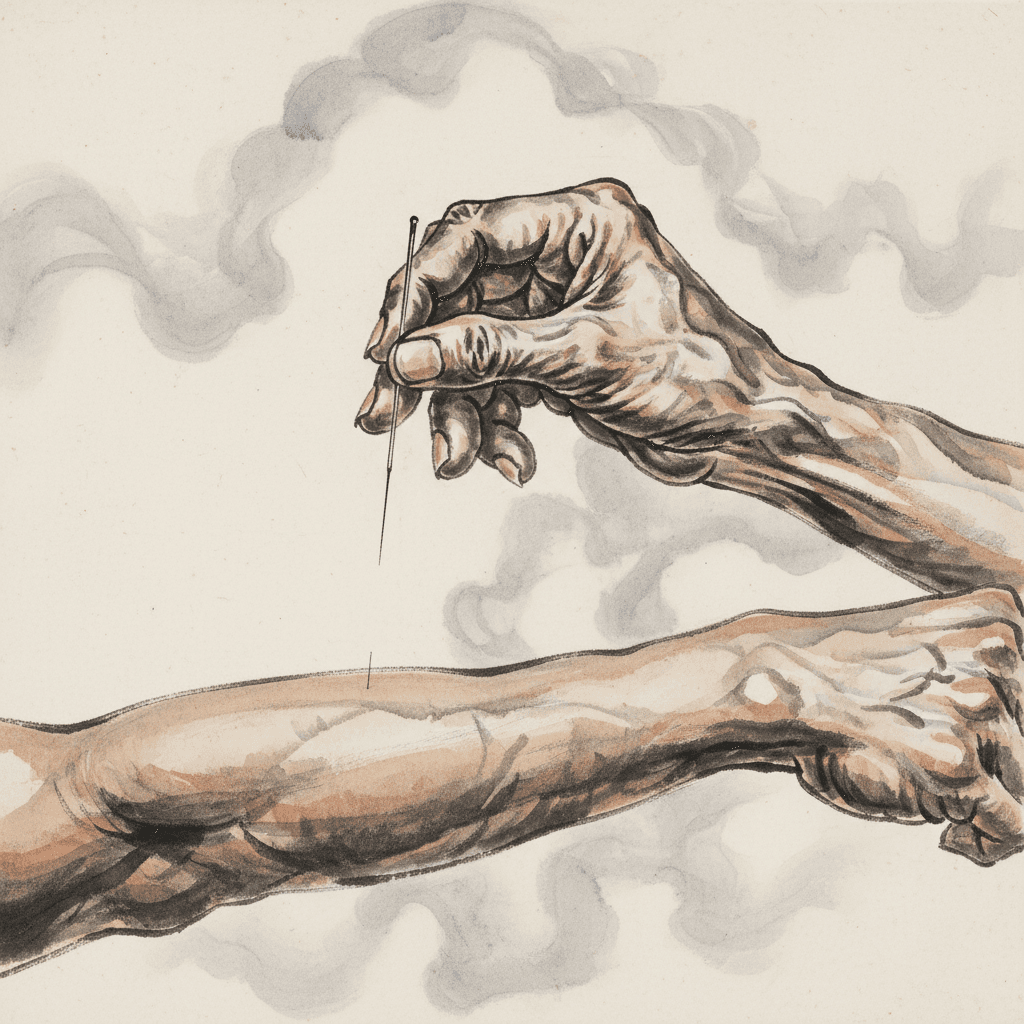
La technique principale implique l'insertion d'aiguilles stériles à usage unique à des profondeurs spécifiques. Les méthodes de manipulation comprennent le levage, la poussée, la torsion et la rotation pour obtenir les effets thérapeutiques souhaités.
La moxibustion (艾灸), utilisant de l'armoise brûlante près des points d'acupuncture, complète souvent l'aiguilletage. La ventouse (拔罐) et l'électroacupuncture sont d'autres thérapies adjuvantes courantes.
Applications cliniques et efficacité
L'acupuncture est appliquée pour un large éventail de conditions, y compris la douleur chronique, les migraines, les nausées et les troubles musculo-squelettiques. Elle est également utilisée pour la réduction du stress et le soutien à la fertilité.
L'Organisation Mondiale de la Santé (OMS) répertorie de nombreuses conditions pour lesquelles l'acupuncture s'est avérée efficace ou pour lesquelles son efficacité a été démontrée.
Recherche moderne et intégration
La recherche contemporaine étudie les mécanismes physiologiques de l'acupuncture, explorant ses effets sur le système nerveux, les hormones et les réponses inflammatoires. Des études de neuroimagerie révèlent des changements dans l'activité cérébrale.
L'acupuncture est de plus en plus intégrée dans les milieux de soins de santé conventionnels à travers le monde. Ce mélange de sagesse ancienne et de science moderne améliore les soins aux patients et les résultats thérapeutiques.