Le Concept Fondamental
Le Yin et le Yang (阴阳) sont des concepts fondamentaux de la Médecine Traditionnelle Chinoise (MTC), issus de l'ancienne philosophie chinoise. Ils décrivent deux forces opposées mais interdépendantes présentes dans tous les aspects de l'univers. Cette dualité aide à expliquer le changement constant et l'équilibre dans la nature.
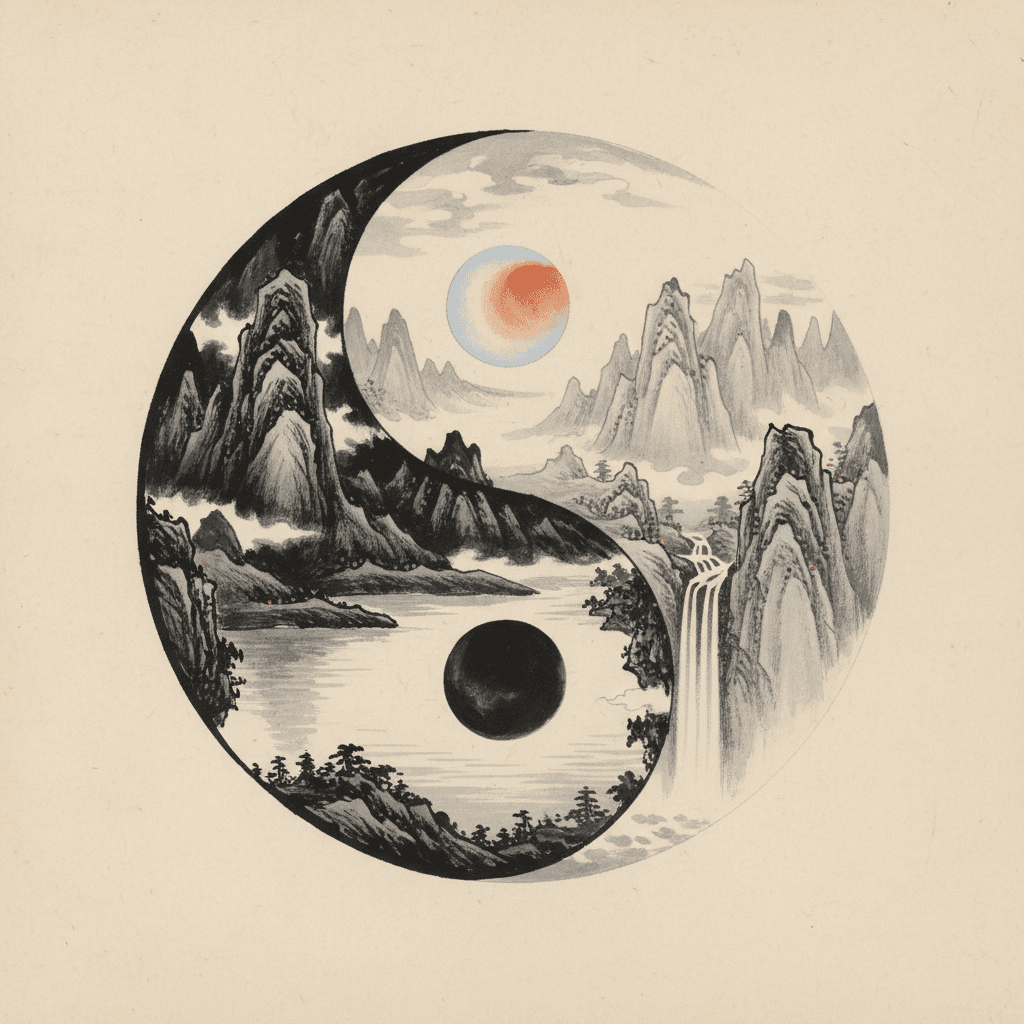
Ni le Yin ni le Yang ne peuvent exister l'un sans l'autre ; ils sont toujours relatifs. Le symbole iconique du Taijitu le représente visuellement, montrant l'interpénétration et l'harmonie dynamique entre les aspects sombres (Yin) et lumineux (Yang), chacun contenant une graine de l'autre.
Définir le Yin et le Yang
Le Yin est généralement associé à l'obscurité, au froid, à la passivité, à l'intériorité, au mouvement descendant et à la substance. Il représente le féminin, la nuit, la lune et le repos. Des attributs comme la fraîcheur, l'immobilité et la nutrition relèvent du domaine du Yin.
Le Yang, à l'inverse, est lié à la lumière, à la chaleur, à l'activité, à l'extériorité, au mouvement ascendant et à la fonction. Il incarne le masculin, le jour, le soleil et le mouvement. Des caractéristiques comme la chaleur, le dynamisme et la transformation sont des qualités Yang.
Interaction Dynamique
La relation entre le Yin et le Yang est complexe, caractérisée par quatre aspects principaux. Premièrement, l'opposition : ce sont des forces contraires, comme le chaud et le froid. Deuxièmement, l'interdépendance : l'un ne peut exister sans l'autre ; le jour a besoin de la nuit.
Troisièmement, la consommation mutuelle : ils se régulent constamment l'un l'autre. Un excès de l'un diminue naturellement l'autre. Quatrièmement, l'inter-transformation : sous certaines conditions, le Yin peut se transformer en Yang, et vice versa, comme la nuit se transformant en jour.
Application en MTC
En MTC, le corps humain est considéré comme un microcosme de l'univers, régi par le Yin et le Yang. Le haut du corps et l'extérieur sont Yang, tandis que le bas du corps et l'intérieur sont Yin. Les organes sont également classés : les organes pleins, de stockage (Zang) sont Yin, et les organes creux, fonctionnels (Fu) sont Yang.
Les substances corporelles comme le Sang et les Fluides Corporels sont Yin, apportant nutrition et humidité. Le Qi et le Shen (Esprit) sont Yang, représentant l'activité, la chaleur et la conscience. La santé dépend de l'équilibre harmonieux et de la circulation de ces aspects Yin et Yang.
Diagnostiquer la Maladie
La maladie en MTC découle d'un déséquilibre du Yin et du Yang. Cela peut se manifester par un excès ou une déficience de l'un ou de l'autre. Par exemple, une déficience de Yin peut entraîner des symptômes de « chaleur vide » comme les sueurs nocturnes, tandis qu'une déficience de Yang provoque des frilosités et de la fatigue.
Un praticien de MTC identifie ces schémas par le diagnostic du pouls et de la langue, ainsi que par l'analyse des symptômes. Comprendre le déséquilibre spécifique guide le choix des stratégies de traitement appropriées pour restaurer l'harmonie.
Références Classiques et Recherche Moderne
S'appuyant sur ses racines philosophiques, le Yin et le Yang sont explicitement définis dans les textes classiques de la MTC comme les principes fondamentaux régissant l'univers et le corps humain. Le chapitre Suwen du Huangdi Neijing déclare : « Le Yin et le Yang sont le Dao du ciel et de la terre, les 纲纪 (principes directeurs) de toutes choses », les établissant à la fois comme des lois cosmiques et la base des processus physiologiques et pathologiques. Ce texte fondateur souligne que la santé est maintenue lorsque « le Yin est fluide et le Yang est secret, alors l'esprit est régulé » (Suwen · Shengqi Tongtian Lun), mettant en évidence l'importance cruciale de leur équilibre dynamique. De plus, le Shanghan Lun utilise le Yin et le Yang comme cadre diagnostique global, guidant les cliniciens dans la différenciation des schémas de maladies, comme la distinction entre « fièvre avec aversion au froid provenant du Yang » et « pas de fièvre avec aversion au froid provenant du Yin ».
La recherche scientifique moderne explore de plus en plus les fondements physiologiques et moléculaires des concepts de Yin et de Yang. Des études menées par des institutions comme l'Université de Médecine Traditionnelle Chinoise de Shanghai ont lié le déséquilibre Yin-Yang à des changements physiologiques observables, identifiant spécifiquement une corrélation avec un dysfonctionnement du système nerveux autonome, tel qu'un déséquilibre sympathique et parasympathique. Ce déséquilibre peut même être évalué quantitativement par des mesures comme la variabilité de la fréquence cardiaque (Zhou et al., 2019). Au niveau moléculaire, la recherche de l'Académie Chinoise des Sciences Médicales Chinoises a commencé à élucider les marqueurs biochimiques associés à des états Yin-Yang spécifiques. Par exemple, la « déficience de Yin » a été corrélée à un dysfonctionnement mitochondrial et à des marqueurs de stress oxydatif élevés, tels que le malondialdéhyde (MDA), offrant une perspective contemporaine pour comprendre ces concepts anciens (China Journal of Chinese Materia Medica, 2021).
L'application pratique des principes du Yin et du Yang s'étend profondément à la préservation de la santé et aux conseils de mode de vie. Des textes classiques comme le Suwen conseillent d'aligner la vie quotidienne sur les changements saisonniers, préconisant de « nourrir le Yang au printemps et en été, et de nourrir le Yin en automne et en hiver » (Suwen · Siqi Tiaoshen Dalun). Cela se traduit par des conseils pratiques tels que la consommation d'aliments réchauffants en hiver et d'aliments rafraîchissants en été pour maintenir l'équilibre interne. La diétothérapie, enracinée dans la classification des substances médicinales de textes comme le Shennong Ben Cao Jing, suit également les principes Yin-Yang. Par exemple, les personnes souffrant de déficience de Yin se voient souvent recommander des aliments comme le bulbe de lys et le tremella pour nourrir le Yin, tandis que celles souffrant de déficience de Yang pourraient bénéficier d'ingrédients réchauffants tels que le gingembre et l'agneau pour tonifier le Yang. Ces applications démontrent la pertinence durable du Yin et du Yang pour guider le bien-être holistique.
Approches Thérapeutiques
L'objectif du traitement en MTC est toujours de restaurer l'équilibre dynamique entre le Yin et le Yang. Cela peut impliquer de renforcer les aspects déficients ou de réduire les excès. L'acupuncture, la phytothérapie chinoise, la diétothérapie et les ajustements de mode de vie sont des modalités courantes.
Par exemple, s'il y a un excès de Yang (chaleur), des herbes rafraîchissantes ou des points d'acupuncture peuvent être utilisés. Si le Yin est déficient, des substances ou des méthodes nourrissantes sont employées. L'approche est holistique, s'attaquant à la cause profonde du déséquilibre.