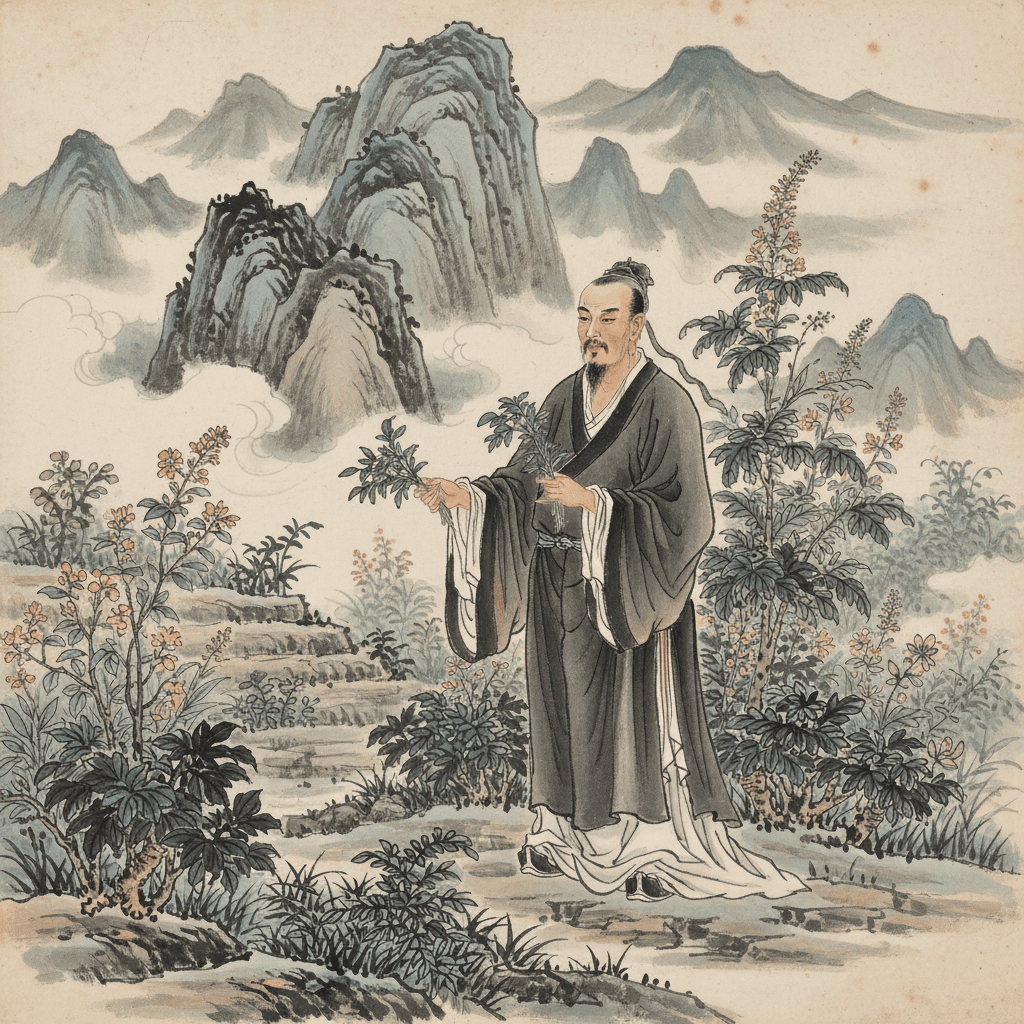
Introduction à une légende médicale
Hua Tuo (v. 140-208 ap. J.-C.) est une figure emblématique de l'histoire de la Médecine Traditionnelle Chinoise (MTC). Ayant vécu durant la tumultueuse dynastie des Han orientaux, il s'est distingué comme médecin, chirurgien et acupuncteur. Ses approches novatrices en matière de guérison étaient révolutionnaires pour son époque, lui valant le surnom de « Médecin Divin » (神醫).
Ses contributions dépassaient le simple diagnostic et les remèdes à base de plantes. Hua Tuo a repoussé les limites de la pratique médicale ancienne, démontrant une compréhension approfondie de l'anatomie et de la physiologie humaines. Son héritage continue d'inspirer les praticiens et les chercheurs en médecine chinoise du monde entier.
Anesthésie pionnière : le Mafeisan
L'une des réalisations les plus célèbres de Hua Tuo fut l'invention du Mafeisan (麻沸散), un anesthésique à base de plantes. Cette puissante concoction était administrée par voie orale, permettant aux patients de subir des interventions chirurgicales complexes sans ressentir de douleur atroce. Elle représente l'une des premières utilisations connues de l'anesthésie générale dans l'histoire médicale.
Bien que les ingrédients précis du Mafeisan restent un mystère, les récits historiques décrivent son efficacité à induire un état d'inconscience. Cette innovation a permis à Hua Tuo de réaliser des opérations auparavant inimaginables, marquant un bond en avant significatif dans les capacités chirurgicales.
Innovations chirurgicales avancées
Les prouesses chirurgicales de Hua Tuo étaient extraordinaires pour son époque. Il aurait effectué diverses opérations complexes, notamment des laparotomies pour traiter les occlusions intestinales et des excisions de tumeurs. Des récits suggèrent qu'il pouvait même réaliser des résections d'organes, démontrant une compréhension sophistiquée de la médecine interne.
Ses techniques incluaient l'utilisation de sutures pour fermer les plaies et des soins post-opératoires méticuleux. Ces pratiques soulignent ses compétences chirurgicales avancées et son engagement envers le rétablissement du patient, établissant une norme élevée pour l'intervention médicale antique.
Exercices thérapeutiques : le Wu Qin Xi
Au-delà de l'intervention chirurgicale, Hua Tuo mettait également l'accent sur la médecine préventive et le bien-être physique. Il a développé le Wu Qin Xi (五禽戏), ou « Jeu des Cinq Animaux », une série d'exercices thérapeutiques. Ces mouvements imitent les actions du tigre, du cerf, de l'ours, du singe et de l'oiseau.
Le Wu Qin Xi a été conçu pour améliorer la circulation, renforcer les muscles, accroître la souplesse et promouvoir la santé globale. Il incarne une approche holistique du bien-être, intégrant l'activité physique à la concentration mentale, un principe toujours central dans les pratiques modernes de Qigong et de Tai Chi.
Héritage et influence durable
L'esprit novateur et le génie médical de Hua Tuo ont laissé une marque indélébile sur la Médecine Traditionnelle Chinoise. Son travail pionnier en anesthésie et en chirurgie, associé à son accent sur les exercices préventifs, a profondément influencé les générations de médecins suivantes. Il est vénéré comme un saint patron de la médecine dans de nombreuses régions de Chine.
Ses méthodes et sa philosophie continuent d'être étudiées et admirées, symbolisant le potentiel d'avancées médicales révolutionnaires même dans l'Antiquité. Hua Tuo demeure un témoignage de l'ingéniosité humaine dans la quête de la guérison et de la santé.
Contexte historique et fin tragique
La vie de Hua Tuo s'est tragiquement achevée sous le règne du puissant seigneur de guerre Cao Cao. Souffrant de maux de tête chroniques, Cao Cao avait sollicité l'expertise de Hua Tuo. Cependant, Cao Cao devint de plus en plus méfiant et paranoïaque face aux compétences extraordinaires et à la nature indépendante du médecin.
Finalement, Cao Cao ordonna l'exécution de Hua Tuo. Cet événement malheureux entraîna la perte de nombreux textes médicaux précieux et de connaissances de Hua Tuo, y compris la formule précise du Mafeisan, une perte significative pour l'avancement de la médecine.