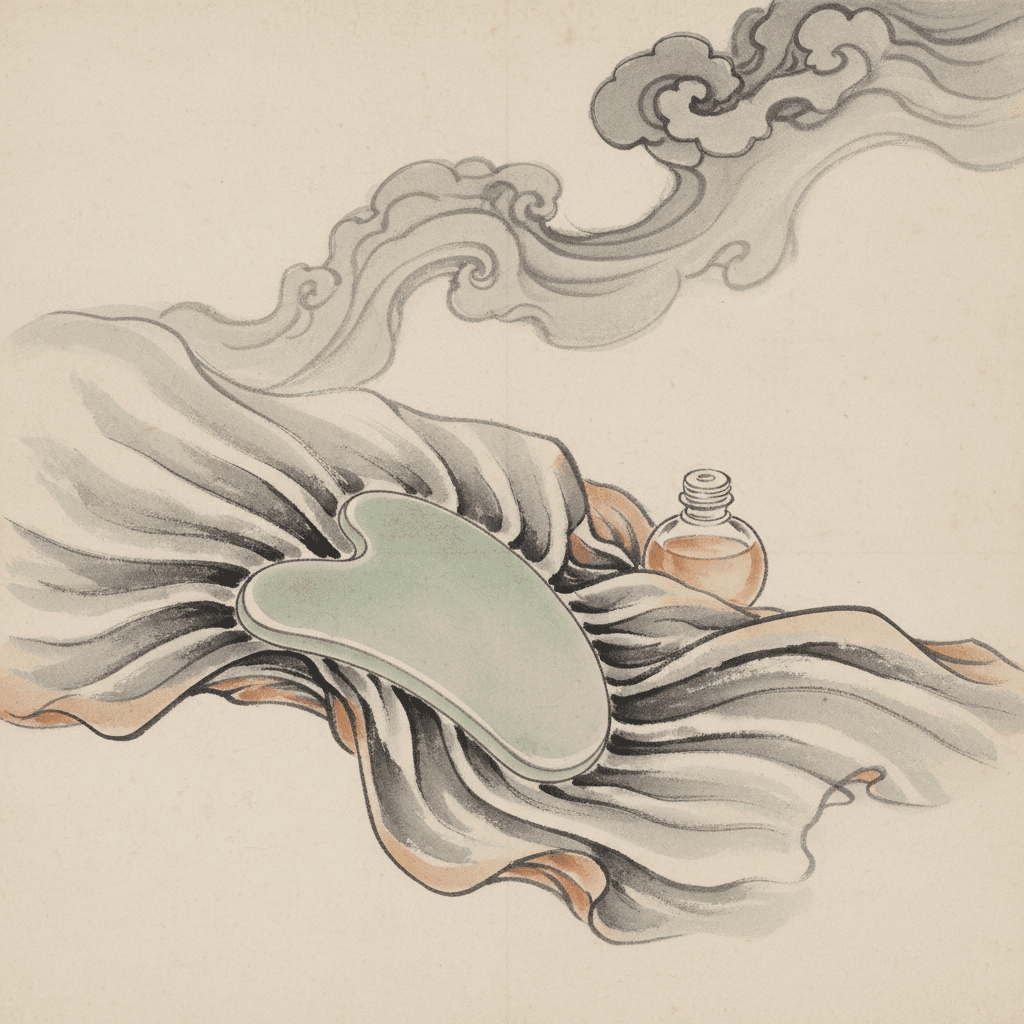
Qu'est-ce que le Gua Sha ?
Le Gua Sha, signifiant 'gratter le sable', est une ancienne technique de guérison enracinée dans la Médecine Traditionnelle Chinoise (MTC). Les praticiens utilisent un outil à bord lisse pour frotter la peau de manière répétée, généralement sur le dos, le cou, les épaules ou les membres. Cette action crée de légères pétéchies, appelées 'sha', qui sont de petites taches rouges indiquant une amélioration de la circulation.
Cette pratique thérapeutique vise à libérer les éléments malsains du corps, à stimuler la circulation sanguine et à favoriser la guérison métabolique. On pense qu'elle s'attaque à la stagnation du qi (énergie vitale) et du sang, que la MTC considère comme une cause principale de douleur et de maladie. Le Gua Sha est utilisé depuis des siècles dans diverses cultures.
Le mécanisme du 'Sha'
Les pétéchies rouges ou violettes caractéristiques, ou 'sha', ne sont pas des ecchymoses au sens conventionnel. Elles représentent des cellules sanguines extravasées des capillaires, ramenées à la surface. En MTC, l'apparition du sha signifie la libération du sang stagnant et des toxines des tissus sous-jacents. La couleur et l'intensité du sha peuvent indiquer la sévérité de la stagnation.
En ramenant ces micro-traumatismes à la surface, le Gua Sha est censé déclencher une réponse anti-inflammatoire et immunoprotectrice dans le corps. Ce processus aide à décomposer le tissu cicatriciel, à améliorer la microcirculation et à faciliter l'élimination des déchets métaboliques. Il favorise également la circulation du qi et du sang, rétablissant l'équilibre.
Bénéfices et Indications
Le Gua Sha est largement utilisé pour soulager les douleurs musculaires et articulaires, la raideur et la tension. Il est efficace pour des affections comme les douleurs cervicales, les douleurs dorsales, l'épaule gelée et le syndrome du canal carpien. Beaucoup trouvent un soulagement immédiat de l'inconfort après une séance, avec une amplitude de mouvement accrue.
Au-delà des problèmes musculo-squelettiques, le Gua Sha est également appliqué pour diverses autres affections. Celles-ci incluent les rhumes courants, la fièvre, les maux de tête, les migraines et même les problèmes respiratoires comme l'asthme et la bronchite. On pense qu'il aide à libérer les agents pathogènes et à promouvoir les capacités de guérison naturelles du corps.
Outils et Technique
Les outils traditionnels de Gua Sha sont généralement fabriqués à partir de matériaux comme le jade, la corne de buffle, la céramique ou l'acier inoxydable. Ces outils ont des bords lisses et arrondis pour éviter d'endommager la peau. Le praticien applique une huile ou un baume lubrifiant sur la peau avant de gratter doucement, mais fermement, dans une seule direction.
Le mouvement de raclage est généralement effectué par de longs traits le long de méridiens ou de groupes musculaires spécifiques. La pression est ajustée en fonction du confort de l'individu et de l'effet thérapeutique désiré. Le processus se poursuit jusqu'à l'apparition du 'sha' caractéristique, indiquant la libération de la stagnation.
Références Classiques et Recherche Moderne
Au-delà de sa signification littérale, le cœur théorique du Gua Sha en MTC est profondément enraciné dans le 'Sha Syndrome' (痧症学说), qui postule que le 'sha' représente la manifestation externe d'une stagnation interne ou d'une accumulation 'toxique'. Cette approche thérapeutique vise à débloquer les méridiens (疏通经络), à revigorer la circulation sanguine et à dissiper la stase sanguine (活血化瘀), et à expulser les facteurs pathogènes (驱邪外达). Sa lignée historique remonte à des textes fondamentaux comme le Huangdi Neijing (Canon Interne de l'Empereur Jaune), qui soutient indirectement la régulation des méridiens par des thérapies externes. Le texte de la dynastie Qing Shazhang Yuheng (1676) de Guo Zhisui a fourni le premier traité systématique sur le 'Sha Syndrome', décrivant explicitement les indications et les directives opérationnelles du Gua Sha, solidifiant sa place dans la pratique de la MTC.
La recherche scientifique moderne a commencé à élucider les mécanismes physiologiques sous-jacents aux bienfaits traditionnels du Gua Sha. Des recherches du Massachusetts General Hospital de la Harvard Medical School (Nielsen et al., 2011) ont démontré que le Gua Sha peut réguler à la hausse localement l'hème oxygénase-1 (HO-1), une enzyme connue pour ses effets anti-inflammatoires et cytoprotecteurs, tout en inhibant simultanément les cytokines inflammatoires comme l'IL-6. D'autres études, telles que celles menées par l'Université de Médecine Chinoise de Pékin (2020) utilisant l'IRMf, ont montré que le Gua Sha peut activer le réseau du mode par défaut du cerveau et moduler la fonction du système nerveux autonome, suggérant des effets régulateurs neurologiques et systémiques plus larges. Ces découvertes fournissent des preuves contemporaines soutenant le rôle du Gua Sha dans le soulagement de la douleur, la réduction de l'inflammation et l'équilibre physiologique général.
Reconnu pour son potentiel thérapeutique, le Gua Sha est appliqué cliniquement pour une gamme de conditions, y compris les douleurs musculo-squelettiques, les stades initiaux des rhumes courants et la fatigue chronique, comme souligné dans le rapport 2019 de l'Organisation Mondiale de la Santé (OMS) sur les pratiques de médecine traditionnelle. Bien que généralement sûr, les praticiens insistent sur l'adhésion à des directives opérationnelles spécifiques, telles que le raclage unidirectionnel le long des méridiens (par exemple, le méridien de la Vessie) avec une pression appropriée pour obtenir une sensation de 'de qi', et généralement effectué 1 à 2 fois par semaine. Les contre-indications incluent la peau lésée ou les troubles de la coagulation, soulignant l'importance d'une application professionnelle pour garantir l'efficacité et éviter les réactions indésirables.
Effets Secondaires Potentiels et Précautions
L'effet secondaire le plus courant du Gua Sha est l'apparition temporaire de 'sha', qui peut varier du rouge clair au violet foncé. Ces marques disparaissent généralement en 2 à 7 jours. Une certaine sensibilité ou douleur dans la zone traitée est également normale, similaire aux sensations post-massage.
Le Gua Sha ne doit pas être pratiqué sur une peau lésée, des plaies ouvertes, des éruptions cutanées ou des zones présentant des ecchymoses sévères. Les personnes atteintes de certaines conditions médicales, telles que des troubles de la coagulation, des varices sévères ou celles sous anticoagulants, doivent consulter un professionnel de la santé avant le traitement. Les femmes enceintes doivent également faire preuve de prudence.