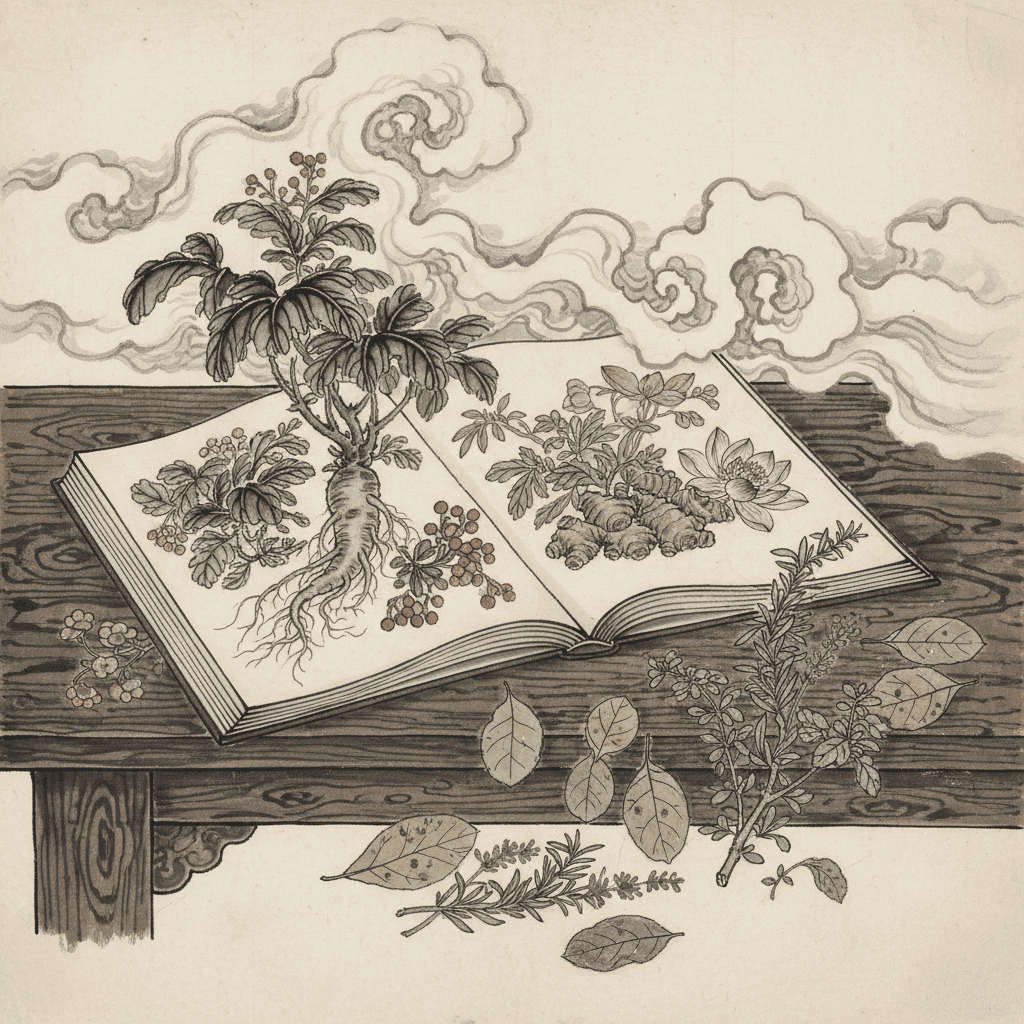
Introduction au Ben Cao Gang Mu
Le Ben Cao Gang Mu, ou 'Compendium de Matière Médicale', est une œuvre monumentale dans l'histoire de la Médecine Traditionnelle Chinoise (MTC). Rédigé par Li Shizhen pendant la dynastie Ming, il représente l'aboutissement de siècles de connaissances pharmacologiques chinoises. Son approche systématique et sa vaste portée ont établi une nouvelle norme pour la littérature médicale.
Achevée à la fin du 16e siècle, cette encyclopédie détaille méticuleusement les substances médicinales de diverses catégories. Elle va au-delà des simples descriptions, offrant des aperçus sur leurs origines, leurs méthodes de traitement, leurs propriétés et leurs applications thérapeutiques. L'influence de l'œuvre s'étend bien au-delà de la Chine, impactant la compréhension mondiale de la phytothérapie.
L'Auteur : Li Shizhen
Li Shizhen (1518–1593) était un médecin, pharmacologue et naturaliste distingué de la dynastie Ming. Né dans une famille de médecins, il a dédié sa vie à la recherche et à la pratique médicale. Insatisfait des inexactitudes et des incohérences des textes de materia medica existants, il s'est lancé dans le projet ambitieux de compiler le Ben Cao Gang Mu.
Li Shizhen a passé près de trois décennies à voyager, observer, collecter et documenter méticuleusement. Il a consulté plus de 800 textes médicaux existants et a personnellement étudié d'innombrables substances. Son approche empirique rigoureuse et son analyse critique étaient révolutionnaires pour son époque, assurant l'exactitude et l'exhaustivité de son travail.
Contenu et Structure
Le Ben Cao Gang Mu est organisé en 52 volumes (juan) et couvre 1 892 substances médicinales distinctes. Celles-ci sont classées en 16 sections, telles que les herbes, les céréales, les légumes, les fruits, les bois, les pierres et les animaux. Chaque entrée fournit des informations détaillées, y compris les synonymes, les descriptions, le traitement, les propriétés, les indications et les contre-indications.
L'œuvre comprend également plus de 11 000 prescriptions, dont beaucoup sont originales ou raffinées par Li Shizhen lui-même. Elle présente de nombreuses illustrations pour faciliter l'identification des substances. Au-delà de la pharmacologie, elle aborde la botanique, la zoologie, la minéralogie, la géographie et même l'histoire, ce qui en fait une ressource précieuse dans de multiples disciplines.
Innovations Méthodologiques
Li Shizhen a introduit plusieurs méthodologies innovantes. Il a adopté un nouveau système de classification basé sur les relations naturelles, allant au-delà du système traditionnel de grades 'supérieur, moyen, inférieur'. Cette structure hiérarchique, similaire à la taxonomie moderne, a rendu la vaste quantité d'informations plus accessible et logique.
Il a également mis l'accent sur l'observation empirique et l'évaluation critique. Li Shizhen a corrigé de nombreuses erreurs des textes précédents et a ajouté de nouvelles découvertes. Son approche méticuleuse de la recherche, y compris les études de terrain et l'expérimentation directe, a considérablement amélioré la rigueur scientifique et la fiabilité de la materia medica.
Héritage Durable et Impact
Le Ben Cao Gang Mu est rapidement devenu l'ouvrage de référence définitif pour la materia medica en Chine et en Asie de l'Est. Son influence sur la pratique, l'éducation et la recherche en MTC est incommensurable. Il a fourni une base standardisée et complète pour la phytothérapie, guidant des générations de praticiens.
L'impact de l'œuvre s'étend à l'échelle mondiale. Il a été traduit dans diverses langues, introduisant les connaissances pharmacologiques chinoises au monde occidental. Le Ben Cao Gang Mu reste un témoignage des réalisations scientifiques chinoises anciennes et continue d'être étudié pour ses aperçus historiques, médicaux et botaniques.
Références Classiques et Recherche Moderne
Au-delà de son acclamation générale, le Ben Cao Gang Mu est précisément défini comme une œuvre pharmacologique monumentale compilée par Li Shizhen, documentant systématiquement 1 892 substances médicinales, y compris des plantes, des animaux et des minéraux. Celles-ci sont méticuleusement organisées en 16 divisions et 60 catégories, accompagnées de 11 096 prescriptions. Sa méthode de classification innovante 'gangmu body', qui combine une recherche textuelle rigoureuse avec une vaste expérience clinique, a conduit Joseph Needham à le décrire célèbrement comme l''Encyclopédie Orientale de Materia Medica', soulignant son ampleur et sa profondeur inégalées.
L'approche méticuleuse de Li Shizhen a impliqué la synthèse et le raffinement de siècles de connaissances. Il a intégré la 'classification à trois grades' du Shennong Ben Cao Jing et s'est appuyé sur les cadres théoriques du Huangdi Neijing, tels que le principe 'les drogues toxiques attaquent le mal, les cinq céréales nourrissent' pour illustrer le concept de la médecine et de l'alimentation partageant des origines communes. De manière cruciale, il n'a pas seulement compilé mais a examiné de manière critique les textes précédents comme le Zhenglei Ben Cao, corrigeant de nombreuses inexactitudes. Un exemple notable est sa réfutation de la croyance erronée selon laquelle le mercure était non toxique, une correction qui a souligné son engagement envers l'observation empirique et la rigueur scientifique.
La valeur scientifique durable du Ben Cao Gang Mu continue d'être validée par la recherche moderne. Par exemple, l'Institut de Materia Medica de Shanghai de l'Académie Chinoise des Sciences a réussi à isoler un extrait éthéré actif antipaludique de l'Artemisia annua (qinghao), une découverte qui a conduit au prix Nobel de Tu Youyou pour l'artémisinine. De plus, l'Académie Chinoise de Médecine Traditionnelle Chinoise a développé une base de données dédiée au Ben Cao Gang Mu, facilitant l'analyse des mécanismes moléculaires pour plus de 300 médicaments répertoriés. Ses applications pratiques s'étendent à la préservation de la santé, avec des recommandations diététiques comme les baies de goji pour la santé rénale et visuelle, désormais scientifiquement soutenues par la présence de zéaxanthine. Même les avertissements traditionnels, tels que les '18 incompatibilités' (par exemple, Aconite root et Pinellia ternata), sont expliqués scientifiquement comme des effets synergiques toxiques, renforçant le besoin de conseils médicaux.
Pertinence Moderne
Même au 21e siècle, le Ben Cao Gang Mu conserve une pertinence significative. Les chercheurs continuent d'explorer ses substances documentées pour de potentiels nouveaux médicaments et applications thérapeutiques. Ses descriptions détaillées des usages traditionnels fournissent des pistes précieuses pour les études pharmacologiques modernes et la découverte de médicaments.
Les principes et classifications contenus dans le Ben Cao Gang Mu éclairent également l'éducation et la pratique contemporaines de la MTC. Il sert de pont entre la sagesse ancienne et l'enquête scientifique moderne, assurant l'évolution continue et la compréhension de la phytothérapie.