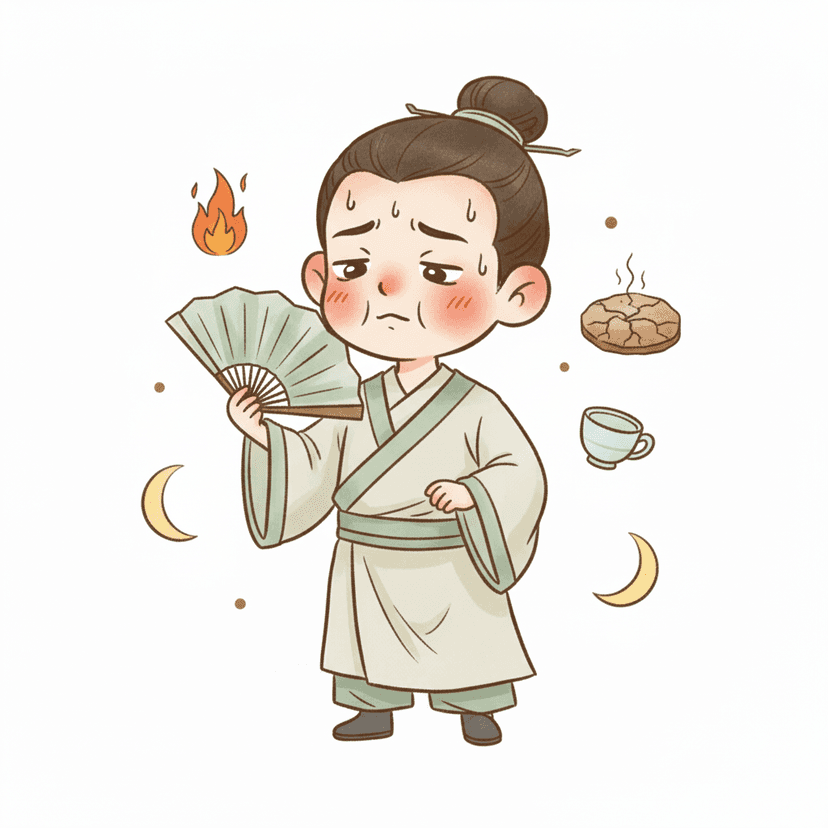
Características clave
Palmas de las manos y plantas de los pies calientes
Sequedad en la boca y la garganta
Sudores nocturnos
Complexión delgada
Mejillas enrojecidas
Sueño inquieto
Síntomas comunes
- •Piel y cabello secos
- •Estreñimiento con heces secas
- •Irritabilidad
- •Mareos
- •Tinnitus
- •Sofocos (especialmente durante la menopausia)
Recomendaciones dietéticas
✓Alimentos refrescantes e hidratantes: pera, pepino, tofu, pato
✓Abundante líquido, pero no helado
✓Sopas y congees que nutran el Yin
✓Evitar alimentos picantes, fritos y a la parrilla
✓Sésamo negro, bulbo de lirio, hongo de nieve
Alimentos a evitar
✗Alimentos picantes (chile, pimienta, ajo)
✗Alimentos fritos
✗Café y alcohol
✗Cordero y venado (demasiado calóricos)
Consejos de estilo de vida
Evitar el exceso de trabajo y trasnochar
Ejercicio suave y refrescante: natación, caminata
Meditación y prácticas calmantes
Dormir lo suficiente (antes de las 11 pm)
Evitar saunas y exposición excesiva al sol
Hierbas recomendadas
Guía estacional
El calor del verano es difícil. La sequedad otoñal agrava los síntomas. El invierno es la mejor estación para nutrir el Yin.
Opinión del experto
La Deficiencia de Yin (阴虚质) en la Medicina Tradicional China (MTC) se refiere a un estado en el que el Yin del cuerpo —los aspectos refrescantes y nutritivos— resulta insuficiente. Este desequilibrio suele afectar los Riñones, el Hígado y los Pulmones, dando lugar a síntomas como sequedad, sensaciones de calor, sudores nocturnos e irritabilidad. El problema fundamental es un agotamiento de los fluidos corporales y una deficiencia de las funciones refrescantes e hidratantes, lo que puede generar una amplia variedad de síntomas físicos y emocionales.
En la medicina occidental, la Deficiencia de Yin puede correlacionarse con afecciones como el síndrome de fatiga crónica, el agotamiento suprarrenal y ciertos trastornos autoinmunes. Investigaciones recientes han demostrado que las personas con Deficiencia de Yin suelen presentar signos de estrés oxidativo e inflamación, que pueden vincularse a enfermedades crónicas como la diabetes, la hipertensión y los trastornos tiroideos. Estudios también han encontrado que los tratamientos herbales y los cambios en el estilo de vida orientados a restaurar el Yin pueden mejorar los marcadores de estrés oxidativo e inflamación.
Clínicamente, el mejor enfoque para tratar la Deficiencia de Yin implica una combinación de fitoterapia, ajustes dietéticos y modificaciones en el estilo de vida. Hierbas como Rehmannia, Ophiopogon y Schisandra se utilizan habitualmente para nutrir el Yin y reducir el calor. La dieta debe centrarse en alimentos refrescantes e hidratantes, como frijoles mungo, algas marinas y pato. El ejercicio debe ser suave y restaurador, como el Tai Chi o el yoga. Los errores frecuentes incluyen el exceso de trabajo, el consumo excesivo de alimentos picantes o secos y descuidar la hidratación. El seguimiento periódico con un profesional de MTC es esencial para controlar el progreso y ajustar el plan de tratamiento según sea necesario.
Preguntas frecuentes
¿Cómo se diagnostica la Deficiencia de Yin en MTC?
La Deficiencia de Yin se diagnostica mediante una combinación de diagnóstico del pulso, examen de la lengua y evaluación de síntomas. Los signos comunes incluyen un pulso fino y rápido, una lengua roja con poca o ninguna capa, y síntomas como sequedad bucal, sudores nocturnos e irritabilidad.
¿Qué alimentos debo evitar si tengo Deficiencia de Yin?
Evite los alimentos picantes, fritos y excesivamente procesados, ya que pueden agravar el calor y la sequedad. Limite también el alcohol y la cafeína, que pueden agotar el Yin y aumentar el calor interno.
¿Cuáles son los mejores ejercicios para alguien con Deficiencia de Yin?
Los ejercicios suaves y restauradores como el Tai Chi, el yoga y la caminata son ideales. Estas actividades ayudan a calmar la mente, nutrir el cuerpo y favorecer la circulación del Qi sin agotar el Yin.
¿Qué hierbas son más efectivas para tratar la Deficiencia de Yin?
Hierbas como Rehmannia, Ophiopogon y Schisandra son muy eficaces. Ayudan a nutrir el Yin, reducir el calor y promover el equilibrio general. Consulte a un profesional de MTC para obtener fórmulas herbales personalizadas.
¿Qué cambios en el estilo de vida pueden ayudar a mejorar la Deficiencia de Yin?
Priorice el descanso y la relajación, maneje el estrés mediante la atención plena y la meditación, y mantenga un horario de sueño regular. Evite el exceso de trabajo y cree un entorno de vida tranquilo y fresco.
¿Cómo afectan los cambios estacionales a la Deficiencia de Yin?
La Deficiencia de Yin puede empeorar en climas cálidos y secos o durante el verano. Manténgase hidratado, use aire acondicionado y evite la exposición excesiva al sol. En invierno, enfóquese en alimentos cálidos y nutritivos para equilibrar el cuerpo.
¿Qué afecciones occidentales se asocian con la Deficiencia de Yin?
Afecciones como el síndrome de fatiga crónica, el agotamiento suprarrenal, la diabetes, la hipertensión y ciertos trastornos autoinmunes pueden solaparse con la Deficiencia de Yin. Estas afecciones suelen implicar inflamación crónica y estrés oxidativo.
¿Cuánto tiempo tarda en verse mejoría con la Deficiencia de Yin?
Las mejoras pueden variar, pero muchas personas notan cambios en pocas semanas o en unos meses con un tratamiento constante. La paciencia y la perseverancia son clave, ya que restaurar el Yin es un proceso gradual.
¿Cuáles son los conceptos erróneos comunes sobre la Deficiencia de Yin?
Un concepto erróneo frecuente es que la Deficiencia de Yin es únicamente un problema físico. También afecta el bienestar emocional y mental, y se necesita un enfoque holístico para un tratamiento eficaz.
¿Cuándo debo buscar ayuda profesional para la Deficiencia de Yin?
Busque ayuda profesional si los síntomas persisten o empeoran a pesar de los esfuerzos de autocuidado. Un profesional de MTC puede proporcionar un plan de tratamiento personalizado y supervisar su progreso para una salud óptima.
¿Cree que este podría ser su tipo?
Esta información es solo con fines educativos. La evaluación de la constitución debe ser realizada por un profesional de MTC cualificado.