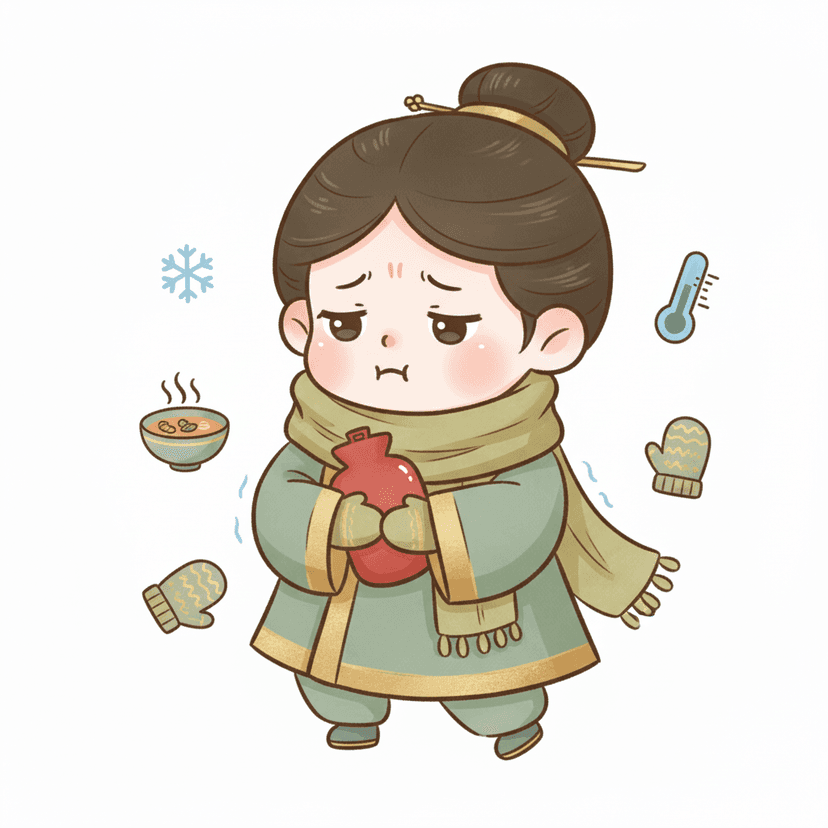
Características clave
Manos y pies fríos
Prefiere ambientes cálidos
Rostro pálido e hinchado
Micción frecuente (orina clara)
Debilidad en la zona lumbar y las rodillas
Bajo deseo sexual
Síntomas comunes
- •Sensación frecuente de frío
- •Abdomen frío
- •Edema
- •Alimentos sin digerir en las heces
- •Diarrea de madrugada
- •Baja energía, especialmente en invierno
Recomendaciones dietéticas
✓Consumir siempre alimentos tibios y cocidos
✓Alimentos que calientan el Yang: cordero, jengibre, canela, hinojo, nueces
✓Evitar completamente los alimentos fríos y crudos
✓Usar especias calentadoras en la cocina: pimienta negra, ajo, cardamomo
Alimentos a evitar
✗Bebidas frías y helados
✗Verduras y frutas crudas
✗Sandía
✗Pera
✗Melón amargo
Consejos de estilo de vida
Mantenerse abrigado, especialmente la zona lumbar y los pies
Exposición al sol cuando sea posible
Baños de pies calientes antes de dormir
Ejercicio vigoroso para generar calor corporal
Moxibustión en puntos clave
Hierbas recomendadas
Guía estacional
El invierno es la estación más difícil. El calor del verano es terapéutico. Siempre protegerse del frío y el viento.
Opinión del experto
La Deficiencia de Yang (阳虚质) en la Medicina Tradicional China (MTC) hace referencia a un estado constitucional en el que la energía Yang del cuerpo es insuficiente. La energía Yang es responsable del calor, el movimiento y la transformación. Esta deficiencia afecta con frecuencia a los riñones y al bazo, que son órganos clave en la MTC para mantener la energía Yang. El desequilibrio fundamental en la Deficiencia de Yang es la falta de calor y vitalidad, lo que genera síntomas como extremidades frías, fatiga y tez pálida.
En la medicina occidental, la Deficiencia de Yang puede correlacionarse con condiciones como el hipotiroidismo, el síndrome de fatiga crónica y la insuficiencia suprarrenal. Investigaciones recientes han demostrado que las personas con Deficiencia de Yang suelen presentar tasas metabólicas basales más bajas y una termogénesis reducida. Los estudios también sugieren que estos individuos pueden tener niveles alterados de hormonas tiroideas y cortisol, que son fundamentales para mantener la temperatura corporal y los niveles de energía.
Desde el punto de vista clínico, el mejor enfoque para tratar la Deficiencia de Yang implica una combinación de hierbas calentadoras, ajustes dietéticos y modificaciones en el estilo de vida. Hierbas como el jengibre seco (干姜) y la canela (肉桂) son particularmente efectivas. La dieta debe incluir alimentos calentadores como sopas y guisos, y se deben evitar los alimentos fríos y crudos. El ejercicio suave y regular, como el Tai Chi y el Qi Gong, puede contribuir a mejorar la circulación y la energía. Los errores comunes que deben evitarse incluyen la dependencia excesiva de estimulantes y el exceso de esfuerzo físico, que pueden agotar aún más la energía Yang.
Preguntas frecuentes
¿Cómo se diagnostica la Deficiencia de Yang en MTC?
La Deficiencia de Yang se diagnostica mediante una combinación de diagnóstico del pulso, examen de la lengua y evaluación de síntomas. Los signos comunes incluyen una lengua pálida y húmeda con saburra blanca, un pulso débil y lento, extremidades frías y preferencia por ambientes cálidos.
¿Qué alimentos debo consumir para mejorar la Deficiencia de Yang?
Los alimentos calentadores y nutritivos son beneficiosos. Incluya jengibre, ajo, cebolla, puerro, cordero, pollo y verduras de raíz como zanahorias y camotes. Las sopas y guisos son ideales, ya que son de fácil digestión y aportan calor sostenido.
¿Qué ejercicios se recomiendan para la Deficiencia de Yang?
Los ejercicios suaves como el Tai Chi, el Qi Gong y el yoga son ideales. Estas prácticas mejoran la circulación y la energía sin sobreexigir al cuerpo. Evite los entrenamientos de alta intensidad que puedan agotar la energía Yang.
¿Cuáles son las mejores hierbas para tratar la Deficiencia de Yang?
Las hierbas como el jengibre seco (干姜), la canela (肉桂) y el cuerno de ciervo (鹿茸) son muy eficaces. Ayudan a calentar el cuerpo y fortalecer la energía Yang. Consulte a un practicante de MTC para obtener fórmulas herbales personalizadas.
¿Qué cambios en el estilo de vida pueden ayudar a manejar la Deficiencia de Yang?
Mantenga un ambiente cálido, use ropa adecuada y evite las condiciones de frío y humedad. Realice ejercicio suave regular y asegúrese de descansar lo suficiente. Las técnicas de manejo del estrés, como la meditación, también pueden ser beneficiosas.
¿Cómo afectan los cambios estacionales a la Deficiencia de Yang?
La Deficiencia de Yang es más pronunciada en las estaciones más frías, como el invierno. Durante estos períodos, enfóquese en alimentos y actividades calentadoras. En las estaciones más cálidas, continúe apoyando la energía Yang con una dieta equilibrada y ejercicio para mantener la salud general.
¿Qué condiciones occidentales se asocian con la Deficiencia de Yang?
La Deficiencia de Yang puede correlacionarse con condiciones como el hipotiroidismo, el síndrome de fatiga crónica y la insuficiencia suprarrenal. Estas condiciones frecuentemente implican baja energía, intolerancia al frío y problemas metabólicos.
¿Cuánto tiempo se tarda en mejorar la Deficiencia de Yang?
La mejoría puede variar, pero el tratamiento constante y los cambios en el estilo de vida pueden mostrar resultados notables en unos pocos meses. La paciencia y la perseverancia son clave, ya que la reconstrucción de la energía Yang es un proceso gradual.
¿Cuáles son los conceptos erróneos más comunes sobre la Deficiencia de Yang?
Un error frecuente es creer que la Deficiencia de Yang es únicamente una condición de frío. Si bien los síntomas de frío son prominentes, también involucra fatiga, baja energía y mala digestión. Otro error es la dependencia excesiva de estimulantes, que pueden agotar aún más la energía Yang.
¿Cuándo debo buscar ayuda profesional para la Deficiencia de Yang?
Busque ayuda profesional si los síntomas son graves, persistentes o empeoran. Un practicante de MTC puede proporcionar un plan de tratamiento personalizado, que incluya medicina herbal, asesoramiento dietético y modificaciones en el estilo de vida para manejar eficazmente la Deficiencia de Yang.
¿Cree que este podría ser su tipo?
Esta información es solo con fines educativos. La evaluación de la constitución debe ser realizada por un profesional de MTC cualificado.