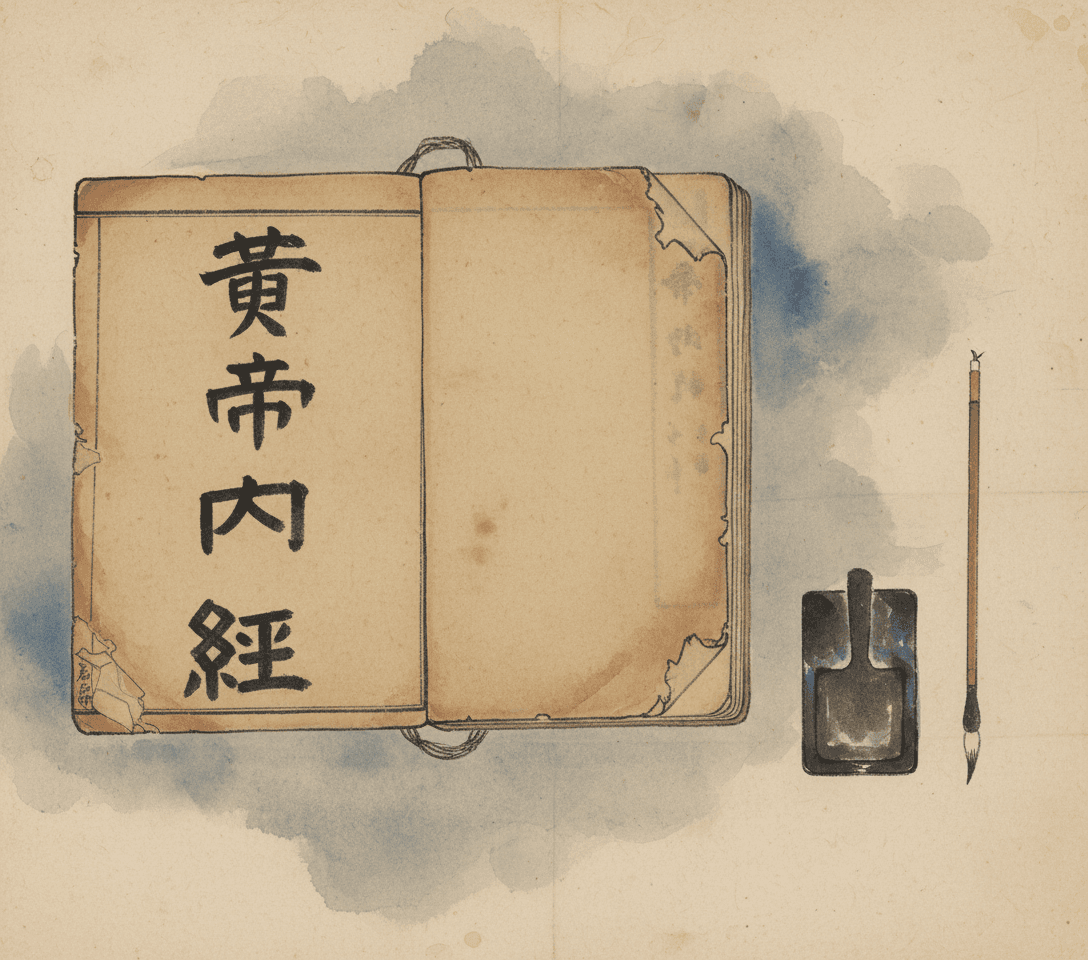
黃帝內經 · Huang Di Nei Jing
《Huang Di Nei Jing》(黃帝內經)是中醫藥(TCM)的奠基性著作。它系統地闡述了指導中醫藥數千年的核心理論和原則。
The Huang Di Nei Jing, or Yellow Emperor's Inner Canon, is the seminal text of Traditional Chinese Medicine (TCM). It is revered as the earliest comprehensive medical treatise in China, laying the groundwork for millennia of medical practice.
Attributed to the mythical Yellow Emperor, Huang Di, the text compiles ancient medical knowledge and philosophical insights. It systematically articulates the principles that define TCM's unique approach to health and disease.
Its profound influence extends beyond medicine, touching upon philosophy, cosmology, and the understanding of human existence within the natural world. It remains indispensable for TCM practitioners.
The Huang Di Nei Jing is traditionally divided into two major parts: the Su Wen (素問, Basic Questions) and the Ling Shu (靈樞, Spiritual Pivot). Each part addresses distinct yet complementary aspects of medicine.
The Su Wen primarily discusses theoretical foundations, including cosmology, physiology, pathology, diagnosis, and prevention. It explores the relationship between humans, nature, and the cosmos.
The Ling Shu, also known as Zhen Jing (針經, Needle Classic), focuses on acupuncture and moxibustion. It details meridians, acupoints, needling techniques, and the circulation of Qi and blood.
Central to the Nei Jing are the theories of Yin-Yang and the Five Elements (Wu Xing). These philosophical concepts are applied to explain physiological functions, pathological changes, and the interrelationships within the body and with the environment.
The text elaborates on the Zang-Fu organ systems, describing their functions, interconnections, and roles in maintaining health. It introduces the concept of Qi (vital energy), blood, and body fluids as fundamental substances.
It also systematically presents the meridian (Jing Luo) system, a network of pathways through which Qi circulates. Understanding these pathways is crucial for acupuncture and understanding disease progression.
The principles outlined in the Huang Di Nei Jing form the theoretical bedrock for almost all branches of TCM. This includes herbal medicine, acupuncture, moxibustion, dietary therapy, and Qigong.
Its diagnostic methods, such as pulse and tongue diagnosis, and its understanding of disease patterns are directly derived from its teachings. Practitioners still rely on its wisdom for clinical reasoning.
The text emphasizes a holistic approach, treating the individual rather than just symptoms, and focusing on preventing disease. This patient-centered philosophy continues to shape TCM practice globally.
While attributed to the mythical Yellow Emperor, the Huang Di Nei Jing is a compilation of medical knowledge from various authors over several centuries. Its final form likely emerged during the Western Han Dynasty.
It synthesizes earlier medical traditions with contemporary philosophical thought, particularly Taoism and Confucianism. This integration reflects the intellectual climate of ancient China.
The text's enduring presence highlights its comprehensive nature and its ability to adapt and inform medical practice across different historical periods.
The Huang Di Nei Jing, compiled primarily during the Warring States to Han Dynasty period (approximately 475 BCE – 220 CE), stands as China's earliest extant medical classic. It systematically articulates the foundational principles of TCM, including the intricate theories of Yin-Yang and Five Elements, the functions of Zang-Fu organs, the network of Jing-Luo (meridians and collaterals), and the profound concept of Tian Ren Xiang Ying (Heaven-Human Correspondence). These core ideas not only define the unique approach to health and disease but also deeply embed human existence within the rhythms and laws of the natural world, extending its influence far beyond clinical practice into philosophy and cosmology.
The text's enduring wisdom is exemplified through its practical guidance on health preservation. As articulated in the `Su Wen · Shang Gu Tian Zhen Lun`, ancient sages understood the importance of aligning with Yin-Yang principles, maintaining moderation in diet, regularity in daily life, and avoiding excessive exertion to achieve harmony between body and spirit. Further, the `Ling Shu · Ben Shen` emphasizes adapting to the four seasons and managing emotions for optimal well-being. These principles translate into practical applications such as seasonal調養 (seasonal regulation), advocating practices like early sleep and late rising in winter to align with the "Spring birth, Summer growth, Autumn harvest, Winter storage" cycle, and情志調節 (emotional regulation), utilizing theories like "anger harms the liver" to inform therapeutic approaches such as five-tone music therapy for emotional balance.
The Huang Di Nei Jing's relevance is continuously affirmed by modern scientific inquiry. Research from the Chinese Academy of Chinese Medical Sciences (2020), utilizing bibliometric analysis, has shown partial validation of its Jing-Luo theory in acupuncture mechanism studies, with fMRI scans demonstrating activation of specific brain regions upon needling corresponding acupoints. Furthermore, studies funded by the U.S. National Institutes of Health (2018) have identified consistencies between the Nei Jing's "Four Seasons Health Preservation" theory and contemporary chronobiology, highlighting the text's foresight in understanding biological rhythms. These ongoing investigations underscore the Nei Jing's continued role as a vital guide for both clinical practice and cutting-edge research in Traditional Chinese Medicine.
Despite its ancient origins, the Huang Di Nei Jing remains highly relevant in contemporary TCM education and clinical practice. Its holistic view of health resonates with modern integrative medicine approaches.
Researchers continue to explore its concepts, seeking to bridge ancient wisdom with modern scientific understanding. Studies investigate the mechanisms behind acupuncture and herbal remedies based on Nei Jing principles.
The text offers timeless insights into lifestyle, preventive care, and the harmonious balance between humans and their environment, making it a valuable resource for global health.
The Huang Di Nei Jing, or Yellow Emperor's Inner Canon, is the seminal text of Traditional Chinese Medicine (TCM). It is revered as the earliest comprehensive medical treatise in China, laying the groundwork for millennia of medical practice.
Attributed to the mythical Yellow Emperor, Huang Di, the text compiles ancient medical knowledge and philosophical insights. It systematically articulates the principles that define TCM's unique approach to health and disease.
Its profound influence extends beyond medicine, touching upon philosophy, cosmology, and the understanding of human existence within the natural world. It remains indispensable for TCM practitioners.
The Huang Di Nei Jing is traditionally divided into two major parts: the Su Wen (素問, Basic Questions) and the Ling Shu (靈樞, Spiritual Pivot). Each part addresses distinct yet complementary aspects of medicine.
The Su Wen primarily discusses theoretical foundations, including cosmology, physiology, pathology, diagnosis, and prevention. It explores the relationship between humans, nature, and the cosmos.
The Ling Shu, also known as Zhen Jing (針經, Needle Classic), focuses on acupuncture and moxibustion. It details meridians, acupoints, needling techniques, and the circulation of Qi and blood.
Central to the Nei Jing are the theories of Yin-Yang and the Five Elements (Wu Xing). These philosophical concepts are applied to explain physiological functions, pathological changes, and the interrelationships within the body and with the environment.
The text elaborates on the Zang-Fu organ systems, describing their functions, interconnections, and roles in maintaining health. It introduces the concept of Qi (vital energy), blood, and body fluids as fundamental substances.
It also systematically presents the meridian (Jing Luo) system, a network of pathways through which Qi circulates. Understanding these pathways is crucial for acupuncture and understanding disease progression.
The principles outlined in the Huang Di Nei Jing form the theoretical bedrock for almost all branches of TCM. This includes herbal medicine, acupuncture, moxibustion, dietary therapy, and Qigong.
Its diagnostic methods, such as pulse and tongue diagnosis, and its understanding of disease patterns are directly derived from its teachings. Practitioners still rely on its wisdom for clinical reasoning.
The text emphasizes a holistic approach, treating the individual rather than just symptoms, and focusing on preventing disease. This patient-centered philosophy continues to shape TCM practice globally.
While attributed to the mythical Yellow Emperor, the Huang Di Nei Jing is a compilation of medical knowledge from various authors over several centuries. Its final form likely emerged during the Western Han Dynasty.
It synthesizes earlier medical traditions with contemporary philosophical thought, particularly Taoism and Confucianism. This integration reflects the intellectual climate of ancient China.
The text's enduring presence highlights its comprehensive nature and its ability to adapt and inform medical practice across different historical periods.
The Huang Di Nei Jing, compiled primarily during the Warring States to Han Dynasty period (approximately 475 BCE – 220 CE), stands as China's earliest extant medical classic. It systematically articulates the foundational principles of TCM, including the intricate theories of Yin-Yang and Five Elements, the functions of Zang-Fu organs, the network of Jing-Luo (meridians and collaterals), and the profound concept of Tian Ren Xiang Ying (Heaven-Human Correspondence). These core ideas not only define the unique approach to health and disease but also deeply embed human existence within the rhythms and laws of the natural world, extending its influence far beyond clinical practice into philosophy and cosmology.
The text's enduring wisdom is exemplified through its practical guidance on health preservation. As articulated in the `Su Wen · Shang Gu Tian Zhen Lun`, ancient sages understood the importance of aligning with Yin-Yang principles, maintaining moderation in diet, regularity in daily life, and avoiding excessive exertion to achieve harmony between body and spirit. Further, the `Ling Shu · Ben Shen` emphasizes adapting to the four seasons and managing emotions for optimal well-being. These principles translate into practical applications such as seasonal調養 (seasonal regulation), advocating practices like early sleep and late rising in winter to align with the "Spring birth, Summer growth, Autumn harvest, Winter storage" cycle, and情志調節 (emotional regulation), utilizing theories like "anger harms the liver" to inform therapeutic approaches such as five-tone music therapy for emotional balance.
The Huang Di Nei Jing's relevance is continuously affirmed by modern scientific inquiry. Research from the Chinese Academy of Chinese Medical Sciences (2020), utilizing bibliometric analysis, has shown partial validation of its Jing-Luo theory in acupuncture mechanism studies, with fMRI scans demonstrating activation of specific brain regions upon needling corresponding acupoints. Furthermore, studies funded by the U.S. National Institutes of Health (2018) have identified consistencies between the Nei Jing's "Four Seasons Health Preservation" theory and contemporary chronobiology, highlighting the text's foresight in understanding biological rhythms. These ongoing investigations underscore the Nei Jing's continued role as a vital guide for both clinical practice and cutting-edge research in Traditional Chinese Medicine.
Despite its ancient origins, the Huang Di Nei Jing remains highly relevant in contemporary TCM education and clinical practice. Its holistic view of health resonates with modern integrative medicine approaches.
Researchers continue to explore its concepts, seeking to bridge ancient wisdom with modern scientific understanding. Studies investigate the mechanisms behind acupuncture and herbal remedies based on Nei Jing principles.
The text offers timeless insights into lifestyle, preventive care, and the harmonious balance between humans and their environment, making it a valuable resource for global health.
本資訊僅供教育目的,不構成醫療建議。使用任何草藥前,請務必諮詢合格的醫療從業人員。