针灸 · Zhen Jiu
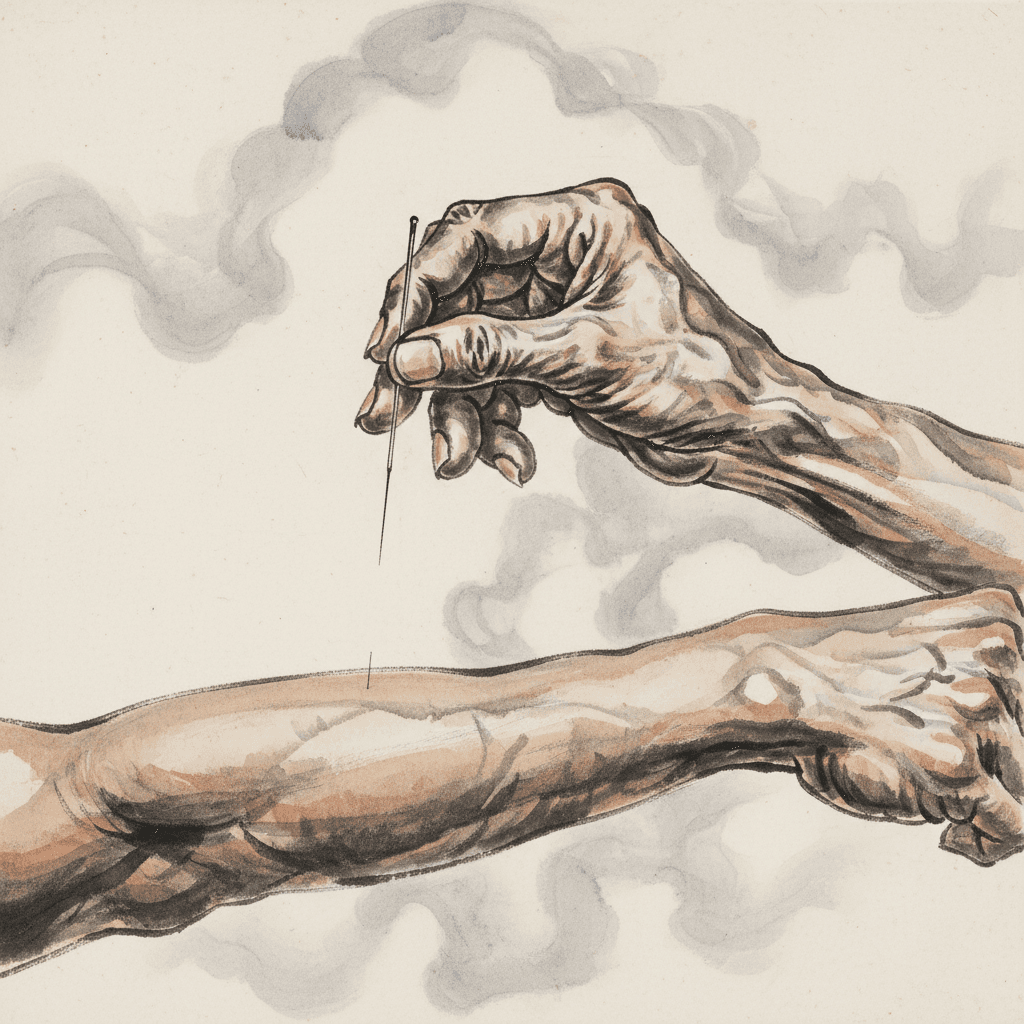
Acupuncture (针灸) 是Traditional Chinese Medicine (TCM) 中的一种基础疗法,它通过将细针插入身体特定穴位进行治疗。这种古老疗法旨在恢复平衡,调节Qi的流动,并促进身体的自然愈合能力。
Acupuncture boasts a history spanning over two millennia, with its origins traceable to ancient China. Early records, like the Huangdi Neijing, detail its theoretical framework and clinical applications.
Over centuries, acupuncture techniques and theories were refined, becoming a sophisticated medical system. Its global dissemination began in the 20th century, gaining widespread acceptance.
Acupuncture's efficacy is rooted in TCM principles, primarily the concept of Qi (vital energy) flowing through meridians (经络). These invisible pathways connect internal organs and body surfaces.
Disease arises from blockages or imbalances in Qi flow. Acupoints (穴位) are specific locations along meridians where Qi can be accessed and regulated, restoring harmony.
The interplay of Yin and Yang, and the Five Elements theory, also guide diagnosis and treatment strategies in acupuncture.
The primary technique involves sterile, single-use needles inserted at specific depths. Manipulation methods include lifting, thrusting, twirling, and rotating to achieve desired therapeutic effects.
Moxibustion (艾灸), using burning mugwort near acupoints, often complements needling. Cupping (拔罐) and electroacupuncture are other common adjunctive therapies.
Acupuncture is applied for a wide range of conditions, including chronic pain, migraines, nausea, and musculoskeletal disorders. It is also used for stress reduction and fertility support.
The World Health Organization (WHO) lists numerous conditions for which acupuncture has been proven effective or for which its efficacy has been demonstrated.
Contemporary research investigates acupuncture's physiological mechanisms, exploring its effects on the nervous system, hormones, and inflammatory responses. Neuroimaging studies reveal brain activity changes.
Acupuncture is increasingly integrated into conventional healthcare settings worldwide. This blend of ancient wisdom and modern science enhances patient care and therapeutic outcomes.
Acupuncture boasts a history spanning over two millennia, with its origins traceable to ancient China. Early records, like the Huangdi Neijing, detail its theoretical framework and clinical applications.
Over centuries, acupuncture techniques and theories were refined, becoming a sophisticated medical system. Its global dissemination began in the 20th century, gaining widespread acceptance.
Acupuncture's efficacy is rooted in TCM principles, primarily the concept of Qi (vital energy) flowing through meridians (经络). These invisible pathways connect internal organs and body surfaces.
Disease arises from blockages or imbalances in Qi flow. Acupoints (穴位) are specific locations along meridians where Qi can be accessed and regulated, restoring harmony.
The interplay of Yin and Yang, and the Five Elements theory, also guide diagnosis and treatment strategies in acupuncture.
The primary technique involves sterile, single-use needles inserted at specific depths. Manipulation methods include lifting, thrusting, twirling, and rotating to achieve desired therapeutic effects.
Moxibustion (艾灸), using burning mugwort near acupoints, often complements needling. Cupping (拔罐) and electroacupuncture are other common adjunctive therapies.
Acupuncture is applied for a wide range of conditions, including chronic pain, migraines, nausea, and musculoskeletal disorders. It is also used for stress reduction and fertility support.
The World Health Organization (WHO) lists numerous conditions for which acupuncture has been proven effective or for which its efficacy has been demonstrated.
Contemporary research investigates acupuncture's physiological mechanisms, exploring its effects on the nervous system, hormones, and inflammatory responses. Neuroimaging studies reveal brain activity changes.
Acupuncture is increasingly integrated into conventional healthcare settings worldwide. This blend of ancient wisdom and modern science enhances patient care and therapeutic outcomes.
本信息仅供教育目的,不构成医疗建议。使用任何草药前,请务必咨询合格的医疗从业人员。