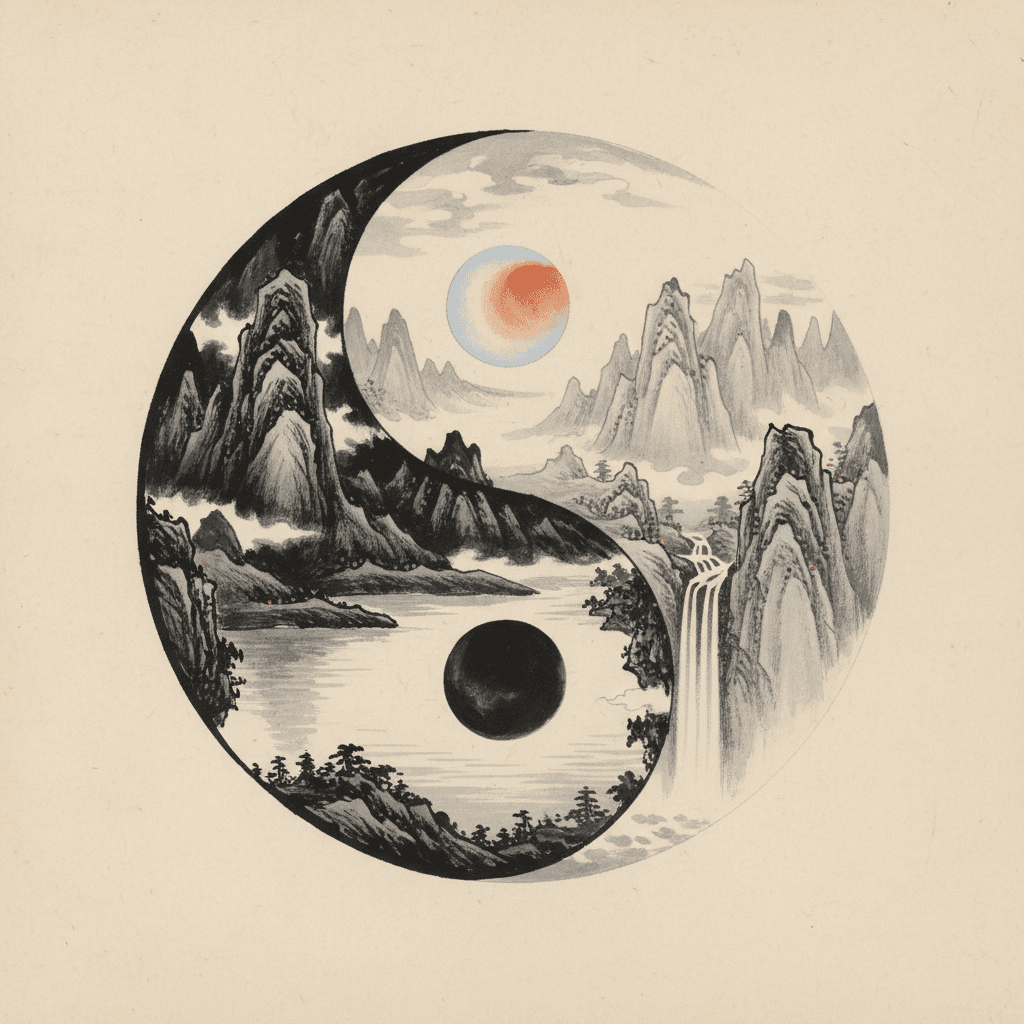
阴阳 · Yin Yang
Yin 和 Yang 代表着两种基本且互补的力量,它们主宰着宇宙中的一切现象,包括人体。在中医中,理解它们的动态平衡对于诊断健康和疾病至关重要。
Yin and Yang (阴阳) are foundational concepts in Traditional Chinese Medicine (TCM), originating from ancient Chinese philosophy. They describe two opposing yet interdependent forces present in all aspects of the universe. This duality helps explain the constant change and balance in nature.
Neither Yin nor Yang can exist without the other; they are always relative. The iconic Taijitu symbol visually represents this, showing the interpenetration and dynamic harmony between the dark (Yin) and light (Yang) aspects, each containing a seed of the other.
Yin is typically associated with darkness, cold, passivity, interiority, downward movement, and substance. It represents the feminine, night, moon, and rest. Attributes like coolness, stillness, and nourishment fall under Yin's domain.
Yang, conversely, is linked to light, warmth, activity, exteriority, upward movement, and function. It embodies the masculine, day, sun, and movement. Characteristics such as heat, dynamism, and transformation are Yang qualities.
The relationship between Yin and Yang is complex, characterized by four main aspects. First, **opposition**: they are contrary forces, like hot and cold. Second, **interdependence**: one cannot exist without the other; day needs night.
Third, **mutual consumption**: they are constantly regulating each other. An excess of one naturally diminishes the other. Fourth, **inter-transformation**: under certain conditions, Yin can transform into Yang, and vice versa, like night turning into day.
In TCM, the human body is viewed as a microcosm of the universe, governed by Yin and Yang. The upper body and exterior are Yang, while the lower body and interior are Yin. Organs are also categorized: solid, storage organs (Zang) are Yin, and hollow, functional organs (Fu) are Yang.
Bodily substances like Blood and Body Fluids are Yin, providing nourishment and moisture. Qi and Shen (Spirit) are Yang, representing activity, warmth, and consciousness. Health depends on the harmonious balance and flow of these Yin and Yang aspects.
Disease in TCM arises from an imbalance of Yin and Yang. This can manifest as an excess or deficiency of either. For example, a Yin deficiency might lead to "empty heat" symptoms like night sweats, while Yang deficiency causes coldness and fatigue.
A TCM practitioner identifies these patterns through pulse and tongue diagnosis, along with symptom analysis. Understanding the specific imbalance guides the selection of appropriate treatment strategies to restore harmony.
Building upon its philosophical roots, Yin and Yang are explicitly defined in classical TCM texts as the fundamental principles governing the universe and human body. The *Suwen* chapter of *Huangdi Neijing* states, "Yin and Yang are the Dao of heaven and earth, the 纲纪 (guiding principles) of all things," establishing them as both cosmic laws and the basis for physiological and pathological processes. This foundational text emphasizes that health is maintained when "Yin is smooth and Yang is secret, then the spirit is regulated" (*Suwen · Shengqi Tongtian Lun*), highlighting the critical importance of their dynamic equilibrium. Furthermore, the *Shanghan Lun* utilizes Yin and Yang as the overarching diagnostic framework, guiding clinicians in differentiating disease patterns, such as distinguishing between "fever with aversion to cold originating from Yang" and "no fever with aversion to cold originating from Yin."
Modern scientific research is increasingly exploring the physiological and molecular underpinnings of Yin and Yang concepts. Studies from institutions like Shanghai University of Traditional Chinese Medicine have linked Yin-Yang imbalance to observable physiological changes, specifically identifying a correlation with autonomic nervous system dysfunction, such as sympathetic and parasympathetic imbalance. This imbalance can even be quantitatively assessed through measures like heart rate variability (Zhou et al., 2019). At a molecular level, research by the China Academy of Chinese Medical Sciences has begun to elucidate the biochemical markers associated with specific Yin-Yang states. For instance, "Yin deficiency" has been found to correlate with mitochondrial dysfunction and elevated oxidative stress markers, such as malondialdehyde (MDA), providing a contemporary lens through which to understand these ancient concepts (*China Journal of Chinese Materia Medica*, 2021).
The practical application of Yin and Yang principles extends deeply into health preservation and lifestyle guidance. Classical texts like the *Suwen* advise aligning daily life with seasonal changes, advocating to "nourish Yang in spring and summer, and nourish Yin in autumn and winter" (*Suwen · Siqi Tiaoshen Dalun*). This translates into practical advice such as consuming warming foods in winter and cooling foods in summer to maintain internal balance. Dietary therapy, rooted in the classification of medicinal substances from texts like *Shennong Ben Cao Jing*, also follows Yin-Yang principles. For example, individuals with Yin deficiency are often recommended foods like lily bulb and tremella to nourish Yin, while those with Yang deficiency might benefit from warming ingredients such as ginger and lamb to tonify Yang. These applications demonstrate the enduring relevance of Yin and Yang in guiding holistic well-being.
The goal of TCM treatment is always to restore the dynamic balance between Yin and Yang. This might involve strengthening deficient aspects or reducing excessive ones. Acupuncture, herbal medicine, dietary therapy, and lifestyle adjustments are common modalities.
For instance, if there's an excess of Yang (heat), cooling herbs or acupuncture points might be used. If Yin is deficient, nourishing substances or methods are employed. The approach is holistic, addressing the root cause of the imbalance.
Yin and Yang (阴阳) are foundational concepts in Traditional Chinese Medicine (TCM), originating from ancient Chinese philosophy. They describe two opposing yet interdependent forces present in all aspects of the universe. This duality helps explain the constant change and balance in nature.
Neither Yin nor Yang can exist without the other; they are always relative. The iconic Taijitu symbol visually represents this, showing the interpenetration and dynamic harmony between the dark (Yin) and light (Yang) aspects, each containing a seed of the other.
Yin is typically associated with darkness, cold, passivity, interiority, downward movement, and substance. It represents the feminine, night, moon, and rest. Attributes like coolness, stillness, and nourishment fall under Yin's domain.
Yang, conversely, is linked to light, warmth, activity, exteriority, upward movement, and function. It embodies the masculine, day, sun, and movement. Characteristics such as heat, dynamism, and transformation are Yang qualities.
The relationship between Yin and Yang is complex, characterized by four main aspects. First, **opposition**: they are contrary forces, like hot and cold. Second, **interdependence**: one cannot exist without the other; day needs night.
Third, **mutual consumption**: they are constantly regulating each other. An excess of one naturally diminishes the other. Fourth, **inter-transformation**: under certain conditions, Yin can transform into Yang, and vice versa, like night turning into day.
In TCM, the human body is viewed as a microcosm of the universe, governed by Yin and Yang. The upper body and exterior are Yang, while the lower body and interior are Yin. Organs are also categorized: solid, storage organs (Zang) are Yin, and hollow, functional organs (Fu) are Yang.
Bodily substances like Blood and Body Fluids are Yin, providing nourishment and moisture. Qi and Shen (Spirit) are Yang, representing activity, warmth, and consciousness. Health depends on the harmonious balance and flow of these Yin and Yang aspects.
Disease in TCM arises from an imbalance of Yin and Yang. This can manifest as an excess or deficiency of either. For example, a Yin deficiency might lead to "empty heat" symptoms like night sweats, while Yang deficiency causes coldness and fatigue.
A TCM practitioner identifies these patterns through pulse and tongue diagnosis, along with symptom analysis. Understanding the specific imbalance guides the selection of appropriate treatment strategies to restore harmony.
Building upon its philosophical roots, Yin and Yang are explicitly defined in classical TCM texts as the fundamental principles governing the universe and human body. The *Suwen* chapter of *Huangdi Neijing* states, "Yin and Yang are the Dao of heaven and earth, the 纲纪 (guiding principles) of all things," establishing them as both cosmic laws and the basis for physiological and pathological processes. This foundational text emphasizes that health is maintained when "Yin is smooth and Yang is secret, then the spirit is regulated" (*Suwen · Shengqi Tongtian Lun*), highlighting the critical importance of their dynamic equilibrium. Furthermore, the *Shanghan Lun* utilizes Yin and Yang as the overarching diagnostic framework, guiding clinicians in differentiating disease patterns, such as distinguishing between "fever with aversion to cold originating from Yang" and "no fever with aversion to cold originating from Yin."
Modern scientific research is increasingly exploring the physiological and molecular underpinnings of Yin and Yang concepts. Studies from institutions like Shanghai University of Traditional Chinese Medicine have linked Yin-Yang imbalance to observable physiological changes, specifically identifying a correlation with autonomic nervous system dysfunction, such as sympathetic and parasympathetic imbalance. This imbalance can even be quantitatively assessed through measures like heart rate variability (Zhou et al., 2019). At a molecular level, research by the China Academy of Chinese Medical Sciences has begun to elucidate the biochemical markers associated with specific Yin-Yang states. For instance, "Yin deficiency" has been found to correlate with mitochondrial dysfunction and elevated oxidative stress markers, such as malondialdehyde (MDA), providing a contemporary lens through which to understand these ancient concepts (*China Journal of Chinese Materia Medica*, 2021).
The practical application of Yin and Yang principles extends deeply into health preservation and lifestyle guidance. Classical texts like the *Suwen* advise aligning daily life with seasonal changes, advocating to "nourish Yang in spring and summer, and nourish Yin in autumn and winter" (*Suwen · Siqi Tiaoshen Dalun*). This translates into practical advice such as consuming warming foods in winter and cooling foods in summer to maintain internal balance. Dietary therapy, rooted in the classification of medicinal substances from texts like *Shennong Ben Cao Jing*, also follows Yin-Yang principles. For example, individuals with Yin deficiency are often recommended foods like lily bulb and tremella to nourish Yin, while those with Yang deficiency might benefit from warming ingredients such as ginger and lamb to tonify Yang. These applications demonstrate the enduring relevance of Yin and Yang in guiding holistic well-being.
The goal of TCM treatment is always to restore the dynamic balance between Yin and Yang. This might involve strengthening deficient aspects or reducing excessive ones. Acupuncture, herbal medicine, dietary therapy, and lifestyle adjustments are common modalities.
For instance, if there's an excess of Yang (heat), cooling herbs or acupuncture points might be used. If Yin is deficient, nourishing substances or methods are employed. The approach is holistic, addressing the root cause of the imbalance.
本信息仅供教育目的,不构成医疗建议。使用任何草药前,请务必咨询合格的医疗从业人员。