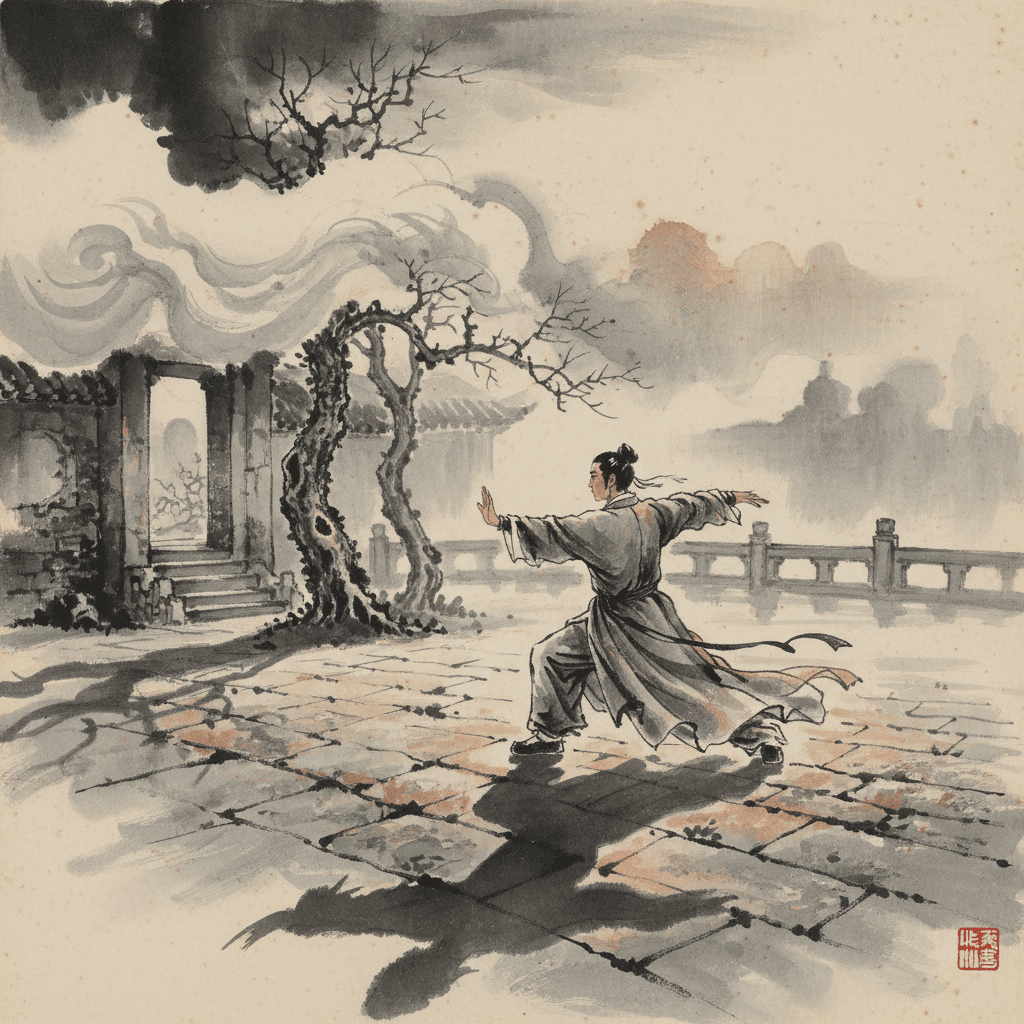
太极 · Tai Ji
Tai Chi,又称 Taijiquan,是一种古老的中国武术,也是一种深奥的身心练习,根植于 Traditional Chinese Medicine (TCM) 的原理。它包括缓慢、柔和、流畅的动作、深呼吸和冥想,旨在培养和平衡身体的生命能量,即 Qi。
Tai Chi, often translated as 'Supreme Ultimate Fist,' originated as a martial art in ancient China. Over centuries, it evolved into a profound health practice, deeply integrated with the philosophical and medical theories of Traditional Chinese Medicine (TCM). It is recognized globally for its gentle, flowing movements and meditative qualities.
At its core, Tai Chi embodies fundamental TCM concepts such as Yin and Yang, and Qi (vital energy). The practice seeks to balance these opposing yet complementary forces within the body, promoting harmony and preventing disease. Its movements are designed to cultivate and guide Qi, fostering overall well-being.
The philosophy of Tai Chi is rooted in the dynamic balance of Yin and Yang. Each movement integrates opposing elements – expansion and contraction, rising and falling, empty and full – to achieve equilibrium. This constant interplay mirrors the natural world and promotes internal harmony within the practitioner.
Central to Tai Chi is the concept of Qi, the vital life force that flows through the body's meridians. Tai Chi movements, combined with deep breathing and mental focus, aim to unblock stagnant Qi and enhance its smooth circulation. This improved flow is believed to nourish organs, strengthen the body, and prevent illness.
From a TCM perspective, Tai Chi offers numerous physical benefits. It enhances balance, flexibility, and muscle strength, particularly in the legs and core. Regular practice improves coordination and reduces the risk of falls, especially beneficial for older adults by strengthening their 'root' and stability.
Mentally and emotionally, Tai Chi is a powerful stress reducer. Its meditative aspect calms the 'Shen' (spirit) and clears the mind, alleviating anxiety and promoting mental clarity. This balance of mind and body is crucial for harmonious Qi flow, preventing emotional stagnation that can impact physical health.
Internally, the gentle, continuous movements are thought to 'massage' the internal organs, aiding digestion, improving cardiovascular function, and enhancing respiratory capacity. This internal cultivation supports the healthy functioning of all organ systems, contributing to overall vitality and longevity.
A typical Tai Chi practice involves a series of slow, deliberate, and continuous movements, often performed in a 'form' or sequence. Emphasis is placed on deep, abdominal breathing synchronized with the movements, and maintaining a relaxed yet focused mental state. The goal is fluidity, not force.
While various styles exist, such as Yang, Chen, and Wu, all share the foundational TCM principles. Each style offers unique nuances in its movements and emphasis, but the core objective of cultivating Qi and achieving mind-body harmony remains consistent. Learning from a qualified instructor is highly recommended.
In TCM, Tai Chi is a prime example of 'Yang Sheng' (nourishing life) – a philosophy focused on preventing illness and promoting health proactively. It's not merely a treatment for existing conditions but a powerful tool for maintaining wellness and strengthening the body's inherent resilience before disease manifests.
Consistent practice helps to fortify the body's 'Wei Qi' (defensive Qi), which acts as an energetic shield against external pathogens like wind, cold, and dampness. By strengthening this protective energy, Tai Chi enhances the body's ability to adapt to environmental changes and resist illness.
Within Traditional Chinese Medicine, Tai Chi is more than just a physical exercise; it is a profound philosophical concept and a core theory guiding health preservation practices, embodying the dynamic balance of Yin and Yang. As articulated in the classical text *Leijing*, 'Tai Chi is the root of Yin and Yang,' underscoring its role as a fundamental principle governing life activities. This deep connection to TCM's theoretical underpinnings is further evident in foundational texts like the *Huangdi Neijing Suwen* (Yellow Emperor's Inner Canon), which states, 'Yin and Yang are the way of heaven and earth, the guiding principles for all things,' aligning perfectly with Tai Chi's emphasis on achieving harmony through these complementary forces. Even without direct mention of 'Tai Chi,' the diagnostic and treatment principles found in works such as Zhang Zhongjing's *Shanghan Lun* (Treatise on Cold Damage) are inherently structured around the restoration of Yin-Yang balance, reflecting the same underlying philosophy.
Modern scientific research increasingly validates these ancient insights into Tai Chi's therapeutic efficacy. A 2021 study from Harvard Medical School, for instance, revealed that Tai Chi can significantly improve heart rate variability (HRV) by regulating the autonomic nervous system, and reduce markers of chronic inflammation, such as Interleukin-6 (IL-6). Furthermore, a comprehensive review of 32 clinical trials published in 2020 by the U.S. National Institutes of Health (NIH) confirmed Tai Chi's notable intervention effects on conditions like hypertension, diabetes, and anxiety disorders (PMID: 32033833), bridging the gap between traditional wisdom and evidence-based medicine.
In practical application within TCM, various Tai Chi and Qigong routines are recommended for health preservation, such as the widely practiced 'Baduanjin' (Eight Brocades) and the 'Twenty-Four Form Tai Chi.' These practices emphasize slow, deliberate movements coordinated with breath regulation to optimize the flow of Qi. A 2019 study by a team at Beijing University of Chinese Medicine introduced 'Tai Chi-Qigong Therapy' (TQMT), demonstrating that just 30 minutes of daily practice significantly enhanced balance in older adults, reducing their risk of falls by 41%, and also improved cognitive function (Frontiers in Aging Neuroscience). Collectively, these findings underscore Tai Chi's integral role as a core practice for cultivating both physical and mental well-being within TCM, with its scientific mechanisms and clinical value continuously being substantiated by modern research.
Tai Chi's low-impact nature and adaptability make it an ideal practice for integration into modern, busy lifestyles. It requires minimal space and equipment, allowing individuals to practice almost anywhere, from parks to living rooms. Its accessibility makes it a sustainable path to long-term health.
As a holistic practice, Tai Chi complements other TCM therapies like acupuncture, herbal medicine, and dietary therapy. By fostering internal balance and promoting Qi flow, it enhances the effectiveness of these treatments, offering a comprehensive approach to health and well-being in contemporary society.
Tai Chi, often translated as 'Supreme Ultimate Fist,' originated as a martial art in ancient China. Over centuries, it evolved into a profound health practice, deeply integrated with the philosophical and medical theories of Traditional Chinese Medicine (TCM). It is recognized globally for its gentle, flowing movements and meditative qualities.
At its core, Tai Chi embodies fundamental TCM concepts such as Yin and Yang, and Qi (vital energy). The practice seeks to balance these opposing yet complementary forces within the body, promoting harmony and preventing disease. Its movements are designed to cultivate and guide Qi, fostering overall well-being.
The philosophy of Tai Chi is rooted in the dynamic balance of Yin and Yang. Each movement integrates opposing elements – expansion and contraction, rising and falling, empty and full – to achieve equilibrium. This constant interplay mirrors the natural world and promotes internal harmony within the practitioner.
Central to Tai Chi is the concept of Qi, the vital life force that flows through the body's meridians. Tai Chi movements, combined with deep breathing and mental focus, aim to unblock stagnant Qi and enhance its smooth circulation. This improved flow is believed to nourish organs, strengthen the body, and prevent illness.
From a TCM perspective, Tai Chi offers numerous physical benefits. It enhances balance, flexibility, and muscle strength, particularly in the legs and core. Regular practice improves coordination and reduces the risk of falls, especially beneficial for older adults by strengthening their 'root' and stability.
Mentally and emotionally, Tai Chi is a powerful stress reducer. Its meditative aspect calms the 'Shen' (spirit) and clears the mind, alleviating anxiety and promoting mental clarity. This balance of mind and body is crucial for harmonious Qi flow, preventing emotional stagnation that can impact physical health.
Internally, the gentle, continuous movements are thought to 'massage' the internal organs, aiding digestion, improving cardiovascular function, and enhancing respiratory capacity. This internal cultivation supports the healthy functioning of all organ systems, contributing to overall vitality and longevity.
A typical Tai Chi practice involves a series of slow, deliberate, and continuous movements, often performed in a 'form' or sequence. Emphasis is placed on deep, abdominal breathing synchronized with the movements, and maintaining a relaxed yet focused mental state. The goal is fluidity, not force.
While various styles exist, such as Yang, Chen, and Wu, all share the foundational TCM principles. Each style offers unique nuances in its movements and emphasis, but the core objective of cultivating Qi and achieving mind-body harmony remains consistent. Learning from a qualified instructor is highly recommended.
In TCM, Tai Chi is a prime example of 'Yang Sheng' (nourishing life) – a philosophy focused on preventing illness and promoting health proactively. It's not merely a treatment for existing conditions but a powerful tool for maintaining wellness and strengthening the body's inherent resilience before disease manifests.
Consistent practice helps to fortify the body's 'Wei Qi' (defensive Qi), which acts as an energetic shield against external pathogens like wind, cold, and dampness. By strengthening this protective energy, Tai Chi enhances the body's ability to adapt to environmental changes and resist illness.
Within Traditional Chinese Medicine, Tai Chi is more than just a physical exercise; it is a profound philosophical concept and a core theory guiding health preservation practices, embodying the dynamic balance of Yin and Yang. As articulated in the classical text *Leijing*, 'Tai Chi is the root of Yin and Yang,' underscoring its role as a fundamental principle governing life activities. This deep connection to TCM's theoretical underpinnings is further evident in foundational texts like the *Huangdi Neijing Suwen* (Yellow Emperor's Inner Canon), which states, 'Yin and Yang are the way of heaven and earth, the guiding principles for all things,' aligning perfectly with Tai Chi's emphasis on achieving harmony through these complementary forces. Even without direct mention of 'Tai Chi,' the diagnostic and treatment principles found in works such as Zhang Zhongjing's *Shanghan Lun* (Treatise on Cold Damage) are inherently structured around the restoration of Yin-Yang balance, reflecting the same underlying philosophy.
Modern scientific research increasingly validates these ancient insights into Tai Chi's therapeutic efficacy. A 2021 study from Harvard Medical School, for instance, revealed that Tai Chi can significantly improve heart rate variability (HRV) by regulating the autonomic nervous system, and reduce markers of chronic inflammation, such as Interleukin-6 (IL-6). Furthermore, a comprehensive review of 32 clinical trials published in 2020 by the U.S. National Institutes of Health (NIH) confirmed Tai Chi's notable intervention effects on conditions like hypertension, diabetes, and anxiety disorders (PMID: 32033833), bridging the gap between traditional wisdom and evidence-based medicine.
In practical application within TCM, various Tai Chi and Qigong routines are recommended for health preservation, such as the widely practiced 'Baduanjin' (Eight Brocades) and the 'Twenty-Four Form Tai Chi.' These practices emphasize slow, deliberate movements coordinated with breath regulation to optimize the flow of Qi. A 2019 study by a team at Beijing University of Chinese Medicine introduced 'Tai Chi-Qigong Therapy' (TQMT), demonstrating that just 30 minutes of daily practice significantly enhanced balance in older adults, reducing their risk of falls by 41%, and also improved cognitive function (Frontiers in Aging Neuroscience). Collectively, these findings underscore Tai Chi's integral role as a core practice for cultivating both physical and mental well-being within TCM, with its scientific mechanisms and clinical value continuously being substantiated by modern research.
Tai Chi's low-impact nature and adaptability make it an ideal practice for integration into modern, busy lifestyles. It requires minimal space and equipment, allowing individuals to practice almost anywhere, from parks to living rooms. Its accessibility makes it a sustainable path to long-term health.
As a holistic practice, Tai Chi complements other TCM therapies like acupuncture, herbal medicine, and dietary therapy. By fostering internal balance and promoting Qi flow, it enhances the effectiveness of these treatments, offering a comprehensive approach to health and well-being in contemporary society.
本信息仅供教育目的,不构成医疗建议。使用任何草药前,请务必咨询合格的医疗从业人员。