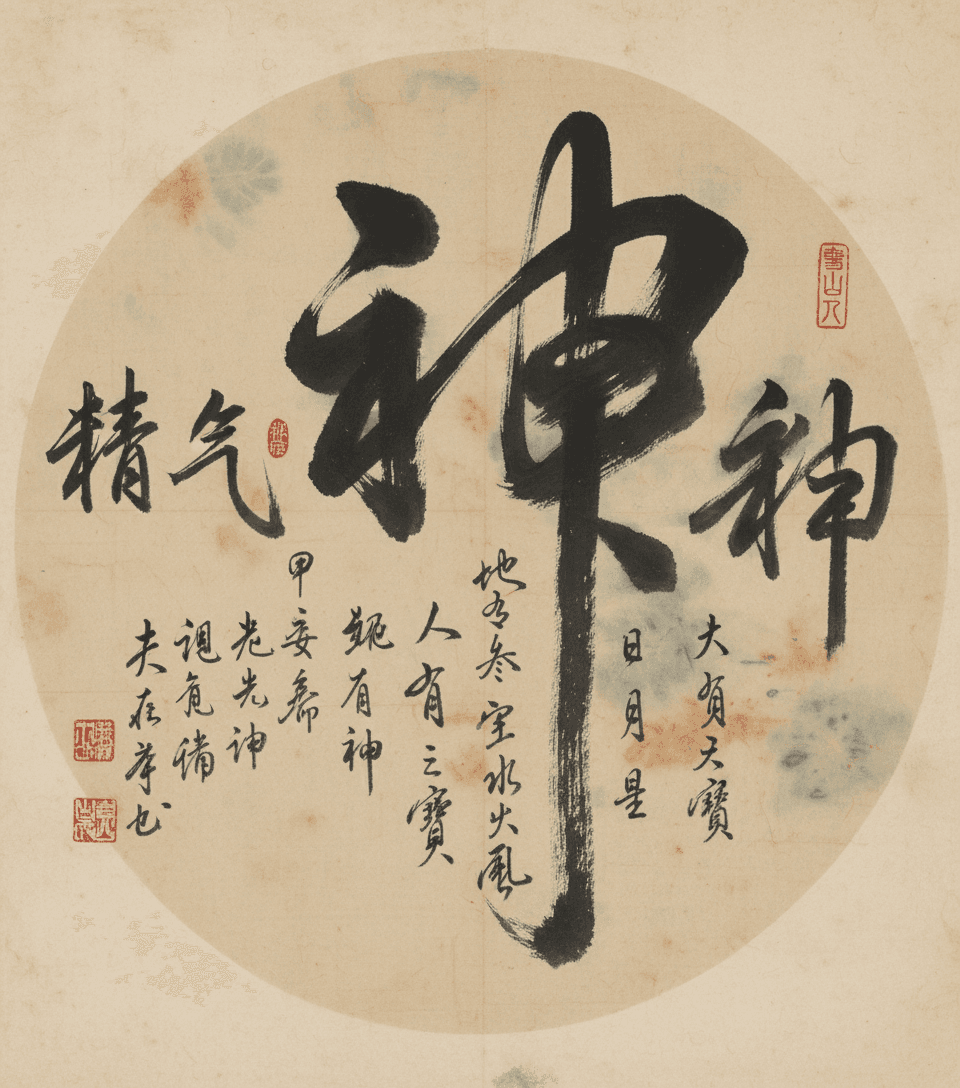
神 · Shen
在中医中,Shen (神) 代表着精神、心智、意识和整体的生命活力。它被认为是人类生命最高层次的体现,也是健康的关键指标。
Shen (神), often translated as "Spirit," is a fundamental and profound concept in Traditional Chinese Medicine (TCM) that extends far beyond a simple spiritual connotation. It encompasses consciousness, thought, emotions, mental clarity, vitality, and the overall energetic radiance of an individual. Considered the highest and most refined form of Qi (life force), Shen is the animating force that gives life its meaning, purpose, and expression. It is the essence of our personality, our capacity for wisdom, compassion, and our ability to connect with the world around us. A vibrant Shen is indicative of robust health, mental acuity, and emotional balance, making its assessment crucial in TCM diagnosis and treatment.
The concept of Shen has deep roots in ancient Chinese philosophy, particularly Daoism and Confucianism, long before its formal integration into medical theory. Early philosophical texts often referred to Shen as a cosmic force, a mysterious and transformative power that animated the universe. With the development of medical thought, notably in foundational texts like the *Huangdi Neijing* (Yellow Emperor's Classic of Internal Medicine, c. 3rd century BCE), Shen began to be understood more specifically in relation to human physiology and psychology. It evolved from a broad, universal principle to a more refined concept representing the human mind, spirit, and consciousness, intrinsically linked to the body's vital substances and organ functions.
In TCM, the Heart is considered the "Emperor" of the body and the primary residence of Shen. The Heart's role is to govern Blood and blood vessels, but its most profound function is to house and stabilize Shen. A strong Heart Qi and abundant Heart Blood are essential for Shen to be well-rooted, allowing for clear thinking, emotional stability, restful sleep, and a vibrant personality. When the Heart is imbalanced, Shen can become restless, leading to symptoms like anxiety, insomnia, palpitations, and poor memory.
Shen is nourished by *Jing* (Essence) and *Blood*. Jing, stored in the Kidneys, provides the fundamental material basis for all life activities, including the generation of Shen. Blood, produced by the Spleen and stored by the Liver, carries Qi and nutrients throughout the body, providing the necessary sustenance for Shen. A deficiency in either Jing or Blood can directly impair Shen, leading to a dull spirit, lack of vitality, and mental fatigue. Shen manifests outwardly through the eyes, which are often called the "windows to the Shen." Bright, clear, and sparkling eyes indicate a strong Shen, while dull, lifeless eyes suggest a depleted or disturbed Shen.
While the Heart houses Shen, all other Zang-Fu (internal organs) play a crucial role in supporting its health and expression:
* **Liver:** Stores Blood, ensures the smooth flow of Qi, and influences emotional regulation (anger, frustration). A stagnant Liver Qi can disturb Shen, leading to irritability and mood swings.
* **Spleen:** Governs transformation and transportation, producing Qi and Blood. It influences thinking, concentration, and memory. Spleen deficiency can lead to excessive worry and mental fogginess.
* **Lung:** Governs Qi and respiration, influencing courage and the ability to let go. Lung imbalances can manifest as grief or sadness affecting Shen.
* **Kidney:** Stores Jing, the root of Yin and Yang, and influences willpower and fear. Strong Kidney Jing provides the foundation for a resilient Shen.
Observing the state of Shen is paramount in TCM diagnosis. A practitioner assesses the patient's overall demeanor, the brightness of their eyes, the clarity of their speech, their emotional responsiveness, and their mental coherence. A patient with a strong Shen, even when physically ill, often has a better prognosis. Conversely, a "Shen-less" presentation—characterized by dull eyes, confused speech, and a lack of responsiveness—indicates a severe depletion of vital energy and a poorer outlook.
TCM treatments for Shen imbalances aim to address the underlying disharmony of Qi, Blood, Jing, and the Zang-Fu organs.
* **Acupuncture:** Specific points on meridians related to the Heart, Liver, Spleen, and Kidneys are used to calm, nourish, or regulate Shen.
* **Herbal Medicine:** Formulas are prescribed to nourish Blood, strengthen Jing, regulate Qi, or calm the spirit, depending on the specific pattern of imbalance.
* **Dietary Therapy:** Foods that nourish Blood (e.g., dark leafy greens, red meat) or calm the spirit (e.g., oats, chamomile) are recommended.
* **Lifestyle Adjustments:** Practices like Qigong, Tai Chi, meditation, adequate sleep, stress reduction techniques, and spending time in nature are vital for cultivating and protecting Shen.
Maintaining a healthy Shen involves conscious effort in daily life. This includes fostering emotional resilience, practicing mindfulness, engaging in creative activities, maintaining healthy relationships, seeking purpose, and ensuring a balanced lifestyle that integrates physical activity, proper nutrition, and sufficient rest.
* **Shen is merely the "soul" or "ghost":** While Shen encompasses spiritual aspects, it is not a separate, disembodied entity like the Western concept of a soul that leaves the body upon death. In TCM, Shen is deeply integrated with the physical body and its physiological functions, manifesting as consciousness and vitality.
* **Shen is only about mental health:** While central to mental and emotional well-being, Shen is inextricably linked to physical health. A strong Shen relies on robust physical health, and conversely, physical ailments can profoundly impact Shen.
* **Shen is a static entity:** Shen is dynamic and constantly influenced by internal factors (Qi, Blood, Jing, organ function) and external factors (environment, lifestyle, emotions). It can be strengthened, weakened, disturbed, or harmonized.
While TCM's concept of Shen is rooted in an ancient energetic framework, modern science offers intriguing parallels. The holistic view of Shen aligns well with the contemporary understanding of the **mind-body connection** and fields like **psychoneuroimmunology**, which studies the interactions between psychological processes, the nervous and immune systems, and overall health.
A healthy, balanced Shen could be correlated with optimal brain function, balanced neurotransmitter activity (e.g., serotonin, dopamine), and a well-regulated nervous system. Disturbances in Shen, manifesting as anxiety or depression, resonate with Western diagnoses of mental health conditions often linked to neurochemical imbalances or chronic stress responses (e.g., HPA axis dysfunction).
The TCM emphasis on cultivating Shen through mindfulness, meditation, and stress reduction finds support in neuroscience research demonstrating the positive effects of these practices on brain plasticity, emotional regulation, and overall well-being. Ultimately, the concept of Shen serves as a comprehensive model for understanding and promoting integrated human health, bridging the gap between physical vitality and mental-spiritual flourishing.
Shen (神), often translated as "Spirit," is a fundamental and profound concept in Traditional Chinese Medicine (TCM) that extends far beyond a simple spiritual connotation. It encompasses consciousness, thought, emotions, mental clarity, vitality, and the overall energetic radiance of an individual. Considered the highest and most refined form of Qi (life force), Shen is the animating force that gives life its meaning, purpose, and expression. It is the essence of our personality, our capacity for wisdom, compassion, and our ability to connect with the world around us. A vibrant Shen is indicative of robust health, mental acuity, and emotional balance, making its assessment crucial in TCM diagnosis and treatment.
The concept of Shen has deep roots in ancient Chinese philosophy, particularly Daoism and Confucianism, long before its formal integration into medical theory. Early philosophical texts often referred to Shen as a cosmic force, a mysterious and transformative power that animated the universe. With the development of medical thought, notably in foundational texts like the *Huangdi Neijing* (Yellow Emperor's Classic of Internal Medicine, c. 3rd century BCE), Shen began to be understood more specifically in relation to human physiology and psychology. It evolved from a broad, universal principle to a more refined concept representing the human mind, spirit, and consciousness, intrinsically linked to the body's vital substances and organ functions.
In TCM, the Heart is considered the "Emperor" of the body and the primary residence of Shen. The Heart's role is to govern Blood and blood vessels, but its most profound function is to house and stabilize Shen. A strong Heart Qi and abundant Heart Blood are essential for Shen to be well-rooted, allowing for clear thinking, emotional stability, restful sleep, and a vibrant personality. When the Heart is imbalanced, Shen can become restless, leading to symptoms like anxiety, insomnia, palpitations, and poor memory.
Shen is nourished by *Jing* (Essence) and *Blood*. Jing, stored in the Kidneys, provides the fundamental material basis for all life activities, including the generation of Shen. Blood, produced by the Spleen and stored by the Liver, carries Qi and nutrients throughout the body, providing the necessary sustenance for Shen. A deficiency in either Jing or Blood can directly impair Shen, leading to a dull spirit, lack of vitality, and mental fatigue. Shen manifests outwardly through the eyes, which are often called the "windows to the Shen." Bright, clear, and sparkling eyes indicate a strong Shen, while dull, lifeless eyes suggest a depleted or disturbed Shen.
While the Heart houses Shen, all other Zang-Fu (internal organs) play a crucial role in supporting its health and expression:
* **Liver:** Stores Blood, ensures the smooth flow of Qi, and influences emotional regulation (anger, frustration). A stagnant Liver Qi can disturb Shen, leading to irritability and mood swings.
* **Spleen:** Governs transformation and transportation, producing Qi and Blood. It influences thinking, concentration, and memory. Spleen deficiency can lead to excessive worry and mental fogginess.
* **Lung:** Governs Qi and respiration, influencing courage and the ability to let go. Lung imbalances can manifest as grief or sadness affecting Shen.
* **Kidney:** Stores Jing, the root of Yin and Yang, and influences willpower and fear. Strong Kidney Jing provides the foundation for a resilient Shen.
Observing the state of Shen is paramount in TCM diagnosis. A practitioner assesses the patient's overall demeanor, the brightness of their eyes, the clarity of their speech, their emotional responsiveness, and their mental coherence. A patient with a strong Shen, even when physically ill, often has a better prognosis. Conversely, a "Shen-less" presentation—characterized by dull eyes, confused speech, and a lack of responsiveness—indicates a severe depletion of vital energy and a poorer outlook.
TCM treatments for Shen imbalances aim to address the underlying disharmony of Qi, Blood, Jing, and the Zang-Fu organs.
* **Acupuncture:** Specific points on meridians related to the Heart, Liver, Spleen, and Kidneys are used to calm, nourish, or regulate Shen.
* **Herbal Medicine:** Formulas are prescribed to nourish Blood, strengthen Jing, regulate Qi, or calm the spirit, depending on the specific pattern of imbalance.
* **Dietary Therapy:** Foods that nourish Blood (e.g., dark leafy greens, red meat) or calm the spirit (e.g., oats, chamomile) are recommended.
* **Lifestyle Adjustments:** Practices like Qigong, Tai Chi, meditation, adequate sleep, stress reduction techniques, and spending time in nature are vital for cultivating and protecting Shen.
Maintaining a healthy Shen involves conscious effort in daily life. This includes fostering emotional resilience, practicing mindfulness, engaging in creative activities, maintaining healthy relationships, seeking purpose, and ensuring a balanced lifestyle that integrates physical activity, proper nutrition, and sufficient rest.
* **Shen is merely the "soul" or "ghost":** While Shen encompasses spiritual aspects, it is not a separate, disembodied entity like the Western concept of a soul that leaves the body upon death. In TCM, Shen is deeply integrated with the physical body and its physiological functions, manifesting as consciousness and vitality.
* **Shen is only about mental health:** While central to mental and emotional well-being, Shen is inextricably linked to physical health. A strong Shen relies on robust physical health, and conversely, physical ailments can profoundly impact Shen.
* **Shen is a static entity:** Shen is dynamic and constantly influenced by internal factors (Qi, Blood, Jing, organ function) and external factors (environment, lifestyle, emotions). It can be strengthened, weakened, disturbed, or harmonized.
While TCM's concept of Shen is rooted in an ancient energetic framework, modern science offers intriguing parallels. The holistic view of Shen aligns well with the contemporary understanding of the **mind-body connection** and fields like **psychoneuroimmunology**, which studies the interactions between psychological processes, the nervous and immune systems, and overall health.
A healthy, balanced Shen could be correlated with optimal brain function, balanced neurotransmitter activity (e.g., serotonin, dopamine), and a well-regulated nervous system. Disturbances in Shen, manifesting as anxiety or depression, resonate with Western diagnoses of mental health conditions often linked to neurochemical imbalances or chronic stress responses (e.g., HPA axis dysfunction).
The TCM emphasis on cultivating Shen through mindfulness, meditation, and stress reduction finds support in neuroscience research demonstrating the positive effects of these practices on brain plasticity, emotional regulation, and overall well-being. Ultimately, the concept of Shen serves as a comprehensive model for understanding and promoting integrated human health, bridging the gap between physical vitality and mental-spiritual flourishing.
本信息仅供教育目的,不构成医疗建议。使用任何草药前,请务必咨询合格的医疗从业人员。