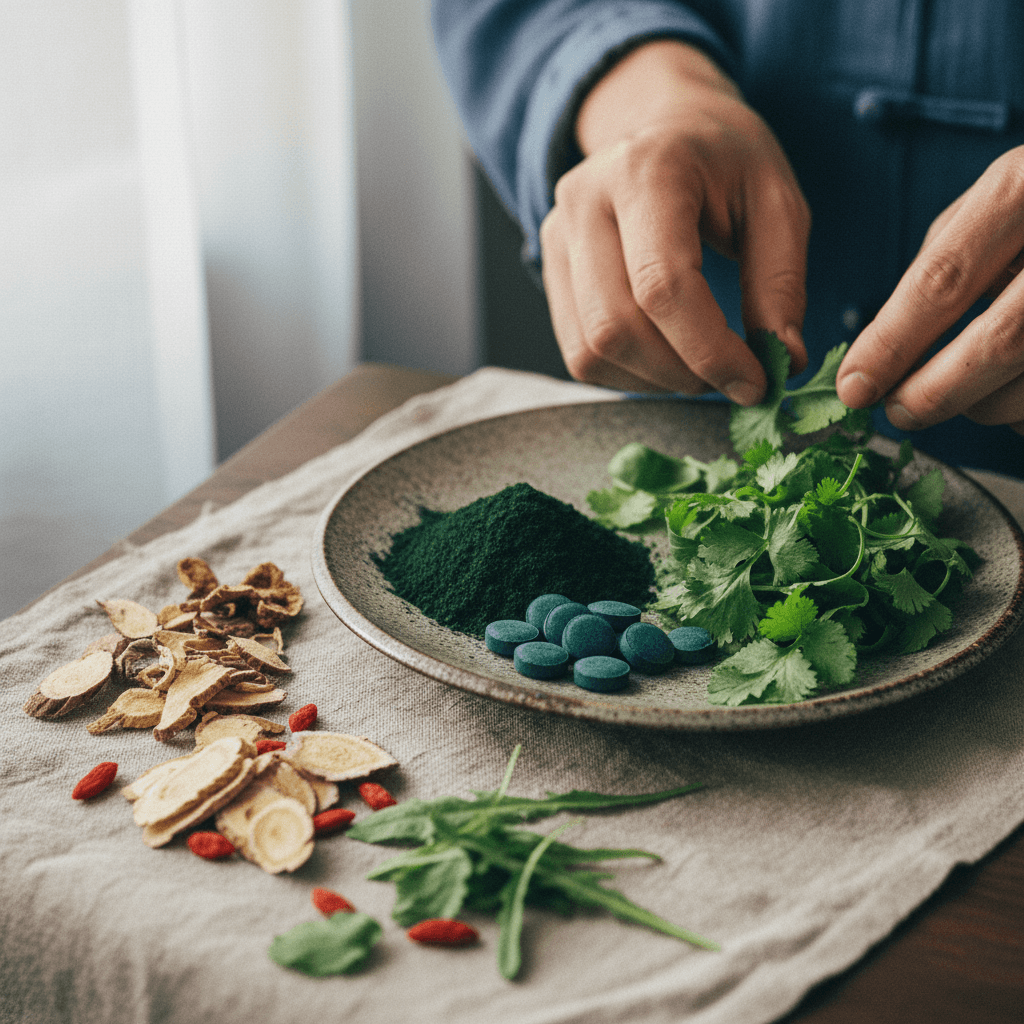
The whispers of ancient wisdom often hold profound truths, yet in our modern world, these truths sometimes collide with new challenges. Consider the concept of Zhòng Jīn Shǔ Pái Dú (重金属排毒)—Heavy Metal Detoxification in Traditional Chinese Medicine (TCM). It’s a term that conjures images of deep cleansing and purification, a natural antidote to the environmental toxins that increasingly permeate our lives.
But the story of heavy metals in TCM is far more complex than a simple quest for purity. While Zhòng Jīn Shǔ Pái Dú, or 'Heavy Metal Detoxification,' is not a single herb with a Latin name, it refers to a vital category of traditional Chinese medicine strategies and specific herbs aimed at mitigating the impact of toxins.
Ironically, while some TCM practices historically utilized mineral compounds, modern research now highlights the critical concern of heavy metal contamination within herbal sources themselves. This presents a fascinating paradox we must address with both reverence for tradition and rigorous scientific scrutiny.
I often see patients like Sarah, a busy executive who came to me with baffling fatigue and brain fog. She’d self-diagnosed heavy metal toxicity from online research and was experimenting with various 'detox smoothies.' My first step was always to ground her in reality: to seek proper medical testing and discuss the profound wisdom of TCM for supporting her body's natural cleansing, while also educating her about the very real risks of contamination in unregulated herbal products.
It’s about balance, always, and informed choices.
What Makes It Special: The TCM Perspective on Detoxification
In Traditional Chinese Medicine, the concept of Pái Dú (排毒), or 'detoxification,' is deeply ingrained. It’s not about quick fixes but about gently restoring harmony and supporting the body's inherent capacity to cleanse itself. Rather than targeting specific chemicals, TCM focuses on strengthening the organs responsible for transformation and elimination: primarily the Liver, Kidneys, and Spleen.
The Liver, in TCM, is responsible for the smooth flow of Qi (energy) and blood, and it oversees detoxification. If the Liver Qi is stagnant or overburdened, toxins can accumulate. The Kidneys are the body's 'root of life,' governing water metabolism and filtering waste. A robust Kidney essence (Jing) is vital for overall vitality and the ability to expel impurities.
The Spleen and Stomach, meanwhile, are central to digestion and nutrient absorption, ensuring that the body can process what it needs and eliminate what it doesn't, preventing the accumulation of 'dampness' or 'phlegm'—metabolic waste products that can be a breeding ground for toxicity.
This holistic framework means that a TCM approach to detoxification might involve a combination of herbs, acupuncture, and dietary adjustments designed to clear heat, drain dampness, invigorate blood, and support organ function. One excellent example of an herb deeply intertwined with detoxification is Tǔ Fú Líng (土茯苓), or Smilax glabra. In TCM terms, Tǔ Fú Líng is sweet and bland in flavor, with a neutral nature. It primarily targets the Liver and Stomach meridians.
Its traditional actions include dispelling dampness, detoxifying, and benefiting the joints. This aligns beautifully with the classical text Bencao Gangmu (《本草纲目》), which states: “Tǔ Fú Líng, zhǔ zhì shí zhōng dú, lì jīn gǔ tòng, qiáng jué yīn zhī qì, qù shī rè” (土茯苓,主治食中毒,利筋骨痛,强厥阴之气,去湿热)—meaning, it primarily addresses food poisoning, relieves joint pain, strengthens the Qi of the Liver meridian, and clears damp-heat. This traditional understanding directly connects to its modern application in addressing certain toxic exposures.
Top Benefits: Supporting Your Body's Detox Pathways
For Supporting the Liver and Kidneys
In TCM, a healthy Liver and Kidney system is foundational for detoxification. Herbs used in Zhòng Jīn Shǔ Pái Dú strategies are selected to nourish these organs, ensuring they can efficiently process and eliminate waste. The Liver metabolizes toxins, while the Kidneys filter them out. Tǔ Fú Líng, for instance, supports both by clearing dampness and heat that can burden these organs.
From a functional medicine perspective, this aligns with supporting phase I and phase II liver detoxification pathways and ensuring optimal renal function, crucial for excreting heavy metals and other xenobiotics.
For Clearing Dampness and Heat
Many environmental toxins and metabolic byproducts are seen in TCM as accumulating 'dampness' and 'heat' in the body. These pathological factors can manifest as inflammation, skin issues, digestive disturbances, and a general feeling of sluggishness. Herbs with a draining or cooling nature, like Tǔ Fú Líng, are traditionally employed to resolve dampness and clear heat, thereby reducing the overall toxic burden and inflammatory responses.
This concept resonates with Western functional medicine's focus on reducing systemic inflammation and supporting healthy inflammatory responses.
For Enhancing Elimination
Effective detoxification relies on efficient elimination through the bowels, kidneys, and skin. TCM detoxification strategies often include herbs that promote healthy bowel movements, increase urination, and support the body's ability to sweat. By ensuring these channels are clear and functioning optimally, the body can more effectively excrete toxins. This is a fundamental principle that functional medicine practitioners like Dr. Andrew Weil at the University of Arizona also emphasize: supporting the body's natural elimination routes is key to health.
Without proper elimination, toxins can be reabsorbed, creating a vicious cycle.
What the Science Says: A Critical Look at Heavy Metal Detoxification
The scientific discourse around heavy metal detoxification in TCM is complex, often highlighting a crucial paradox. On one hand, modern research validates some traditional uses for detoxification. On the other, it reveals significant safety concerns about heavy metal contamination within TCM materials themselves.
A comprehensive systematic review by Chen et al. in 2020 analyzed 296 research reports and found widespread heavy metal contamination in Traditional Chinese Medicinal Materials (TCMM). Herba-type materials, the plant parts commonly used, showed the highest risk, with lead (Pb) being the most common contaminant. Alarmingly, lead levels exceeded safety standards by up to 37.67% in some cases. This isn't an isolated finding.
A 2014 clinical review published in Yonsei Medical Journal, led by researchers Hyunah Kim (Sookmyung Women's University, Korea), Peter J Hughes (Samford University, USA), and Emily M Hawes (University of North Carolina School of Medicine, USA), identified 9 case reports involving 22 serious heavy metal toxicities, primarily lead, directly linked to TCM usage in Korea. They reported lead intake from some TCMs was 3-4000 times higher than recommended amounts. These studies underscore a critical safety issue that cannot be ignored.
The source of this contamination is multi-faceted, as highlighted in a 2024 overview in Science of The Total Environment (PMID: 39244068). Heavy metal accumulation in TCMs is influenced by the growth ecosystem, anthropogenic factors like pollution, specific plant varieties, and even the medicinal part used. Lead (Pb), copper (Cu), and chromium (Cr) are major cumulative elements in botanicals, while arsenic (As) and copper (Cu) are often found in mineral or animal-derived medicines. This is why careful sourcing is absolutely non-negotiable.
Despite these concerns, research also explores the detoxifying potential of specific TCM herbs. For example, a 2022 study in Chinese Traditional and Herbal Drugs (《中草药》第53卷第1期) demonstrated that the ethyl acetate fraction of Tǔ Fú Líng (Smilax glabra) significantly reduced lead content in the blood, liver, and kidneys of lead-poisoned mice. The acute toxicity experiment showed a 45.7% reduction in lead content in the ethyl acetate group (P<0.05).
This provides a modern scientific lens on Tǔ Fú Líng's traditional detoxifying reputation. Furthermore, innovative processing methods are being investigated. Li Qiong et al. (2005) published in Chemical Bulletin (《化学通报》) on how supercritical CO2 extraction technology can effectively remove heavy metals from TCM, achieving lead and cadmium removal rates of 68.2% and 72.5% respectively. This shows promise for safer TCM products.
The traditional TCM practice of Pao Zhi (炮制), or herbal processing, also plays a critical role. Wei Lixin (2021) in China Journal of Chinese Materia Medica (《中国中药杂志》) highlighted that the toxicity of heavy metal-containing TCMs is closely related to the chemical form of the compound and the processing techniques. For example, different valency states of arsenic compounds can have 3-8 times different toxicity levels, underscoring the importance of proper preparation.
This reminds us that ancient wisdom often contains sophisticated insights into material science, even if the language was different.
Historically, some mineral-based TCMs, like Dan Sha (Cinnabar, or mercury sulfide), were prized. Shennong Bencao Jing (《神农本草经》) states: “Dan Sha, wèi gān wēi hán, zhǔ shēn tǐ wǔ zàng bǎi bìng, shā jīng mèi xié è guǐ, jiǔ fú tōng shén míng bù lǎo” (丹砂,味甘微寒,主身体五脏百病,杀精魅邪恶鬼,久服通神明不老)—describing it as sweet and slightly cold, treating various ailments, dispelling evil, and promoting immortality with long-term use.
Today, we know mercury is highly toxic, and Dan Sha is largely restricted or avoided in modern clinical practice due to its mercury content. This illustrates the evolution of our understanding as science advances.
How to Approach Heavy Metal Detoxification in TCM
Given the complexities and safety concerns, approaching Zhòng Jīn Shǔ Pái Dú with TCM requires careful, professional guidance. This is not a DIY project. Your first step should always be a thorough consultation with a licensed TCM practitioner who understands both traditional principles and modern scientific evidence, and who collaborates with your Western medical doctor if you have diagnosed heavy metal toxicity.
A qualified practitioner will assess your unique constitution and imbalances according to TCM diagnostics (pulse, tongue, symptoms) to formulate a personalized strategy. This typically involves a combination of herbs, dietary adjustments, and lifestyle recommendations. For specific herbs like Tǔ Fú Líng, the dosage and preparation will be tailored to your condition.
If Tǔ Fú Líng is part of your prescribed protocol, it is most commonly prepared as a decoction. For example, 15-30 grams of dried Tǔ Fú Líng slices (as prescribed by your practitioner) might be simmered in 3-4 cups of water for 30-45 minutes. The strained liquid is then consumed, typically 1-2 times daily. For powdered or capsulated formulas, precise instructions from your practitioner are essential.
Crucially, ensure all herbs are sourced from reputable suppliers who provide third-party heavy metal testing. This is the single most important step to prevent inadvertently increasing your heavy metal burden.
Safety & Who Should Avoid
Heavy Metal Contamination in TCM Herbs: This is the most critical safety concern. As scientific studies have repeatedly shown, many Traditional Chinese Medicinal Materials can be contaminated with lead, mercury, cadmium, and arsenic, sometimes at dangerously high levels. Always demand third-party testing certificates for any TCM herbs you consume. If a product cannot provide this, do not use it.
Unsupervised Chelation and Potent Detox Protocols: Aggressive heavy metal detoxification protocols, especially pharmaceutical chelation, must be medically supervised due to potential severe side effects, including kidney damage, electrolyte imbalances, and depletion of essential minerals. Even herbal protocols, if potent or misused, can cause adverse reactions. Never attempt self-treatment for diagnosed heavy metal toxicity.
Pregnancy and Breastfeeding: Heavy metal detoxification strategies are generally contraindicated during pregnancy and breastfeeding. The body's physiological processes are highly sensitive during these periods, and mobilizing toxins could potentially harm the developing fetus or infant. Always consult your obstetrician or pediatrician before considering any detox program.
Severe Kidney or Liver Disease: Individuals with pre-existing severe kidney or liver conditions should approach any detoxification protocol with extreme caution and only under strict medical supervision. These organs are primary pathways for toxin elimination, and an impaired function could exacerbate health issues or lead to further complications.
Drug Interactions: Certain herbs used in TCM detoxification may interact with pharmaceutical medications. For example, some detoxifying herbs can affect liver enzyme activity, potentially altering the metabolism of drugs like blood thinners (e.g., Warfarin), heart medications, or immunosuppressants. Always disclose all medications and supplements to your healthcare providers.
Closing Thoughts
The journey of understanding Zhòng Jīn Shǔ Pái Dú in TCM is a microcosm of integrative medicine itself—a constant dialogue between ancient wisdom and modern science. We embrace the holistic principles that guide our body's innate ability to heal and cleanse, while rigorously scrutinizing the safety and efficacy of our methods through the lens of evidence.
My hope is that this deeper understanding empowers you to approach your health with informed curiosity, seeking out qualified practitioners who honor both traditions, ensuring that the path to wellness is both wise and safe. Your body is a masterpiece, and it deserves nothing less.
References
- Kim, H., Hughes, P. J., & Hawes, E. M. (2014). Lead poisoning from Traditional Chinese Medicine: A clinical review of studies in Korea. Yonsei Medical Journal, 55(4), 856-863.
- PMID: 39244068. (2024). Heavy metal accumulation in traditional Chinese medicines: A comprehensive overview. Science of The Total Environment.
- 土茯苓醋酸乙酯部位可显著降低铅中毒小鼠血液及肝肾铅含量. 《中草药》第53卷第1期 (2022).
- 魏立新. (2021). 含重金属中药毒性与化合物形态及炮制工艺密切相关. 《中国中药杂志》.