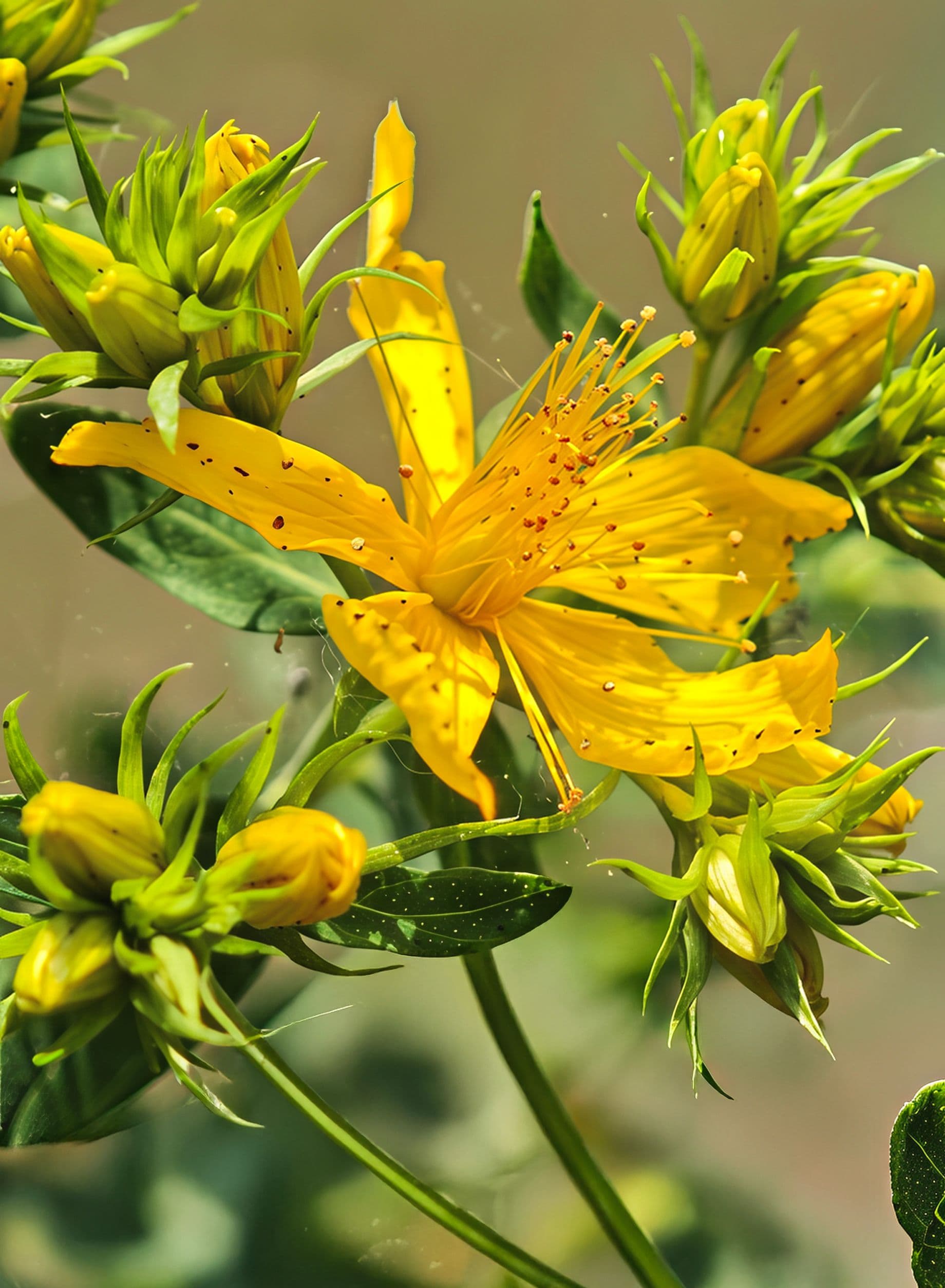
st johns wort
Discover St. John's Wort, an herb revered in both traditional Chinese and Western medicine for its mood-balancing properties, while understanding its crucial safety considerations.
For a traditional tea, steep 3-9 grams of dried St. John's Wort (Guan Ye Lian Qiao) herb in hot water for 10-15 minutes. Strain and drink. This method is less common for mood support as it's harder to standardize the active compounds.
The most common and clinically studied form. Look for standardized extracts containing 0.2-0.3% hypericin or 2-5% hyperforin. Typical dosages in studies range from 300 mg taken three times daily, for a total of 900 mg per day. Always follow the manufacturer's instructions or, ideally, a healthcare professional's specific guidance.
St. John's Wort oil, infused with the herb's constituents, can be applied externally for minor skin irritations, nerve pain, or muscle soreness. Prepare by infusing dried flowers in a carrier oil (like olive or almond) for several weeks in sunlight, then strain. Apply a small amount to the affected area. Be mindful of potential photosensitivity even with topical application.
For a traditional tea, steep 3-9 grams of dried St. John's Wort (Guan Ye Lian Qiao) herb in hot water for 10-15 minutes. Strain and drink. This method is less common for mood support as it's harder to standardize the active compounds.
The most common and clinically studied form. Look for standardized extracts containing 0.2-0.3% hypericin or 2-5% hyperforin. Typical dosages in studies range from 300 mg taken three times daily, for a total of 900 mg per day. Always follow the manufacturer's instructions or, ideally, a healthcare professional's specific guidance.
St. John's Wort oil, infused with the herb's constituents, can be applied externally for minor skin irritations, nerve pain, or muscle soreness. Prepare by infusing dried flowers in a carrier oil (like olive or almond) for several weeks in sunlight, then strain. Apply a small amount to the affected area. Be mindful of potential photosensitivity even with topical application.
St. John's Wort has strong clinical evidence for its efficacy in treating mild to moderate depression, showing comparable effects to some conventional antidepressants and superior outcomes to placebo. However, this efficacy is balanced by significant and well-documented drug interaction concerns, primarily due to its induction of liver enzymes.
Strong — Multiple RCTs
St. John's Wort has strong clinical evidence for its efficacy in treating mild to moderate depression, showing comparable effects to some conventional antidepressants and superior outcomes to placebo. However, this efficacy is balanced by significant and well-documented drug interaction concerns, primarily due to its induction of liver enzymes.
Strong — Multiple RCTs
Insufficient Data
Insufficient Data
Imagine a vibrant yellow bloom, almost glowing against the summer sun, its petals dotted with tiny, translucent glands that, when crushed, release a reddish-purple liquid. This striking plant is St. John's Wort, an herb with a history as rich and complex as its vibrant appearance. For centuries, it has been celebrated across diverse cultures, from ancient Greece to traditional Chinese medicine, for its profound impact on human well-being.
Modern science has taken notice, too, making it one of the most extensively studied herbal remedies for mood support.
As an integrative physician, I often see patients grappling with the ebb and flow of their emotional landscape. They seek solace, clarity, and a gentle lift, often wondering if nature holds an answer. This is where St. John's Wort often enters the conversation. St.
John's Wort (Hypericum perforatum), also known as Qian Ceng Lou or Guan Ye Lian Qiao in Chinese medicine, is an antidepressant herb used in both traditional and modern practices primarily for its neurological effects, particularly in managing mood imbalances. My mission is to help people understand how ancient wisdom, like that found in Traditional Chinese Medicine (TCM), can illuminate our understanding of modern health challenges, and St. John's Wort is a perfect example of this fascinating intersection.
Beyond its Western antidepressant reputation, St. John's Wort holds a unique, yet often overlooked, place in Traditional Chinese Medicine. Discover how this powerful herb is viewed through a TCM lens, its historical applications, and the critical considerations for integrating it into a holistic health approach. It’s a journey that asks us to respect both its therapeutic potential and its formidable power.
In TCM, Hypericum perforatum, known as Guan Ye Lian Qiao or Qian Ceng Lou, is characterized by its energetic properties. The 中华本草 (Chinese Materia Medica) describes it as having a xing ping (neutral temperature) and wei xinku se (spicy, bitter, astringent flavor). This combination suggests it can move, clear, and consolidate.
Its primary impact in TCM is on the Liver and Heart meridians. The Liver, in TCM, is responsible for the smooth flow of Qi (life force energy) throughout the body, including our emotions. When Liver Qi stagnates, we often experience irritability, frustration, or a feeling of being 'stuck' emotionally – symptoms that can mirror aspects of modern depression or anxiety. St.
John's Wort, with its bitter and spicy nature, helps to move this stagnant Liver Qi, promoting a smoother emotional flow.
The Heart meridian, on the other hand, houses the Shen (spirit or mind). When the Shen is disturbed—perhaps by prolonged stress, emotional upset, or an imbalance in Qi and Blood—it can manifest as insomnia, anxiety, or an inability to find peace. St. John's Wort's calming effect on the Shen is invaluable here. It’s like a gentle hand guiding a restless mind towards quietude.
One of my patients, Sarah, found that after incorporating Guan Ye Lian Qiao into her regimen, alongside dietary changes to support her Liver, she felt a subtle but profound shift. "It wasn't a sudden cure," she told me, "but the constant hum of anxiety in my chest finally quieted down. I could breathe again.
Beyond its emotional reach, classical texts also highlight its physical uses. The 本草纲目拾遗 (Compendium of Materia Medica Supplement) notes: 「千层楼,一名赶山鞭,治吐血不止,敷金疮,消肿毒」 (Qian Ceng Lou, also known as Gan Shan Bian, treats incessant vomiting of blood, applied to metal wounds, reduces swelling and toxicity). This points to its traditional application for staunching bleeding and reducing inflammation, showing a broader historical appreciation for its healing capabilities beyond just mental well-being.
Many of us experience periods of feeling low, stressed, or emotionally agitated. In TCM, this often aligns with Liver Qi stagnation or a disturbed Heart Shen. St. John's Wort's ability to shu gan jie yu (soothe the Liver and relieve constraint) and an shen (calm the spirit) makes it a valuable herb for restoring emotional equilibrium. Modern research supports this traditional wisdom. A comprehensive meta-analysis by E. Apaydin and colleagues in BMC Complementary and Alternative Medicine (2016) found that St.
John's Wort monotherapy for mild and moderate depression was superior to placebo and similarly effective as standard antidepressant medication, with fewer adverse events. This aligns perfectly with the TCM understanding of gently restoring balance rather than forcing a change.
Beyond its famed mood effects, St. John's Wort has a long history of use for physical ailments. In TCM, its ability to huo xue tong luo (invigorate blood and unblock channels) and qing re jie du (clear heat and resolve toxicity) speaks to its traditional use for injuries, swelling, and even minor nerve pain. The 本草纲目拾遗 mentions its use for jin chuang (metal wounds) and xiao zhong du (reducing swelling and toxicity). Modern research, as highlighted by M.
Nobakht and colleagues in Iran J Basic Med Sci (2022), notes its traditional uses in Chinese, Greek, and Islamic medicine for antidepressant, wound-healing, and antibacterial purposes. This convergence of traditional and modern understanding underscores its versatility in promoting physical recovery and comfort.
Restless nights are often a symptom of an overactive mind, or in TCM terms, a disturbed Heart Shen. If your mind races with anxieties or persistent thoughts, it can be incredibly difficult to drift off to sleep. Because St. John's Wort helps to calm the Shen and soothe the Liver Qi, it indirectly supports healthy sleep patterns.
It's not a sedative in the conventional sense; rather, it addresses the underlying emotional imbalances that often disrupt our ability to relax and find restful sleep. By fostering a more balanced emotional state during the day, it paves the way for a more peaceful night.
The scientific community has rigorously investigated St. John's Wort, identifying several key active compounds responsible for its effects. The primary players are hypericin and, perhaps even more significantly, hyperforin. Research by 传娟娟等 in 西北药学杂志 (2016) and 吕晨等 in 新青年麻醉论坛 (2024) elaborates on its chemical composition, noting flavonoids (around 9.25%) and phloroglucinol derivatives, with hyperforin content ranging from 0.815% to 7.284%, and hypericin from 0.02% to 0.087%.
The primary mechanism by which St. John's Wort exerts its antidepressant effects is through the inhibition of monoamine neurotransmitter reuptake. This means it helps keep serotonin (5-HT), dopamine (DA), and norepinephrine (NA) active in the brain for longer, similar to how many conventional antidepressants work. This action helps improve mood and reduce anxiety. Clinical studies, like those reviewed by 吕琼琼等 in 国际神经精神科学杂志 (2012), consistently show that St.
John's Wort is as effective as selective serotonin reuptake inhibitors (SSRIs) for mild to moderate depression, with comparable reductions in HAMD (Hamilton Depression Rating Scale) scores, often with a more favorable side effect profile.
However, the scientific community has also unearthed critical safety information. A. A. Izzo and colleagues, reporting in the British Journal of Clinical Pharmacology (2005), highlighted that high-dose hyperforin St. John's Wort extracts are potent inducers of the CYP3A enzyme. This enzyme system is crucial for metabolizing a vast array of medications in the liver. This induction leads to significant drug interactions, which means St. John's Wort can dramatically reduce the effectiveness of many vital pharmaceuticals.
This is not merely a caution; it is a serious clinical concern that underscores the need for professional guidance when considering this herb.
Navigating the practical application of St. John's Wort requires precision, especially given its potency. While traditionally, Guan Ye Lian Qiao might have been used in decoctions, modern usage, particularly for mood support, tends towards standardized extracts for consistent dosing.
For mood disorders, this is the most common and clinically studied form. Look for products standardized to specific levels of hypericin (typically 0.2% to 0.3%) or hyperforin (typically 2% to 5%). A common dosage used in research is 300 mg of a standardized extract, taken three times daily, totaling 900 mg per day. However, it is paramount to follow the specific instructions on the product label and, more importantly, the guidance of an integrative medicine physician or herbalist.
Self-dosing with such a powerful herb is not advised.
While less precise for mood disorders, dried St. John's Wort can be prepared as a tea. Steep 3-9 grams of dried herb in hot water for 10-15 minutes. This method is often used for its more general tonic properties or for topical applications, but achieving consistent therapeutic levels of active compounds for mood support is challenging. Always source high-quality, organic dried herbs from reputable suppliers.
St. John's Wort infused oil is a traditional remedy for minor skin irritations, nerve pain, and muscle soreness. To make it, infuse dried flowers in a carrier oil like olive or almond oil for several weeks in a sunny spot, then strain. Apply a small amount to the affected area. Remember, topical application can still lead to photosensitivity, so use with caution, especially before sun exposure.
While St. John's Wort offers promising benefits, its safety profile demands utmost respect and careful consideration. This is not an herb to take lightly or self-prescribe, especially if you are on any other medications or have underlying health conditions.
This is the most critical warning. St. John's Wort can weaken the effects of a vast array of critically important medicines. You MUST talk with your healthcare provider before using St. John's Wort if you take any type of medicine. Key interactions include, but are not limited to:
Some antidepressants, including amitriptyline and bupropion, and potentially SSRIs, can lead to serotonin syndrome.
Birth control pills, reducing their effectiveness and increasing the risk of unintended pregnancy.
Cyclosporine, used to prevent organ rejection, can have its effects dangerously diminished.
Some drugs used to prevent seizures, including phenytoin and carbamazepine.
Some heart medications, including digoxin and ivabradine.
Some HIV drugs, including indinavir and nevirapine.
Some cancer medications, including irinotecan, imatinib, and docetaxel.
Warfarin, an anticoagulant (blood thinner), increasing the risk of blood clots.
Certain statins, including simvastatin.
Tyramine-rich foods (e.g., aged cheeses) might interact, though evidence is weaker.
Mania and Hypomania: Although evidence is weak, cases have been reported, especially in individuals taking other antidepressants or with underlying psychiatric disorders like bipolar disorder. St. John's Wort is not suitable for bipolar disorder.
Photosensitivity: Oral use or topical application can cause severe skin reactions after sun exposure. Use sunscreen and protective clothing.
Pregnancy and Breastfeeding: Avoid St. John’s Wort during pregnancy due to potential increased risk of birth defects. Avoid during breastfeeding as it may affect the infant.
Other Side Effects: Can include diarrhea, dizziness, trouble sleeping, restlessness, and skin tingling. Older individuals may be more susceptible to certain effects.
St. John's Wort, or Guan Ye Lian Qiao, truly embodies the power and paradox of herbal medicine. It stands as a testament to nature’s profound ability to influence our deepest emotional states, recognized across millennia and validated by contemporary science. Yet, it simultaneously serves as a stark reminder that 'natural' does not equate to 'harmless.'
My practice is built on the belief that true healing comes from understanding the whole person – their unique constitution, their lifestyle, and their emotional landscape – and integrating the best of both ancient wisdom and modern evidence. St. John's Wort, when used thoughtfully and under expert guidance, can be a powerful ally on the path to emotional well-being. But its power demands respect, a keen understanding of its interactions, and a commitment to personalized, evidence-based care.
It’s about cultivating balance, not just suppressing symptoms, and always with an eye toward safety.
Imagine a vibrant yellow bloom, almost glowing against the summer sun, its petals dotted with tiny, translucent glands that, when crushed, release a reddish-purple liquid. This striking plant is St. John's Wort, an herb with a history as rich and complex as its vibrant appearance. For centuries, it has been celebrated across diverse cultures, from ancient Greece to traditional Chinese medicine, for its profound impact on human well-being.
Modern science has taken notice, too, making it one of the most extensively studied herbal remedies for mood support.
As an integrative physician, I often see patients grappling with the ebb and flow of their emotional landscape. They seek solace, clarity, and a gentle lift, often wondering if nature holds an answer. This is where St. John's Wort often enters the conversation. St.
John's Wort (Hypericum perforatum), also known as Qian Ceng Lou or Guan Ye Lian Qiao in Chinese medicine, is an antidepressant herb used in both traditional and modern practices primarily for its neurological effects, particularly in managing mood imbalances. My mission is to help people understand how ancient wisdom, like that found in Traditional Chinese Medicine (TCM), can illuminate our understanding of modern health challenges, and St. John's Wort is a perfect example of this fascinating intersection.
Beyond its Western antidepressant reputation, St. John's Wort holds a unique, yet often overlooked, place in Traditional Chinese Medicine. Discover how this powerful herb is viewed through a TCM lens, its historical applications, and the critical considerations for integrating it into a holistic health approach. It’s a journey that asks us to respect both its therapeutic potential and its formidable power.
In TCM, Hypericum perforatum, known as Guan Ye Lian Qiao or Qian Ceng Lou, is characterized by its energetic properties. The 中华本草 (Chinese Materia Medica) describes it as having a xing ping (neutral temperature) and wei xinku se (spicy, bitter, astringent flavor). This combination suggests it can move, clear, and consolidate.
Its primary impact in TCM is on the Liver and Heart meridians. The Liver, in TCM, is responsible for the smooth flow of Qi (life force energy) throughout the body, including our emotions. When Liver Qi stagnates, we often experience irritability, frustration, or a feeling of being 'stuck' emotionally – symptoms that can mirror aspects of modern depression or anxiety. St.
John's Wort, with its bitter and spicy nature, helps to move this stagnant Liver Qi, promoting a smoother emotional flow.
The Heart meridian, on the other hand, houses the Shen (spirit or mind). When the Shen is disturbed—perhaps by prolonged stress, emotional upset, or an imbalance in Qi and Blood—it can manifest as insomnia, anxiety, or an inability to find peace. St. John's Wort's calming effect on the Shen is invaluable here. It’s like a gentle hand guiding a restless mind towards quietude.
One of my patients, Sarah, found that after incorporating Guan Ye Lian Qiao into her regimen, alongside dietary changes to support her Liver, she felt a subtle but profound shift. "It wasn't a sudden cure," she told me, "but the constant hum of anxiety in my chest finally quieted down. I could breathe again.
Beyond its emotional reach, classical texts also highlight its physical uses. The 本草纲目拾遗 (Compendium of Materia Medica Supplement) notes: 「千层楼,一名赶山鞭,治吐血不止,敷金疮,消肿毒」 (Qian Ceng Lou, also known as Gan Shan Bian, treats incessant vomiting of blood, applied to metal wounds, reduces swelling and toxicity). This points to its traditional application for staunching bleeding and reducing inflammation, showing a broader historical appreciation for its healing capabilities beyond just mental well-being.
Many of us experience periods of feeling low, stressed, or emotionally agitated. In TCM, this often aligns with Liver Qi stagnation or a disturbed Heart Shen. St. John's Wort's ability to shu gan jie yu (soothe the Liver and relieve constraint) and an shen (calm the spirit) makes it a valuable herb for restoring emotional equilibrium. Modern research supports this traditional wisdom. A comprehensive meta-analysis by E. Apaydin and colleagues in BMC Complementary and Alternative Medicine (2016) found that St.
John's Wort monotherapy for mild and moderate depression was superior to placebo and similarly effective as standard antidepressant medication, with fewer adverse events. This aligns perfectly with the TCM understanding of gently restoring balance rather than forcing a change.
Beyond its famed mood effects, St. John's Wort has a long history of use for physical ailments. In TCM, its ability to huo xue tong luo (invigorate blood and unblock channels) and qing re jie du (clear heat and resolve toxicity) speaks to its traditional use for injuries, swelling, and even minor nerve pain. The 本草纲目拾遗 mentions its use for jin chuang (metal wounds) and xiao zhong du (reducing swelling and toxicity). Modern research, as highlighted by M.
Nobakht and colleagues in Iran J Basic Med Sci (2022), notes its traditional uses in Chinese, Greek, and Islamic medicine for antidepressant, wound-healing, and antibacterial purposes. This convergence of traditional and modern understanding underscores its versatility in promoting physical recovery and comfort.
Restless nights are often a symptom of an overactive mind, or in TCM terms, a disturbed Heart Shen. If your mind races with anxieties or persistent thoughts, it can be incredibly difficult to drift off to sleep. Because St. John's Wort helps to calm the Shen and soothe the Liver Qi, it indirectly supports healthy sleep patterns.
It's not a sedative in the conventional sense; rather, it addresses the underlying emotional imbalances that often disrupt our ability to relax and find restful sleep. By fostering a more balanced emotional state during the day, it paves the way for a more peaceful night.
The scientific community has rigorously investigated St. John's Wort, identifying several key active compounds responsible for its effects. The primary players are hypericin and, perhaps even more significantly, hyperforin. Research by 传娟娟等 in 西北药学杂志 (2016) and 吕晨等 in 新青年麻醉论坛 (2024) elaborates on its chemical composition, noting flavonoids (around 9.25%) and phloroglucinol derivatives, with hyperforin content ranging from 0.815% to 7.284%, and hypericin from 0.02% to 0.087%.
The primary mechanism by which St. John's Wort exerts its antidepressant effects is through the inhibition of monoamine neurotransmitter reuptake. This means it helps keep serotonin (5-HT), dopamine (DA), and norepinephrine (NA) active in the brain for longer, similar to how many conventional antidepressants work. This action helps improve mood and reduce anxiety. Clinical studies, like those reviewed by 吕琼琼等 in 国际神经精神科学杂志 (2012), consistently show that St.
John's Wort is as effective as selective serotonin reuptake inhibitors (SSRIs) for mild to moderate depression, with comparable reductions in HAMD (Hamilton Depression Rating Scale) scores, often with a more favorable side effect profile.
However, the scientific community has also unearthed critical safety information. A. A. Izzo and colleagues, reporting in the British Journal of Clinical Pharmacology (2005), highlighted that high-dose hyperforin St. John's Wort extracts are potent inducers of the CYP3A enzyme. This enzyme system is crucial for metabolizing a vast array of medications in the liver. This induction leads to significant drug interactions, which means St. John's Wort can dramatically reduce the effectiveness of many vital pharmaceuticals.
This is not merely a caution; it is a serious clinical concern that underscores the need for professional guidance when considering this herb.
Navigating the practical application of St. John's Wort requires precision, especially given its potency. While traditionally, Guan Ye Lian Qiao might have been used in decoctions, modern usage, particularly for mood support, tends towards standardized extracts for consistent dosing.
For mood disorders, this is the most common and clinically studied form. Look for products standardized to specific levels of hypericin (typically 0.2% to 0.3%) or hyperforin (typically 2% to 5%). A common dosage used in research is 300 mg of a standardized extract, taken three times daily, totaling 900 mg per day. However, it is paramount to follow the specific instructions on the product label and, more importantly, the guidance of an integrative medicine physician or herbalist.
Self-dosing with such a powerful herb is not advised.
While less precise for mood disorders, dried St. John's Wort can be prepared as a tea. Steep 3-9 grams of dried herb in hot water for 10-15 minutes. This method is often used for its more general tonic properties or for topical applications, but achieving consistent therapeutic levels of active compounds for mood support is challenging. Always source high-quality, organic dried herbs from reputable suppliers.
St. John's Wort infused oil is a traditional remedy for minor skin irritations, nerve pain, and muscle soreness. To make it, infuse dried flowers in a carrier oil like olive or almond oil for several weeks in a sunny spot, then strain. Apply a small amount to the affected area. Remember, topical application can still lead to photosensitivity, so use with caution, especially before sun exposure.
While St. John's Wort offers promising benefits, its safety profile demands utmost respect and careful consideration. This is not an herb to take lightly or self-prescribe, especially if you are on any other medications or have underlying health conditions.
This is the most critical warning. St. John's Wort can weaken the effects of a vast array of critically important medicines. You MUST talk with your healthcare provider before using St. John's Wort if you take any type of medicine. Key interactions include, but are not limited to:
Some antidepressants, including amitriptyline and bupropion, and potentially SSRIs, can lead to serotonin syndrome.
Birth control pills, reducing their effectiveness and increasing the risk of unintended pregnancy.
Cyclosporine, used to prevent organ rejection, can have its effects dangerously diminished.
Some drugs used to prevent seizures, including phenytoin and carbamazepine.
Some heart medications, including digoxin and ivabradine.
Some HIV drugs, including indinavir and nevirapine.
Some cancer medications, including irinotecan, imatinib, and docetaxel.
Warfarin, an anticoagulant (blood thinner), increasing the risk of blood clots.
Certain statins, including simvastatin.
Tyramine-rich foods (e.g., aged cheeses) might interact, though evidence is weaker.
Mania and Hypomania: Although evidence is weak, cases have been reported, especially in individuals taking other antidepressants or with underlying psychiatric disorders like bipolar disorder. St. John's Wort is not suitable for bipolar disorder.
Photosensitivity: Oral use or topical application can cause severe skin reactions after sun exposure. Use sunscreen and protective clothing.
Pregnancy and Breastfeeding: Avoid St. John’s Wort during pregnancy due to potential increased risk of birth defects. Avoid during breastfeeding as it may affect the infant.
Other Side Effects: Can include diarrhea, dizziness, trouble sleeping, restlessness, and skin tingling. Older individuals may be more susceptible to certain effects.
St. John's Wort, or Guan Ye Lian Qiao, truly embodies the power and paradox of herbal medicine. It stands as a testament to nature’s profound ability to influence our deepest emotional states, recognized across millennia and validated by contemporary science. Yet, it simultaneously serves as a stark reminder that 'natural' does not equate to 'harmless.'
My practice is built on the belief that true healing comes from understanding the whole person – their unique constitution, their lifestyle, and their emotional landscape – and integrating the best of both ancient wisdom and modern evidence. St. John's Wort, when used thoughtfully and under expert guidance, can be a powerful ally on the path to emotional well-being. But its power demands respect, a keen understanding of its interactions, and a commitment to personalized, evidence-based care.
It’s about cultivating balance, not just suppressing symptoms, and always with an eye toward safety.
This information is for educational purposes only and is not intended as medical advice. Always consult a qualified healthcare practitioner before using any herbal remedy.