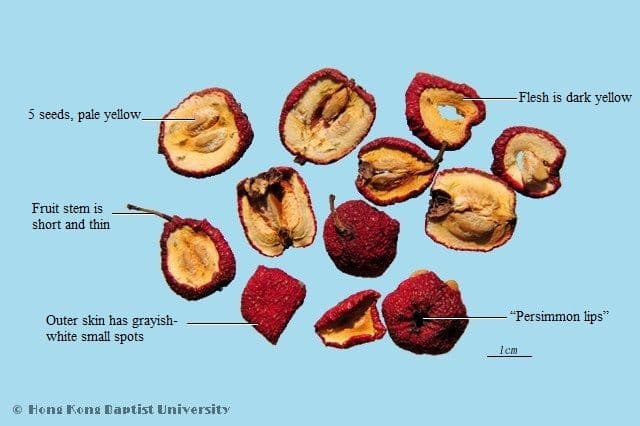
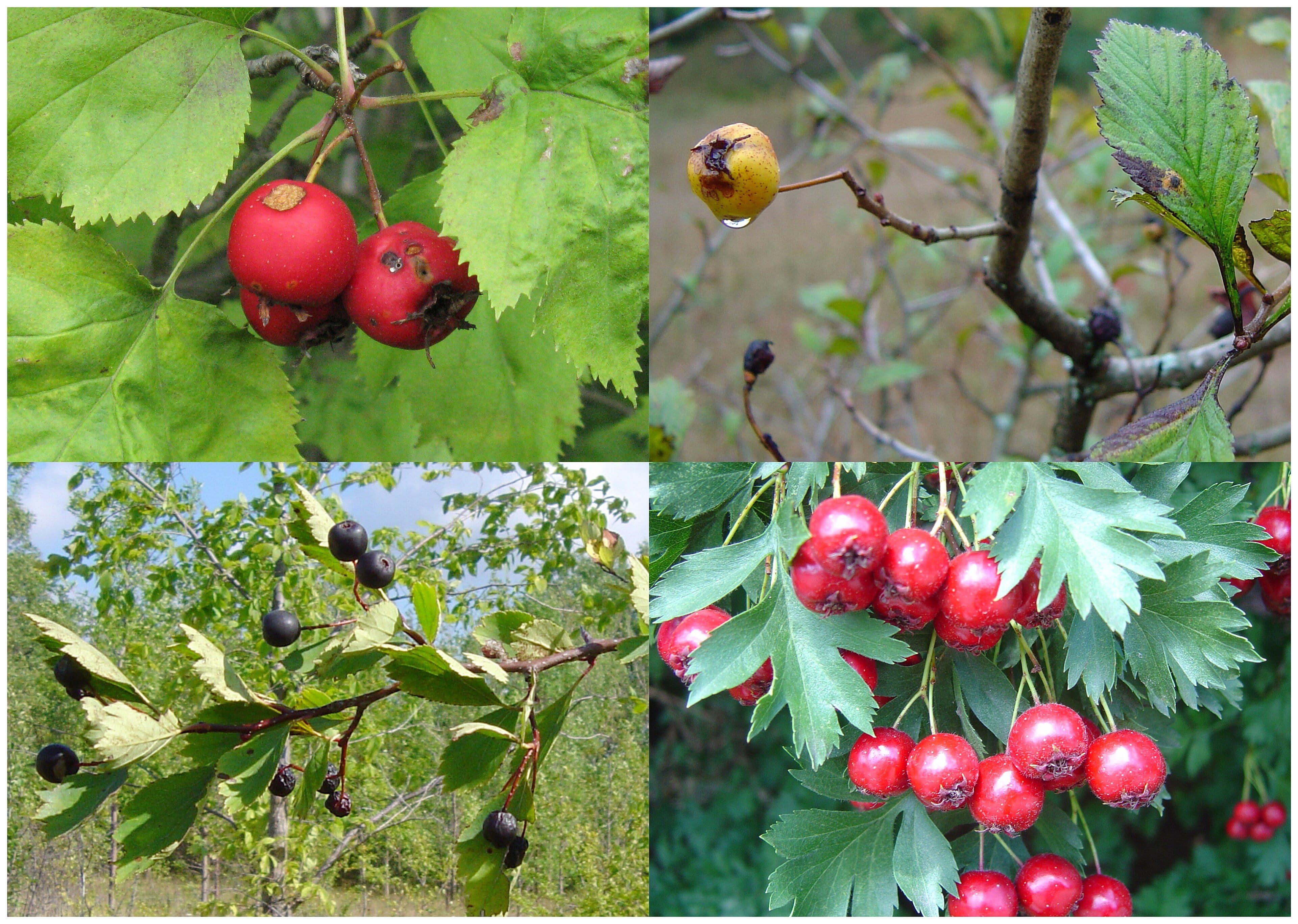
Crataegus Fruit
Warm (温)山楂 · Shan Zha
Fructus Crataegi
TCM Properties
Nature (四气)
Warm (温)Flavor (五味)
Sour (酸)Sweet (甘)
Meridian Tropism
LiverSpleenStomach
山楂 · Shan Zha
Fructus Crataegi
Discover Shan Zha, or Crataegus Fruit, a powerful Traditional Chinese Medicine herb revered for its ability to transform heavy foods and support robust cardiovascular health, bridging ancient wisdom with modern science.
8-16g 30-120g when used alone Tincture: 2-4ml
8-16g 30-120g when used alone Tincture: 2-4ml
Steep 8-16 grams of dried Shan Zha slices in 2-3 cups of hot water for 15-20 minutes. For a more concentrated decoction, simmer the herb in water for 20-30 minutes. Drink warm, ideally after meals for digestive benefits.
Dried Shan Zha can be ground into a fine powder. A typical dosage might be 1-3 grams, mixed into water, smoothies, or yogurt. Consult a practitioner for precise powder dosages.
Follow product-specific instructions. A common dosage for Shan Zha tincture is 2-4 ml, taken orally, often diluted in water. Always adhere to professional guidance.
Steep 8-16 grams of dried Shan Zha slices in 2-3 cups of hot water for 15-20 minutes. For a more concentrated decoction, simmer the herb in water for 20-30 minutes. Drink warm, ideally after meals for digestive benefits.
Dried Shan Zha can be ground into a fine powder. A typical dosage might be 1-3 grams, mixed into water, smoothies, or yogurt. Consult a practitioner for precise powder dosages.
Follow product-specific instructions. A common dosage for Shan Zha tincture is 2-4 ml, taken orally, often diluted in water. Always adhere to professional guidance.
Clinical evidence, including recent meta-analyses and randomized controlled trials, strongly supports Shan Zha's efficacy in managing hyperlipidemia by reducing total cholesterol and LDL-C while increasing HDL-C. Studies also indicate its role in promoting plaque stability and overall cardiovascular health. Traditional uses for digestion are supported by its chemical constituents and observed effects.
Moderate — Some clinical studies
Clinical evidence, including recent meta-analyses and randomized controlled trials, strongly supports Shan Zha's efficacy in managing hyperlipidemia by reducing total cholesterol and LDL-C while increasing HDL-C. Studies also indicate its role in promoting plaque stability and overall cardiovascular health. Traditional uses for digestion are supported by its chemical constituents and observed effects.
Moderate — Some clinical studies
Insufficient Data
Insufficient Data
Imagine strolling through a bustling Beijing street market, the air alive with the aroma of candied fruit on sticks – tanghulu. Those glistening, ruby-red spheres, sweet and tart, are often made from Shan Zha. Beyond this delightful culinary treat, Shan Zha (Fructus Crataegi), also known as Crataegus Fruit or Hawthorn Berry, is a cornerstone herb in Traditional Chinese Medicine, revered for its profound benefits for digestion and cardiovascular health.
It's a testament to how traditional wisdom often holds surprisingly potent keys to modern well-being.
In the intricate landscape of Traditional Chinese Medicine, Shan Zha holds a unique and powerful position. Its nature is described as slightly warm, with distinct sour and sweet flavors. These qualities immediately signal its actions within the body. The sourness, in TCM, is often associated with contraction and digestion, while sweetness points towards nourishment and harmony. But what truly sets Shan Zha apart is its affinity for the liver, spleen, and stomach meridians.
This means it directly influences the channels responsible for digestion, nutrient absorption, and the smooth flow of energy (Qi) throughout the body.
I often explain it to my patients like this: think of your digestive system as a busy kitchen. Sometimes, especially after a rich meal, things can get a bit 'clogged up' – what we call 'Food Stagnation' in TCM. Shan Zha acts like a skilled chef, gently but effectively breaking down the heavy, accumulated foods, particularly fats and meats. It guides these accumulations out, preventing that uncomfortable, bloated feeling.
This isn't just about feeling better; it's about optimizing your body's ability to extract vital nutrients and prevent dampness or toxicity from building up. My teacher at Beijing University of Chinese Medicine always emphasized Shan Zha's remarkable ability to 'clear the path' for proper digestion, a concept that resonates deeply with modern functional medicine's focus on gut health. When the spleen and stomach are happy, the rest of the body often follows.
Shan Zha is perhaps most famously known in TCM for its powerful digestive properties. It excels at reducing and guiding out Food Stagnation, particularly when it comes to the accumulation of rich, fatty, or meaty foods. I remember a patient, Mr. Li, who frequently complained of bloating, belching, and indigestion after enjoying fatty foods – a common issue for many. His tongue coating was thick, a classic sign of 'Food Stagnation' in TCM.
Shan Zha was a key part of his protocol. Within weeks, he reported feeling lighter, less bloated, and his digestion was noticeably smoother. This aligns perfectly with the ancient wisdom captured in the 《本草纲目》, which states: '山楂化饮食,消肉积,癥瘕肠澼' – Shan Zha transforms food, dissipates meat stagnation, and resolves lumps and intestinal issues. It’s a gentle yet potent digestive aid, particularly valuable for breaking down fats and promoting efficient nutrient absorption, preventing the sluggishness that can follow a heavy meal.
Beyond digestion, Shan Zha is a powerful ally for cardiovascular health, deeply connected to its action of transforming Blood Stasis and invigorating Blood circulation. In TCM, Blood Stasis isn't just about a clot; it's a broader concept encompassing sluggish circulation, poor tissue perfusion, and the buildup of metabolic waste that can contribute to pain, stiffness, and even more serious conditions like coronary artery disease.
The 《神农本草经》, one of the earliest Chinese medical texts, notes Shan Zha '主寒热,瘀血癥瘕' – meaning it addresses cold and heat imbalances, and issues of congealed blood and masses. Modern science is now providing compelling evidence for this traditional understanding, showing Shan Zha's potential to treat hypertension, elevated serum cholesterol, and coronary artery disease.
A specific cardiovascular benefit that garners significant attention is Shan Zha's role in lipid management. Its ability to reduce and transform accumulations extends to metabolic accumulations as well. This action helps to balance levels of cholesterol and triglycerides, which are crucial markers for heart health. By supporting the liver and spleen meridians, Shan Zha helps these organs process and eliminate excess fats more efficiently, contributing to a healthier lipid profile.
Modern research has truly begun to unravel the sophisticated mechanisms behind Shan Zha's traditional uses, especially in the realm of cardiovascular health. A significant meta-analysis published in 2024 by Xiaoli Zhou, Chen, Gao, and Miao, synthesizing fourteen randomized controlled trials, concluded that traditional Chinese medicinal preparations containing hawthorn effectively decreased total cholesterol and LDL-C (the 'bad' cholesterol) while increasing HDL-C (the 'good' cholesterol) in patients with hyperlipidemia. This robust finding, with a clinical effective rate ratio of 1.
18, provides strong clinical validation for what TCM practitioners have observed for centuries.
Further supporting these benefits, a comprehensive review in 2015 by S. Dehghani, Mehri, and H. Hosseinzadeh from Mashhad University of Medical Sciences highlighted Crataegus pinnatifida's ability to improve lipid profiles, particularly noting its capacity to lower triglycerides and cholesterol. Animal studies cited within this review demonstrated remarkable effects, such as a 250 mg/kg dose of Shan Zha reducing plasma total cholesterol by 15% and LDL-C by 20%, while elevating HDL-C by 27% in hamsters after just seven days.
The benefits extend beyond just lipid management. A 2017 clinical observation by Wang, Jiang, et al. involving 64 patients with carotid artery atherosclerosis showed that a six-month regimen of hawthorn extract at a dose of 5.0 mg/kg not only reduced serum lipid levels but also promoted plaque stability – a critical factor in preventing serious cardiovascular events.
Chinese research further elaborates that Shan Zha's efficacy in preventing cardiovascular diseases stems from its anti-inflammatory and antioxidant properties, along with its ability to regulate endothelial cells. Researchers, including those from Liaoning University of Traditional Chinese Medicine, have extensively reviewed its main active components, identifying flavonoids and organic acids as key players in these beneficial actions.
Incorporating Shan Zha into your wellness routine can be both simple and effective, whether for digestive support or cardiovascular health. The dosage in traditional decoctions typically ranges from 8-16 grams of dried fruit. For more intensive applications, especially when used alone for significant food stagnation, dosages can go up to 30-120 grams. If you're using a tincture, a general guideline is 2-4 ml. Always consult with a qualified practitioner to determine the most appropriate dosage for your specific needs.
One of the most common ways to enjoy Shan Zha is as a tea. Simply steep 8-16 grams of dried Shan Zha slices in 2-3 cups of hot water for 15-20 minutes. You can drink this warm after meals to aid digestion. For those who find the sourness too intense, a touch of honey or a few slices of ginger can balance the flavor. Shan Zha is also a delightful culinary ingredient.
Its tartness makes it perfect for traditional Chinese sweets like tanghulu or haw flakes, which you might recognize from Asian markets. You can also simmer it in soups, especially those containing fatty meats, or make a vibrant jam or jelly. For a convenient option, powdered Shan Zha can be mixed into smoothies or yogurt.
It’s worth noting that TCM recognizes different preparations: raw Shan Zha is stronger for dissolving food stagnation and blood stasis, while stir-fried (chao shan zha) is gentler and often preferred for spleen and stomach deficiency.
While Shan Zha offers remarkable health benefits, it is crucial to approach its use with careful consideration, as with any potent medicinal herb. My primary concern for patients is ensuring safety and preventing adverse interactions.
Spleen and Stomach Deficiency without Food Stagnation: If your digestive system is already weak but you don't have heavy, stuck food, Shan Zha's strong digestive action can further weaken your system, leading to discomfort.
Acid Regurgitation: For individuals prone to heartburn or acid reflux, the sour nature of Shan Zha can exacerbate these symptoms.
Pregnancy: This is a critical warning. Large doses of Shan Zha are strictly contraindicated in pregnancy as they can lead to fetal death. If you are pregnant or planning to become pregnant, you must avoid Shan Zha entirely.
Digoxin (Lanoxin): Concurrent use of Shan Zha and digoxin, a medication commonly prescribed for heart conditions, must be monitored very carefully by your physician. Shan Zha can potentially potentiate the effects of digoxin, leading to adverse side effects. Always inform your healthcare provider about all herbs and supplements you are taking to avoid dangerous interactions.
Always err on the side of caution. If you have any underlying health conditions, are taking medications, or are unsure if Shan Zha is right for you, consult with a qualified integrative medicine physician or TCM practitioner. Your safety is paramount.
Shan Zha is more than just a sour-sweet berry; it's a bridge between ancient wisdom and modern scientific understanding. From its humble origins in Traditional Chinese Medicine as a digestive aid and blood invigorator to its current recognition as a powerful cardiovascular tonic validated by contemporary research, Shan Zha reminds us that nature holds profound solutions.
It invites us to look beyond simplistic categorizations and embrace a holistic view of health, where the wisdom of the past can illuminate our path to a healthier future.
Imagine strolling through a bustling Beijing street market, the air alive with the aroma of candied fruit on sticks – tanghulu. Those glistening, ruby-red spheres, sweet and tart, are often made from Shan Zha. Beyond this delightful culinary treat, Shan Zha (Fructus Crataegi), also known as Crataegus Fruit or Hawthorn Berry, is a cornerstone herb in Traditional Chinese Medicine, revered for its profound benefits for digestion and cardiovascular health.
It's a testament to how traditional wisdom often holds surprisingly potent keys to modern well-being.
In the intricate landscape of Traditional Chinese Medicine, Shan Zha holds a unique and powerful position. Its nature is described as slightly warm, with distinct sour and sweet flavors. These qualities immediately signal its actions within the body. The sourness, in TCM, is often associated with contraction and digestion, while sweetness points towards nourishment and harmony. But what truly sets Shan Zha apart is its affinity for the liver, spleen, and stomach meridians.
This means it directly influences the channels responsible for digestion, nutrient absorption, and the smooth flow of energy (Qi) throughout the body.
I often explain it to my patients like this: think of your digestive system as a busy kitchen. Sometimes, especially after a rich meal, things can get a bit 'clogged up' – what we call 'Food Stagnation' in TCM. Shan Zha acts like a skilled chef, gently but effectively breaking down the heavy, accumulated foods, particularly fats and meats. It guides these accumulations out, preventing that uncomfortable, bloated feeling.
This isn't just about feeling better; it's about optimizing your body's ability to extract vital nutrients and prevent dampness or toxicity from building up. My teacher at Beijing University of Chinese Medicine always emphasized Shan Zha's remarkable ability to 'clear the path' for proper digestion, a concept that resonates deeply with modern functional medicine's focus on gut health. When the spleen and stomach are happy, the rest of the body often follows.
Shan Zha is perhaps most famously known in TCM for its powerful digestive properties. It excels at reducing and guiding out Food Stagnation, particularly when it comes to the accumulation of rich, fatty, or meaty foods. I remember a patient, Mr. Li, who frequently complained of bloating, belching, and indigestion after enjoying fatty foods – a common issue for many. His tongue coating was thick, a classic sign of 'Food Stagnation' in TCM.
Shan Zha was a key part of his protocol. Within weeks, he reported feeling lighter, less bloated, and his digestion was noticeably smoother. This aligns perfectly with the ancient wisdom captured in the 《本草纲目》, which states: '山楂化饮食,消肉积,癥瘕肠澼' – Shan Zha transforms food, dissipates meat stagnation, and resolves lumps and intestinal issues. It’s a gentle yet potent digestive aid, particularly valuable for breaking down fats and promoting efficient nutrient absorption, preventing the sluggishness that can follow a heavy meal.
Beyond digestion, Shan Zha is a powerful ally for cardiovascular health, deeply connected to its action of transforming Blood Stasis and invigorating Blood circulation. In TCM, Blood Stasis isn't just about a clot; it's a broader concept encompassing sluggish circulation, poor tissue perfusion, and the buildup of metabolic waste that can contribute to pain, stiffness, and even more serious conditions like coronary artery disease.
The 《神农本草经》, one of the earliest Chinese medical texts, notes Shan Zha '主寒热,瘀血癥瘕' – meaning it addresses cold and heat imbalances, and issues of congealed blood and masses. Modern science is now providing compelling evidence for this traditional understanding, showing Shan Zha's potential to treat hypertension, elevated serum cholesterol, and coronary artery disease.
A specific cardiovascular benefit that garners significant attention is Shan Zha's role in lipid management. Its ability to reduce and transform accumulations extends to metabolic accumulations as well. This action helps to balance levels of cholesterol and triglycerides, which are crucial markers for heart health. By supporting the liver and spleen meridians, Shan Zha helps these organs process and eliminate excess fats more efficiently, contributing to a healthier lipid profile.
Modern research has truly begun to unravel the sophisticated mechanisms behind Shan Zha's traditional uses, especially in the realm of cardiovascular health. A significant meta-analysis published in 2024 by Xiaoli Zhou, Chen, Gao, and Miao, synthesizing fourteen randomized controlled trials, concluded that traditional Chinese medicinal preparations containing hawthorn effectively decreased total cholesterol and LDL-C (the 'bad' cholesterol) while increasing HDL-C (the 'good' cholesterol) in patients with hyperlipidemia. This robust finding, with a clinical effective rate ratio of 1.
18, provides strong clinical validation for what TCM practitioners have observed for centuries.
Further supporting these benefits, a comprehensive review in 2015 by S. Dehghani, Mehri, and H. Hosseinzadeh from Mashhad University of Medical Sciences highlighted Crataegus pinnatifida's ability to improve lipid profiles, particularly noting its capacity to lower triglycerides and cholesterol. Animal studies cited within this review demonstrated remarkable effects, such as a 250 mg/kg dose of Shan Zha reducing plasma total cholesterol by 15% and LDL-C by 20%, while elevating HDL-C by 27% in hamsters after just seven days.
The benefits extend beyond just lipid management. A 2017 clinical observation by Wang, Jiang, et al. involving 64 patients with carotid artery atherosclerosis showed that a six-month regimen of hawthorn extract at a dose of 5.0 mg/kg not only reduced serum lipid levels but also promoted plaque stability – a critical factor in preventing serious cardiovascular events.
Chinese research further elaborates that Shan Zha's efficacy in preventing cardiovascular diseases stems from its anti-inflammatory and antioxidant properties, along with its ability to regulate endothelial cells. Researchers, including those from Liaoning University of Traditional Chinese Medicine, have extensively reviewed its main active components, identifying flavonoids and organic acids as key players in these beneficial actions.
Incorporating Shan Zha into your wellness routine can be both simple and effective, whether for digestive support or cardiovascular health. The dosage in traditional decoctions typically ranges from 8-16 grams of dried fruit. For more intensive applications, especially when used alone for significant food stagnation, dosages can go up to 30-120 grams. If you're using a tincture, a general guideline is 2-4 ml. Always consult with a qualified practitioner to determine the most appropriate dosage for your specific needs.
One of the most common ways to enjoy Shan Zha is as a tea. Simply steep 8-16 grams of dried Shan Zha slices in 2-3 cups of hot water for 15-20 minutes. You can drink this warm after meals to aid digestion. For those who find the sourness too intense, a touch of honey or a few slices of ginger can balance the flavor. Shan Zha is also a delightful culinary ingredient.
Its tartness makes it perfect for traditional Chinese sweets like tanghulu or haw flakes, which you might recognize from Asian markets. You can also simmer it in soups, especially those containing fatty meats, or make a vibrant jam or jelly. For a convenient option, powdered Shan Zha can be mixed into smoothies or yogurt.
It’s worth noting that TCM recognizes different preparations: raw Shan Zha is stronger for dissolving food stagnation and blood stasis, while stir-fried (chao shan zha) is gentler and often preferred for spleen and stomach deficiency.
While Shan Zha offers remarkable health benefits, it is crucial to approach its use with careful consideration, as with any potent medicinal herb. My primary concern for patients is ensuring safety and preventing adverse interactions.
Spleen and Stomach Deficiency without Food Stagnation: If your digestive system is already weak but you don't have heavy, stuck food, Shan Zha's strong digestive action can further weaken your system, leading to discomfort.
Acid Regurgitation: For individuals prone to heartburn or acid reflux, the sour nature of Shan Zha can exacerbate these symptoms.
Pregnancy: This is a critical warning. Large doses of Shan Zha are strictly contraindicated in pregnancy as they can lead to fetal death. If you are pregnant or planning to become pregnant, you must avoid Shan Zha entirely.
Digoxin (Lanoxin): Concurrent use of Shan Zha and digoxin, a medication commonly prescribed for heart conditions, must be monitored very carefully by your physician. Shan Zha can potentially potentiate the effects of digoxin, leading to adverse side effects. Always inform your healthcare provider about all herbs and supplements you are taking to avoid dangerous interactions.
Always err on the side of caution. If you have any underlying health conditions, are taking medications, or are unsure if Shan Zha is right for you, consult with a qualified integrative medicine physician or TCM practitioner. Your safety is paramount.
Shan Zha is more than just a sour-sweet berry; it's a bridge between ancient wisdom and modern scientific understanding. From its humble origins in Traditional Chinese Medicine as a digestive aid and blood invigorator to its current recognition as a powerful cardiovascular tonic validated by contemporary research, Shan Zha reminds us that nature holds profound solutions.
It invites us to look beyond simplistic categorizations and embrace a holistic view of health, where the wisdom of the past can illuminate our path to a healthier future.
This information is for educational purposes only and is not intended as medical advice. Always consult a qualified healthcare practitioner before using any herbal remedy.