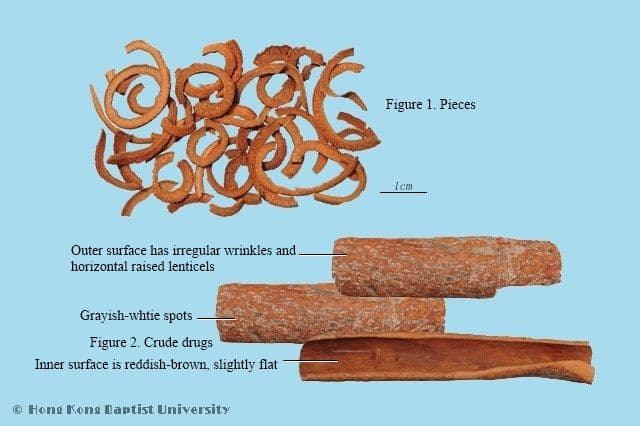
肉桂 · Rou Gui -
Cortex Cinnamomi
Dr. Maya Chen explores Rou Gui (Cortex Cinnamomi), the potent cinnamon bark from Traditional Chinese Medicine, unveiling its warming power for vitality, metabolic balance, and pain relief, now backed by modern science.
1.5-5g add near the end Powders: 1-2g Tincture: 0.25-2ml
For a strong medicinal tea, simmer 1.5-5 grams of Rou Gui bark in 2-3 cups of water for 15-20 minutes. It's often recommended to add Rou Gui towards the end of a multi-herb decoction to preserve its aromatic volatile oils. Strain and drink warm.
Finely ground Rou Gui bark can be taken in powder form, typically 1-2 grams per dose. Mix with a small amount of warm water, honey, or add to a smoothie. This method can be potent, so start with a smaller dose.
A liquid extract made from Rou Gui. Typical dosages range from 0.25-2 ml, taken 1-3 times daily, or as directed by a qualified practitioner. Tinctures offer a convenient and easily absorbed option.
For cold-induced pain, a strong Rou Gui decoction can be used as a warm compress, or diluted Rou Gui essential oil (always with a carrier oil) can be massaged onto the affected area to promote warmth and circulation. Always patch test for sensitivity.
For a strong medicinal tea, simmer 1.5-5 grams of Rou Gui bark in 2-3 cups of water for 15-20 minutes. It's often recommended to add Rou Gui towards the end of a multi-herb decoction to preserve its aromatic volatile oils. Strain and drink warm.
Finely ground Rou Gui bark can be taken in powder form, typically 1-2 grams per dose. Mix with a small amount of warm water, honey, or add to a smoothie. This method can be potent, so start with a smaller dose.
A liquid extract made from Rou Gui. Typical dosages range from 0.25-2 ml, taken 1-3 times daily, or as directed by a qualified practitioner. Tinctures offer a convenient and easily absorbed option.
For cold-induced pain, a strong Rou Gui decoction can be used as a warm compress, or diluted Rou Gui essential oil (always with a carrier oil) can be massaged onto the affected area to promote warmth and circulation. Always patch test for sensitivity.
Clinical studies have shown that Cassia cinnamon, from which Rou Gui is derived, can significantly reduce peak blood glucose responses and improve glucose tolerance, and positively impact fasting blood glucose and HbA1c levels in type 2 diabetes patients. Broader systematic reviews suggest TCM approaches incorporating cinnamon can improve cardiac function, blood glucose, lipids, and inflammation in metabolic and cardiovascular conditions.
Moderate — Some clinical studies
Clinical studies have shown that Cassia cinnamon, from which Rou Gui is derived, can significantly reduce peak blood glucose responses and improve glucose tolerance, and positively impact fasting blood glucose and HbA1c levels in type 2 diabetes patients. Broader systematic reviews suggest TCM approaches incorporating cinnamon can improve cardiac function, blood glucose, lipids, and inflammation in metabolic and cardiovascular conditions.
Moderate — Some clinical studies
Insufficient Data
Insufficient Data
Imagine the comforting aroma of cinnamon wafting through your kitchen on a cold morning. It’s a scent universally recognized for its warmth and spice. But what if I told you that beyond its culinary charm, this familiar spice holds a profound medicinal power, revered for millennia in Traditional Chinese Medicine (TCM)? I’m talking about Rou Gui (Cortex Cinnamomi), also known as Cinnamon Bark or Cassia Cinnamon Bark.
This isn't just a kitchen staple; it's a potent warming and invigorating herb in TCM, primarily used to stoke the body's internal fire, disperse deep cold, and revitalize vital energy.
My journey into integrative medicine began with a deep dive into the classics at Beijing University of Chinese Medicine, where I first learned to appreciate herbs like Rou Gui. Later, during my residency in the US, I saw firsthand how ancient wisdom could resonate with modern scientific understanding. As the ancient text Shennong Ben Cao Jing noted, Rou Gui 'nourishes the spirit, harmonizes complexion, benefits the joints, and communicates with the divine,' speaking to its holistic impact on well-being.
Rou Gui is a remarkable bridge between the familiar and the profound. It’s an herb that can help us understand how our bodies strive for balance, and how a seemingly simple bark can hold complex keys to our health. Let’s unveil the layers of this extraordinary botanical, from its traditional roots to its modern scientific validation.
In TCM, every herb has a unique energetic signature. Rou Gui’s signature is hot, with acrid and sweet flavors. Think of it as a robust, warming embrace for your body's core. The acrid flavor means it disperses and moves, while the sweet flavor suggests it nourishes and harmonizes. This combination makes it exceptionally dynamic.
Rou Gui enters the Heart, Liver, Kidney, Spleen, and Bladder meridians. This wide reach highlights its ability to influence many vital systems. The Kidneys, in TCM, are considered the root of Yang Qi — your body’s warming, active, and vital energy. Rou Gui is renowned for warming the Kidneys and strengthening Ming Men Fire, often referred to as your life gate fire or the fundamental warmth that drives all physiological processes.
When this fire is weak, you might experience deep cold, fatigue, and metabolic slowdown.
I recall a patient, a young woman in her early thirties, who always felt cold, even in summer. She had persistent fatigue, a slow metabolism, and often felt chilly to the bone, a classic presentation of Kidney Yang deficiency. We incorporated Rou Gui into her herbal regimen, and within weeks, she reported a significant improvement in her internal warmth and energy.
Her story is a testament to Rou Gui’s unique ability to disperse deep cold, warm the channels, and literally stoke the body's internal furnace, assisting in the generation of both Qi (vital energy) and Blood.
One of Rou Gui's most celebrated actions is its profound warming capacity. If you suffer from perpetually cold hands and feet, or feel a deep chill that seems to penetrate your bones, Rou Gui might be a powerful ally. In TCM, this relates to its ability to warm the Kidneys, Spleen, and Heart and strengthen Yang and Ming Men Fire. This means it reinvigorates your body's core warmth, improving circulation and overall vitality.
While Western medicine might focus on peripheral vascular issues, Rou Gui approaches it from a holistic perspective, addressing the root of internal coldness.
Many patients come to me seeking natural ways to support their metabolic health. In TCM, a sluggish metabolism often links to a weakened Spleen and Kidney Yang, impacting digestion and energy transformation. Rou Gui's warming action can kickstart these processes. Modern research has begun to echo this ancient understanding. A study by Gutierrez JL, Bowden RG, and Willoughby RC (J Diet Suppl.
, 2016) found that a 5g dose of Cassia cinnamon supplementation reduced peak blood glucose responses and improved glucose tolerance. Furthermore, Lu T et al. (Nutr Res, 2012) observed that cinnamon extract improved fasting blood glucose and glycosylated hemoglobin (HbA1c) levels in Chinese patients with type 2 diabetes. This convergence of traditional use and scientific validation is incredibly exciting.
Pain, especially that which feels worse in cold weather or responds positively to warmth, can often be attributed to 'cold obstruction' or 'blood stagnation' in TCM. Rou Gui's ability to disperse deep Cold, warm the channels, unblock the channels and vessels and alleviate pain makes it a valuable herb for conditions like cold-induced joint pain, lower back discomfort, or certain types of menstrual cramps.
By invigorating blood flow and warming the affected areas, it helps to resolve stagnation and ease discomfort. This aligns with a broader understanding of how improved circulation can reduce pain and inflammation.
The scientific community is increasingly exploring the mechanisms behind Rou Gui's traditional efficacy. The key active compounds in Rou Gui, particularly cinnamaldehyde and various polyphenols, are at the forefront of this research. Studies have demonstrated these components possess significant antioxidant and blood sugar-lowering activities, as highlighted by 刘婕琳 et al. (天津中医药大学学报, 2024), who found high concentrations of cinnamaldehyde (up to 62.72%) and proanthocyanidin B2 in cinnamon essential oil.
Beyond its metabolic benefits, a systematic review by Ding, Wei et al. (Oxidative Medicine and Cellular Longevity, 2022) concluded that TCM, often incorporating herbs like Rou Gui, can serve as a complementary approach for patients with coronary heart disease and diabetes. This review noted improvements in cardiac function, blood rheology, blood glucose, lipids, and inflammation, leading to reduced angina frequency and cardiovascular events. This broader recognition of TCM's systemic benefits aligns perfectly with Rou Gui’s multi-meridian actions.
Emerging research is also exploring Rou Gui's potential in other areas. Preliminary findings from 广西中医药大学 (中国保健营养, 2024) suggest that cinnamon polysaccharides may improve Alzheimer's disease models by inhibiting neuroinflammation, with strong antioxidant activity demonstrated. Furthermore, preclinical models cited by Ruishan Wen et al. (Translational Cancer Research, 2024) indicate that cinnamon compounds could enhance T-cell infiltration and reverse tumor immune evasion, showing promising avenues for future investigation in integrative oncology.
These studies, while still in early stages, underscore the vast therapeutic potential of this ancient herb.
Incorporating Rou Gui into your wellness routine requires careful attention to preparation and dosage. For medicinal purposes, it’s most commonly used in decoctions, but powders and tinctures are also available. Always aim for high-quality, authentic bark from a reputable source.
Decoction (Boiled Tea): The traditional method involves simmering the bark. For a warming decoction, I typically recommend adding 1.5 to 5 grams of Rou Gui bark towards the end of your herbal preparation, simmering for about 15-20 minutes. Adding it later helps preserve its potent volatile oils. Strain and drink warm.
Powders: If using a powdered form, a common dosage is 1-2 grams. This can be mixed into warm water, a spoonful of honey, or added to a morning smoothie. I often suggest starting with a smaller dose to assess your body’s response.
Tinctures: For convenience, Rou Gui tinctures are also an option. Dosages typically range from 0.25-2 ml. Always follow the specific instructions on the product label or consult with a practitioner to determine the right dosage for your needs.
One patient, an elderly gentleman with chronic cold in his lower back, found immense relief by incorporating a small amount of Rou Gui powder into his morning ginger tea. It became a simple, daily ritual that profoundly improved his comfort and mobility. This illustrates how even small, consistent applications can yield significant results.
While Rou Gui offers numerous benefits, its potent warming nature means it is not suitable for everyone. It is contraindicated for those with Yin Deficiency with Heat signs (symptoms like night sweats, dry mouth, flushed cheeks, or a feeling of internal heat). It should also be avoided by individuals with Internal Excess Heat, reckless movement of Hot Blood (e.g., nosebleeds, heavy periods with bright red blood), or those experiencing coughing with a sore throat.
If you have Blood Deficiency with Internal Dryness or Blood Heat following parturition (after childbirth), Rou Gui is also not advisable.
Pregnancy and Breastfeeding: Use caution during pregnancy, and generally, I advise against its use due to its invigorating nature which could potentially stimulate uterine contractions. There is insufficient data to confirm its safety during breastfeeding, so it's best to avoid it during this period as well.
Drug Interactions: Rou Gui (Cassia cinnamon) contains coumarin, a compound that can act as a blood thinner. Therefore, individuals taking anticoagulant medications like warfarin should avoid Rou Gui or use it only under strict medical supervision. Its blood sugar-lowering effects also mean it can interact with diabetes medications, potentially leading to hypoglycemia. Always consult your healthcare provider before combining Rou Gui with any prescription medications, especially if you have liver conditions, as high doses of coumarin can be hepatotoxic.
Rou Gui is more than just a spice or a single-action remedy; it’s a profound example of how nature offers holistic support for our bodies. Its journey from ancient pharmacopeias to modern research labs symbolizes the enduring relevance of TCM principles. By understanding its warming nature and broad actions, we can appreciate how this humble bark contributes to our internal equilibrium, dispelling cold, igniting vitality, and supporting our metabolic landscape.
As we embrace the wisdom of Rou Gui, we’re not just consuming an herb; we're rekindling an ancient fire within, inviting balance and vitality into our modern lives. It's a reminder that true health often lies in the harmonious integration of our body's innate wisdom with the profound gifts of the natural world.
Imagine the comforting aroma of cinnamon wafting through your kitchen on a cold morning. It’s a scent universally recognized for its warmth and spice. But what if I told you that beyond its culinary charm, this familiar spice holds a profound medicinal power, revered for millennia in Traditional Chinese Medicine (TCM)? I’m talking about Rou Gui (Cortex Cinnamomi), also known as Cinnamon Bark or Cassia Cinnamon Bark.
This isn't just a kitchen staple; it's a potent warming and invigorating herb in TCM, primarily used to stoke the body's internal fire, disperse deep cold, and revitalize vital energy.
My journey into integrative medicine began with a deep dive into the classics at Beijing University of Chinese Medicine, where I first learned to appreciate herbs like Rou Gui. Later, during my residency in the US, I saw firsthand how ancient wisdom could resonate with modern scientific understanding. As the ancient text Shennong Ben Cao Jing noted, Rou Gui 'nourishes the spirit, harmonizes complexion, benefits the joints, and communicates with the divine,' speaking to its holistic impact on well-being.
Rou Gui is a remarkable bridge between the familiar and the profound. It’s an herb that can help us understand how our bodies strive for balance, and how a seemingly simple bark can hold complex keys to our health. Let’s unveil the layers of this extraordinary botanical, from its traditional roots to its modern scientific validation.
In TCM, every herb has a unique energetic signature. Rou Gui’s signature is hot, with acrid and sweet flavors. Think of it as a robust, warming embrace for your body's core. The acrid flavor means it disperses and moves, while the sweet flavor suggests it nourishes and harmonizes. This combination makes it exceptionally dynamic.
Rou Gui enters the Heart, Liver, Kidney, Spleen, and Bladder meridians. This wide reach highlights its ability to influence many vital systems. The Kidneys, in TCM, are considered the root of Yang Qi — your body’s warming, active, and vital energy. Rou Gui is renowned for warming the Kidneys and strengthening Ming Men Fire, often referred to as your life gate fire or the fundamental warmth that drives all physiological processes.
When this fire is weak, you might experience deep cold, fatigue, and metabolic slowdown.
I recall a patient, a young woman in her early thirties, who always felt cold, even in summer. She had persistent fatigue, a slow metabolism, and often felt chilly to the bone, a classic presentation of Kidney Yang deficiency. We incorporated Rou Gui into her herbal regimen, and within weeks, she reported a significant improvement in her internal warmth and energy.
Her story is a testament to Rou Gui’s unique ability to disperse deep cold, warm the channels, and literally stoke the body's internal furnace, assisting in the generation of both Qi (vital energy) and Blood.
One of Rou Gui's most celebrated actions is its profound warming capacity. If you suffer from perpetually cold hands and feet, or feel a deep chill that seems to penetrate your bones, Rou Gui might be a powerful ally. In TCM, this relates to its ability to warm the Kidneys, Spleen, and Heart and strengthen Yang and Ming Men Fire. This means it reinvigorates your body's core warmth, improving circulation and overall vitality.
While Western medicine might focus on peripheral vascular issues, Rou Gui approaches it from a holistic perspective, addressing the root of internal coldness.
Many patients come to me seeking natural ways to support their metabolic health. In TCM, a sluggish metabolism often links to a weakened Spleen and Kidney Yang, impacting digestion and energy transformation. Rou Gui's warming action can kickstart these processes. Modern research has begun to echo this ancient understanding. A study by Gutierrez JL, Bowden RG, and Willoughby RC (J Diet Suppl.
, 2016) found that a 5g dose of Cassia cinnamon supplementation reduced peak blood glucose responses and improved glucose tolerance. Furthermore, Lu T et al. (Nutr Res, 2012) observed that cinnamon extract improved fasting blood glucose and glycosylated hemoglobin (HbA1c) levels in Chinese patients with type 2 diabetes. This convergence of traditional use and scientific validation is incredibly exciting.
Pain, especially that which feels worse in cold weather or responds positively to warmth, can often be attributed to 'cold obstruction' or 'blood stagnation' in TCM. Rou Gui's ability to disperse deep Cold, warm the channels, unblock the channels and vessels and alleviate pain makes it a valuable herb for conditions like cold-induced joint pain, lower back discomfort, or certain types of menstrual cramps.
By invigorating blood flow and warming the affected areas, it helps to resolve stagnation and ease discomfort. This aligns with a broader understanding of how improved circulation can reduce pain and inflammation.
The scientific community is increasingly exploring the mechanisms behind Rou Gui's traditional efficacy. The key active compounds in Rou Gui, particularly cinnamaldehyde and various polyphenols, are at the forefront of this research. Studies have demonstrated these components possess significant antioxidant and blood sugar-lowering activities, as highlighted by 刘婕琳 et al. (天津中医药大学学报, 2024), who found high concentrations of cinnamaldehyde (up to 62.72%) and proanthocyanidin B2 in cinnamon essential oil.
Beyond its metabolic benefits, a systematic review by Ding, Wei et al. (Oxidative Medicine and Cellular Longevity, 2022) concluded that TCM, often incorporating herbs like Rou Gui, can serve as a complementary approach for patients with coronary heart disease and diabetes. This review noted improvements in cardiac function, blood rheology, blood glucose, lipids, and inflammation, leading to reduced angina frequency and cardiovascular events. This broader recognition of TCM's systemic benefits aligns perfectly with Rou Gui’s multi-meridian actions.
Emerging research is also exploring Rou Gui's potential in other areas. Preliminary findings from 广西中医药大学 (中国保健营养, 2024) suggest that cinnamon polysaccharides may improve Alzheimer's disease models by inhibiting neuroinflammation, with strong antioxidant activity demonstrated. Furthermore, preclinical models cited by Ruishan Wen et al. (Translational Cancer Research, 2024) indicate that cinnamon compounds could enhance T-cell infiltration and reverse tumor immune evasion, showing promising avenues for future investigation in integrative oncology.
These studies, while still in early stages, underscore the vast therapeutic potential of this ancient herb.
Incorporating Rou Gui into your wellness routine requires careful attention to preparation and dosage. For medicinal purposes, it’s most commonly used in decoctions, but powders and tinctures are also available. Always aim for high-quality, authentic bark from a reputable source.
Decoction (Boiled Tea): The traditional method involves simmering the bark. For a warming decoction, I typically recommend adding 1.5 to 5 grams of Rou Gui bark towards the end of your herbal preparation, simmering for about 15-20 minutes. Adding it later helps preserve its potent volatile oils. Strain and drink warm.
Powders: If using a powdered form, a common dosage is 1-2 grams. This can be mixed into warm water, a spoonful of honey, or added to a morning smoothie. I often suggest starting with a smaller dose to assess your body’s response.
Tinctures: For convenience, Rou Gui tinctures are also an option. Dosages typically range from 0.25-2 ml. Always follow the specific instructions on the product label or consult with a practitioner to determine the right dosage for your needs.
One patient, an elderly gentleman with chronic cold in his lower back, found immense relief by incorporating a small amount of Rou Gui powder into his morning ginger tea. It became a simple, daily ritual that profoundly improved his comfort and mobility. This illustrates how even small, consistent applications can yield significant results.
While Rou Gui offers numerous benefits, its potent warming nature means it is not suitable for everyone. It is contraindicated for those with Yin Deficiency with Heat signs (symptoms like night sweats, dry mouth, flushed cheeks, or a feeling of internal heat). It should also be avoided by individuals with Internal Excess Heat, reckless movement of Hot Blood (e.g., nosebleeds, heavy periods with bright red blood), or those experiencing coughing with a sore throat.
If you have Blood Deficiency with Internal Dryness or Blood Heat following parturition (after childbirth), Rou Gui is also not advisable.
Pregnancy and Breastfeeding: Use caution during pregnancy, and generally, I advise against its use due to its invigorating nature which could potentially stimulate uterine contractions. There is insufficient data to confirm its safety during breastfeeding, so it's best to avoid it during this period as well.
Drug Interactions: Rou Gui (Cassia cinnamon) contains coumarin, a compound that can act as a blood thinner. Therefore, individuals taking anticoagulant medications like warfarin should avoid Rou Gui or use it only under strict medical supervision. Its blood sugar-lowering effects also mean it can interact with diabetes medications, potentially leading to hypoglycemia. Always consult your healthcare provider before combining Rou Gui with any prescription medications, especially if you have liver conditions, as high doses of coumarin can be hepatotoxic.
Rou Gui is more than just a spice or a single-action remedy; it’s a profound example of how nature offers holistic support for our bodies. Its journey from ancient pharmacopeias to modern research labs symbolizes the enduring relevance of TCM principles. By understanding its warming nature and broad actions, we can appreciate how this humble bark contributes to our internal equilibrium, dispelling cold, igniting vitality, and supporting our metabolic landscape.
As we embrace the wisdom of Rou Gui, we’re not just consuming an herb; we're rekindling an ancient fire within, inviting balance and vitality into our modern lives. It's a reminder that true health often lies in the harmonious integration of our body's innate wisdom with the profound gifts of the natural world.
This information is for educational purposes only and is not intended as medical advice. Always consult a qualified healthcare practitioner before using any herbal remedy.