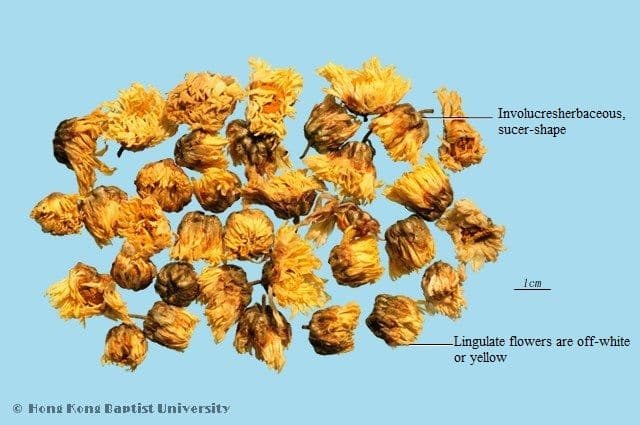
菊花 · Ju Hua
Flos Chrysanthemi
Discover Ju Hua, the humble Chrysanthemum flower, a cornerstone of Traditional Chinese Medicine for its 'cooling' properties, offering relief from eye strain, headaches, and internal heat, validated by modern science.
4.5-20g; Tincture: 2-5ml
For a standard cup of tea, steep 4.5 to 20 grams of dried Ju Hua flowers in 8-12 ounces of hot water (around 200°F or 93°C) for 5-15 minutes. A longer steep will yield a stronger flavor and potentially more potent effects. For chronic conditions, a decoction where the flowers are simmered for 15-20 minutes may be used, but this is best guided by a practitioner.
As a concentrated liquid extract, tinctures offer convenience. Typical dosages range from 2-5 ml, taken 1-3 times daily, or as directed by a qualified herbalist. Always follow the specific instructions on the product label, as concentrations can vary.
To alleviate tired or red eyes, prepare a strong infusion of Ju Hua (around 10-15g steeped in 1 cup of water until cool). Dip clean cotton pads into the liquid, wring out excess, and apply them over closed eyelids for 10-15 minutes. This can be particularly soothing after prolonged screen time.
For a standard cup of tea, steep 4.5 to 20 grams of dried Ju Hua flowers in 8-12 ounces of hot water (around 200°F or 93°C) for 5-15 minutes. A longer steep will yield a stronger flavor and potentially more potent effects. For chronic conditions, a decoction where the flowers are simmered for 15-20 minutes may be used, but this is best guided by a practitioner.
As a concentrated liquid extract, tinctures offer convenience. Typical dosages range from 2-5 ml, taken 1-3 times daily, or as directed by a qualified herbalist. Always follow the specific instructions on the product label, as concentrations can vary.
To alleviate tired or red eyes, prepare a strong infusion of Ju Hua (around 10-15g steeped in 1 cup of water until cool). Dip clean cotton pads into the liquid, wring out excess, and apply them over closed eyelids for 10-15 minutes. This can be particularly soothing after prolonged screen time.
Preclinical studies highlight Ju Hua's diverse pharmacological activities, including antimicrobial, anti-inflammatory, anticancer, and neuroprotective effects, alongside benefits for the cardiovascular and metabolic systems. While human clinical trials are less extensive than traditional use, these findings support the potential of its active compounds like luteolin and chlorogenic acid.
Preliminary — In vitro / animal studies
Preclinical studies highlight Ju Hua's diverse pharmacological activities, including antimicrobial, anti-inflammatory, anticancer, and neuroprotective effects, alongside benefits for the cardiovascular and metabolic systems. While human clinical trials are less extensive than traditional use, these findings support the potential of its active compounds like luteolin and chlorogenic acid.
Preliminary — In vitro / animal studies
Chrysanthemum extracts are known to induce (17) and inhibit CYP3A4 activities (41) (42) resulting in changes in blood levels of substrate drugs. Clinical relevance is unknown. P-Glycoprotein (P-gp) substrates: Chrysanthemum inhibited P-gp, resulting in increased intracellular concentrations of substrate drugs (15). Clinical relevance is unknown.
Use with Caution
Chrysanthemum extracts are known to induce (17) and inhibit CYP3A4 activities (41) (42) resulting in changes in blood levels of substrate drugs. Clinical relevance is unknown. P-Glycoprotein (P-gp) substrates: Chrysanthemum inhibited P-gp, resulting in increased intracellular concentrations of substrate drugs (15). Clinical relevance is unknown.
Use with Caution
Imagine a vibrant autumn morning in China, the air crisp and carrying the faint, sweet aroma of blossoms. You step into a traditional teahouse, and there, in a delicate porcelain cup, floats a handful of golden or white petals, slowly unfurling in the hot water. This isn't just a pretty drink; it's an invitation to centuries of healing wisdom, embodied by the humble Chrysanthemum Flower, known in Traditional Chinese Medicine as Ju Hua (菊花).
Chrysanthemum Flower (Flos Chrysanthemi), also known as Ju Hua, is a perennial flowering plant from the Asteraceae family that is native to Asia and northeastern Europe. This beloved flower and its aerial parts are a foundational herb in TCM, traditionally used for addressing hypertension, angina, fever, and various inflammatory conditions. It's a botanical treasure that elegantly bridges the ancient understanding of wellness with the insights of modern science, particularly in how it helps us adapt to our fast-paced, screen-filled lives.
My own journey into integrative medicine began with a deep appreciation for such herbs. I remember learning about Ju Hua's historical significance, even dating back to the Shennong Ben Cao Jing (The Divine Farmer’s Materia Medica), which notes its ability to address “wind-head dizziness and swelling pain, eyes feeling like they will detach, tearing, dead skin, aversion to wind and damp numbness, and benefiting blood and qi.
” This description, centuries old, speaks directly to conditions we still see today, like severe headaches and eye strain. It’s a testament to the enduring wisdom of these texts.
In Traditional Chinese Medicine, every herb has a unique energetic signature, and Ju Hua's is particularly distinctive. It's classified as Slightly Cool/Cold in nature, which means its primary action is to counteract 'heat' in the body. Think of it as a natural thermostat, gently bringing down inflammation and irritation.
Its flavors are a complex symphony: Sweet, which suggests a nourishing and harmonizing quality; Bitter, indicative of its ability to clear heat and dry dampness; and Acrid, which points to its dispersing action, helping to move stagnant energy and release exterior conditions like colds.
These energetics guide Ju Hua to specific pathways, or meridians, in the body: primarily the Lung and Liver meridians. The Lung is often associated with the superficial layers of the body, our 'exterior' defense against environmental factors like wind and cold, and the first line of defense against pathogens. The Liver, on the other hand, governs the smooth flow of Qi (vital energy) and blood, and it's intimately connected to our eyes, tendons, and emotional regulation.
When Liver Qi becomes stagnant or 'overheated,' it can manifest as irritability, headaches, or eye issues. Ju Hua acts directly on these systems, clearing heat from the Lung and calming an overactive Liver.
This dual action is what makes Ju Hua so special. It's not just a general cooling agent; it's a targeted one. When you have a 'wind-heat' condition – picture the early stages of a cold with a sore throat, mild fever, and a headache – Ju Hua helps 'release the exterior' by dispersing the wind and clearing the heat.
For deeper, more chronic heat, like that simmering 'Liver Fire' causing red, irritated eyes from too much screen time, or tension headaches, Ju Hua gently guides that heat downwards, promoting clarity and calm. It's a holistic approach to balancing internal temperatures and vital functions, a principle that aligns remarkably well with modern understandings of inflammation and homeostasis.
In our modern world, nearly everyone experiences digital eye strain. Hours spent staring at screens can lead to dry, red, tired eyes, and even blurry vision. In TCM, these symptoms are often attributed to 'Liver Heat' or 'Liver Yang Rising,' as the Liver meridian opens into the eyes. Ju Hua is a quintessential herb for this, with its action of 'calming the Liver and clearing the eyes.
' It's like a gentle internal shower for your eyes, washing away the heat and irritation.
I've had countless patients, like Sarah, a software engineer, who came to me complaining of constant eye fatigue and headaches by midday. After incorporating Ju Hua tea into her routine, often with a few goji berries, she reported a significant reduction in eye redness and discomfort. "It's like my eyes can breathe again," she told me, describing how the blurry vision at the end of the day had notably lessened.
This isn't magic; it's the herb's ability to reduce inflammation and promote microcirculation in the ocular area, a concept that modern ophthalmology is increasingly exploring.
When your body feels overheated—whether it’s a mild fever, a tension headache, or the flushed face that accompanies stress—Ju Hua is your ally. Its 'slightly cool' nature is perfect for 'dispersing Wind and clearing Heat,' making it a go-to for what TCM calls wind-heat conditions. These often present like the common cold or seasonal allergies: a scratchy throat, runny nose, slight fever, and headache.
It helps to gently clear these symptoms, often without the drying side effects of some Western remedies.
Beyond physical symptoms, Ju Hua has a calming effect on the mind. In TCM, an overactive 'Liver Yang' can lead to irritability, anger, and difficulty sleeping. By 'calming Liver Yang' and 'extinguishing Wind,' Ju Hua helps to soothe the nervous system, promoting a sense of tranquility. It's a wonderful, caffeine-free evening beverage to help unwind and prepare for restful sleep, especially when stress manifests as a 'buzzing' head or restless thoughts.
Historically, Ju Hua has been used to manage conditions like hypertension (high blood pressure) and angina. In TCM, these are often linked to internal heat or stagnation affecting the Heart and Liver. Ju Hua's action of 'promoting Heart Qi and Blood circulation' and 'calming Liver Yang' contributes to its traditional use in cardiovascular support. Modern preclinical studies are beginning to shed light on these mechanisms, exploring how its compounds may influence blood vessel function and metabolic pathways.
The scientific community is increasingly turning its attention to botanicals like Ju Hua, seeking to understand the biochemical basis for their traditional uses. Researchers are identifying specific active compounds that give Ju Hua its therapeutic power. Key among these are Chlorogenic acid, Luteolin, Chrysanthemol (chrysanthenone), and Acacetin.
A comprehensive review by Li et al. in the Journal of Ethnopharmacology (2020) highlighted Ju Hua's significant activities, including antimicrobial, anti-inflammatory, anticancer, and neuroprotective effects, as well as benefits for the cardiovascular system. This review positions Ju Hua as a representative flower-derived dietary herbal medicine in China, underscoring its broad spectrum of action.
For specific conditions, research is promising. Tu et al., reporting in the Journal of Cancer (2021), found that wild chrysanthemum extract demonstrated potent anti-angiogenic effects in zebrafish by regulating proteasome signaling, suggesting its therapeutic potential for cancer patients. This is a fascinating area of preclinical study, showing how traditional remedies can offer new avenues for modern drug discovery.
Regarding metabolic health, a review citing Yang et al. (2019) indicated that a Ju Hua extract (300 mg/kg daily) showed a hypoglycemic effect on both normal and diabetic mice. This was attributed to the repossession of partially blemished islet cells and increases in hepatic PPARα, GS, and Glut-2 protein expression, offering a glimpse into the cellular mechanisms behind its traditional use for blood sugar balance.
Further research, such as that by Dan Liu et al. (2023), has used advanced spectral analysis to identify luteolin and acacetin as key anti-inflammatory quality markers in chrysanthemum, confirming the traditional understanding of its cooling and soothing properties at a molecular level. Similarly, Zhao Weiping et al. (2022) identified these and other active components in Chuju (a variety of chrysanthemum) that target pathways involved in diabetes and inflammation.
While much of this research is preclinical or in early stages, it provides a strong scientific foundation for many of Ju Hua's traditional applications. It allows us to move beyond simply saying, 'it works because it's traditional,' to understanding how it works, linking ancient concepts to modern physiological understanding.
The versatility of Ju Hua means it can be incorporated into your wellness routine in several accessible ways. The most common and beloved method is as a calming tea, but its uses extend further.
For a soothing infusion, steep 4.5-20 grams of dried chrysanthemum flowers in a mug of hot water (around 200°F or 93°C). Let it steep for 5-15 minutes, depending on your desired strength. The flowers will unfurl beautifully, releasing their delicate aroma and flavor. For enhanced eye benefits, consider adding a few Gou Qi Zi (Goji berries) to your brew. This combination is a classic for nourishing the Liver and brightening the eyes.
You can enjoy Ju Hua tea warm, or chilled as a refreshing iced tea, especially during warmer months or when feeling overheated.
For a more concentrated form, Ju Hua tinctures are available. Typical dosages range from 2-5 ml, taken 1-3 times daily, or as advised by a qualified practitioner. Tinctures offer a convenient way to integrate the herb into your routine, especially if you're on the go.
For tired, red, or irritated eyes, a cooled Ju Hua infusion can be used as a topical compress. Steep a generous amount of flowers (around 10-15g) in hot water, let it cool completely, then strain. Soak clean cotton pads in the liquid and place them over your closed eyelids for 10-15 minutes. This can provide immediate relief and comfort, particularly after long hours of screen exposure.
While Ju Hua is generally well-tolerated and widely consumed as a tea, it's crucial to be aware of certain contraindications and potential interactions. As an integrative physician, I always emphasize that even natural remedies require careful consideration, especially if you have underlying health conditions or are taking medications.
Contraindications:
Avoid large doses of Ju Hua if you experience Qi Deficiency, poor appetite, Stomach Cold, or chronic diarrhea. Its cooling nature can exacerbate these conditions. It is also contraindicated with Yang Deficiency or Cold constitutions, where individuals already tend to feel cold or lack internal warmth. Furthermore, patients with a known allergy to ragweed should avoid this herb due to potential cross-reactivity.
Drug Interactions:
This is perhaps the most critical warning: Chrysanthemum extracts are known to induce and inhibit Cytochrome P450 (CYP) 3A4 activities. This enzyme system is crucial for metabolizing a wide range of pharmaceutical drugs. This means Ju Hua could potentially alter how your body processes certain medications, leading to either reduced effectiveness or an increased risk of side effects and toxicity.
Specifically, transplant patients must avoid this botanical, as it may significantly increase the blood levels of, and risk of toxicity from, immunosuppressive agents (Wang et al., 2018; Gong et al., 2018). Always consult your prescribing physician before combining Ju Hua with any prescription medications.
Pregnancy and Lactation:
While chrysanthemum is generally considered safe in food amounts (like garnishes), medicinal doses should be used with caution during pregnancy due to its cooling nature. It's always prudent to consult with your healthcare provider before using any herbal remedies during pregnancy or while breastfeeding.
The Chrysanthemum flower, or Ju Hua, stands as a beautiful example of how ancient wisdom continues to offer profound insights into modern health challenges. From its delicate petals, we extract not just a pleasant tea, but a complex synergy of compounds that can soothe irritated eyes, calm an overactive mind, and gently bring the body back into balance.
It reminds us that sometimes, the most elegant solutions for our contemporary ailments can be found in the enduring traditions of the past, meticulously studied and validated by the science of today. As we navigate a world that constantly demands our attention, perhaps a simple cup of Ju Hua tea is more than just a remedy; it's an invitation to pause, reflect, and reconnect with our body's innate capacity for harmony.
Imagine a vibrant autumn morning in China, the air crisp and carrying the faint, sweet aroma of blossoms. You step into a traditional teahouse, and there, in a delicate porcelain cup, floats a handful of golden or white petals, slowly unfurling in the hot water. This isn't just a pretty drink; it's an invitation to centuries of healing wisdom, embodied by the humble Chrysanthemum Flower, known in Traditional Chinese Medicine as Ju Hua (菊花).
Chrysanthemum Flower (Flos Chrysanthemi), also known as Ju Hua, is a perennial flowering plant from the Asteraceae family that is native to Asia and northeastern Europe. This beloved flower and its aerial parts are a foundational herb in TCM, traditionally used for addressing hypertension, angina, fever, and various inflammatory conditions. It's a botanical treasure that elegantly bridges the ancient understanding of wellness with the insights of modern science, particularly in how it helps us adapt to our fast-paced, screen-filled lives.
My own journey into integrative medicine began with a deep appreciation for such herbs. I remember learning about Ju Hua's historical significance, even dating back to the Shennong Ben Cao Jing (The Divine Farmer’s Materia Medica), which notes its ability to address “wind-head dizziness and swelling pain, eyes feeling like they will detach, tearing, dead skin, aversion to wind and damp numbness, and benefiting blood and qi.
” This description, centuries old, speaks directly to conditions we still see today, like severe headaches and eye strain. It’s a testament to the enduring wisdom of these texts.
In Traditional Chinese Medicine, every herb has a unique energetic signature, and Ju Hua's is particularly distinctive. It's classified as Slightly Cool/Cold in nature, which means its primary action is to counteract 'heat' in the body. Think of it as a natural thermostat, gently bringing down inflammation and irritation.
Its flavors are a complex symphony: Sweet, which suggests a nourishing and harmonizing quality; Bitter, indicative of its ability to clear heat and dry dampness; and Acrid, which points to its dispersing action, helping to move stagnant energy and release exterior conditions like colds.
These energetics guide Ju Hua to specific pathways, or meridians, in the body: primarily the Lung and Liver meridians. The Lung is often associated with the superficial layers of the body, our 'exterior' defense against environmental factors like wind and cold, and the first line of defense against pathogens. The Liver, on the other hand, governs the smooth flow of Qi (vital energy) and blood, and it's intimately connected to our eyes, tendons, and emotional regulation.
When Liver Qi becomes stagnant or 'overheated,' it can manifest as irritability, headaches, or eye issues. Ju Hua acts directly on these systems, clearing heat from the Lung and calming an overactive Liver.
This dual action is what makes Ju Hua so special. It's not just a general cooling agent; it's a targeted one. When you have a 'wind-heat' condition – picture the early stages of a cold with a sore throat, mild fever, and a headache – Ju Hua helps 'release the exterior' by dispersing the wind and clearing the heat.
For deeper, more chronic heat, like that simmering 'Liver Fire' causing red, irritated eyes from too much screen time, or tension headaches, Ju Hua gently guides that heat downwards, promoting clarity and calm. It's a holistic approach to balancing internal temperatures and vital functions, a principle that aligns remarkably well with modern understandings of inflammation and homeostasis.
In our modern world, nearly everyone experiences digital eye strain. Hours spent staring at screens can lead to dry, red, tired eyes, and even blurry vision. In TCM, these symptoms are often attributed to 'Liver Heat' or 'Liver Yang Rising,' as the Liver meridian opens into the eyes. Ju Hua is a quintessential herb for this, with its action of 'calming the Liver and clearing the eyes.
' It's like a gentle internal shower for your eyes, washing away the heat and irritation.
I've had countless patients, like Sarah, a software engineer, who came to me complaining of constant eye fatigue and headaches by midday. After incorporating Ju Hua tea into her routine, often with a few goji berries, she reported a significant reduction in eye redness and discomfort. "It's like my eyes can breathe again," she told me, describing how the blurry vision at the end of the day had notably lessened.
This isn't magic; it's the herb's ability to reduce inflammation and promote microcirculation in the ocular area, a concept that modern ophthalmology is increasingly exploring.
When your body feels overheated—whether it’s a mild fever, a tension headache, or the flushed face that accompanies stress—Ju Hua is your ally. Its 'slightly cool' nature is perfect for 'dispersing Wind and clearing Heat,' making it a go-to for what TCM calls wind-heat conditions. These often present like the common cold or seasonal allergies: a scratchy throat, runny nose, slight fever, and headache.
It helps to gently clear these symptoms, often without the drying side effects of some Western remedies.
Beyond physical symptoms, Ju Hua has a calming effect on the mind. In TCM, an overactive 'Liver Yang' can lead to irritability, anger, and difficulty sleeping. By 'calming Liver Yang' and 'extinguishing Wind,' Ju Hua helps to soothe the nervous system, promoting a sense of tranquility. It's a wonderful, caffeine-free evening beverage to help unwind and prepare for restful sleep, especially when stress manifests as a 'buzzing' head or restless thoughts.
Historically, Ju Hua has been used to manage conditions like hypertension (high blood pressure) and angina. In TCM, these are often linked to internal heat or stagnation affecting the Heart and Liver. Ju Hua's action of 'promoting Heart Qi and Blood circulation' and 'calming Liver Yang' contributes to its traditional use in cardiovascular support. Modern preclinical studies are beginning to shed light on these mechanisms, exploring how its compounds may influence blood vessel function and metabolic pathways.
The scientific community is increasingly turning its attention to botanicals like Ju Hua, seeking to understand the biochemical basis for their traditional uses. Researchers are identifying specific active compounds that give Ju Hua its therapeutic power. Key among these are Chlorogenic acid, Luteolin, Chrysanthemol (chrysanthenone), and Acacetin.
A comprehensive review by Li et al. in the Journal of Ethnopharmacology (2020) highlighted Ju Hua's significant activities, including antimicrobial, anti-inflammatory, anticancer, and neuroprotective effects, as well as benefits for the cardiovascular system. This review positions Ju Hua as a representative flower-derived dietary herbal medicine in China, underscoring its broad spectrum of action.
For specific conditions, research is promising. Tu et al., reporting in the Journal of Cancer (2021), found that wild chrysanthemum extract demonstrated potent anti-angiogenic effects in zebrafish by regulating proteasome signaling, suggesting its therapeutic potential for cancer patients. This is a fascinating area of preclinical study, showing how traditional remedies can offer new avenues for modern drug discovery.
Regarding metabolic health, a review citing Yang et al. (2019) indicated that a Ju Hua extract (300 mg/kg daily) showed a hypoglycemic effect on both normal and diabetic mice. This was attributed to the repossession of partially blemished islet cells and increases in hepatic PPARα, GS, and Glut-2 protein expression, offering a glimpse into the cellular mechanisms behind its traditional use for blood sugar balance.
Further research, such as that by Dan Liu et al. (2023), has used advanced spectral analysis to identify luteolin and acacetin as key anti-inflammatory quality markers in chrysanthemum, confirming the traditional understanding of its cooling and soothing properties at a molecular level. Similarly, Zhao Weiping et al. (2022) identified these and other active components in Chuju (a variety of chrysanthemum) that target pathways involved in diabetes and inflammation.
While much of this research is preclinical or in early stages, it provides a strong scientific foundation for many of Ju Hua's traditional applications. It allows us to move beyond simply saying, 'it works because it's traditional,' to understanding how it works, linking ancient concepts to modern physiological understanding.
The versatility of Ju Hua means it can be incorporated into your wellness routine in several accessible ways. The most common and beloved method is as a calming tea, but its uses extend further.
For a soothing infusion, steep 4.5-20 grams of dried chrysanthemum flowers in a mug of hot water (around 200°F or 93°C). Let it steep for 5-15 minutes, depending on your desired strength. The flowers will unfurl beautifully, releasing their delicate aroma and flavor. For enhanced eye benefits, consider adding a few Gou Qi Zi (Goji berries) to your brew. This combination is a classic for nourishing the Liver and brightening the eyes.
You can enjoy Ju Hua tea warm, or chilled as a refreshing iced tea, especially during warmer months or when feeling overheated.
For a more concentrated form, Ju Hua tinctures are available. Typical dosages range from 2-5 ml, taken 1-3 times daily, or as advised by a qualified practitioner. Tinctures offer a convenient way to integrate the herb into your routine, especially if you're on the go.
For tired, red, or irritated eyes, a cooled Ju Hua infusion can be used as a topical compress. Steep a generous amount of flowers (around 10-15g) in hot water, let it cool completely, then strain. Soak clean cotton pads in the liquid and place them over your closed eyelids for 10-15 minutes. This can provide immediate relief and comfort, particularly after long hours of screen exposure.
While Ju Hua is generally well-tolerated and widely consumed as a tea, it's crucial to be aware of certain contraindications and potential interactions. As an integrative physician, I always emphasize that even natural remedies require careful consideration, especially if you have underlying health conditions or are taking medications.
Contraindications:
Avoid large doses of Ju Hua if you experience Qi Deficiency, poor appetite, Stomach Cold, or chronic diarrhea. Its cooling nature can exacerbate these conditions. It is also contraindicated with Yang Deficiency or Cold constitutions, where individuals already tend to feel cold or lack internal warmth. Furthermore, patients with a known allergy to ragweed should avoid this herb due to potential cross-reactivity.
Drug Interactions:
This is perhaps the most critical warning: Chrysanthemum extracts are known to induce and inhibit Cytochrome P450 (CYP) 3A4 activities. This enzyme system is crucial for metabolizing a wide range of pharmaceutical drugs. This means Ju Hua could potentially alter how your body processes certain medications, leading to either reduced effectiveness or an increased risk of side effects and toxicity.
Specifically, transplant patients must avoid this botanical, as it may significantly increase the blood levels of, and risk of toxicity from, immunosuppressive agents (Wang et al., 2018; Gong et al., 2018). Always consult your prescribing physician before combining Ju Hua with any prescription medications.
Pregnancy and Lactation:
While chrysanthemum is generally considered safe in food amounts (like garnishes), medicinal doses should be used with caution during pregnancy due to its cooling nature. It's always prudent to consult with your healthcare provider before using any herbal remedies during pregnancy or while breastfeeding.
The Chrysanthemum flower, or Ju Hua, stands as a beautiful example of how ancient wisdom continues to offer profound insights into modern health challenges. From its delicate petals, we extract not just a pleasant tea, but a complex synergy of compounds that can soothe irritated eyes, calm an overactive mind, and gently bring the body back into balance.
It reminds us that sometimes, the most elegant solutions for our contemporary ailments can be found in the enduring traditions of the past, meticulously studied and validated by the science of today. As we navigate a world that constantly demands our attention, perhaps a simple cup of Ju Hua tea is more than just a remedy; it's an invitation to pause, reflect, and reconnect with our body's innate capacity for harmony.
This information is for educational purposes only and is not intended as medical advice. Always consult a qualified healthcare practitioner before using any herbal remedy.