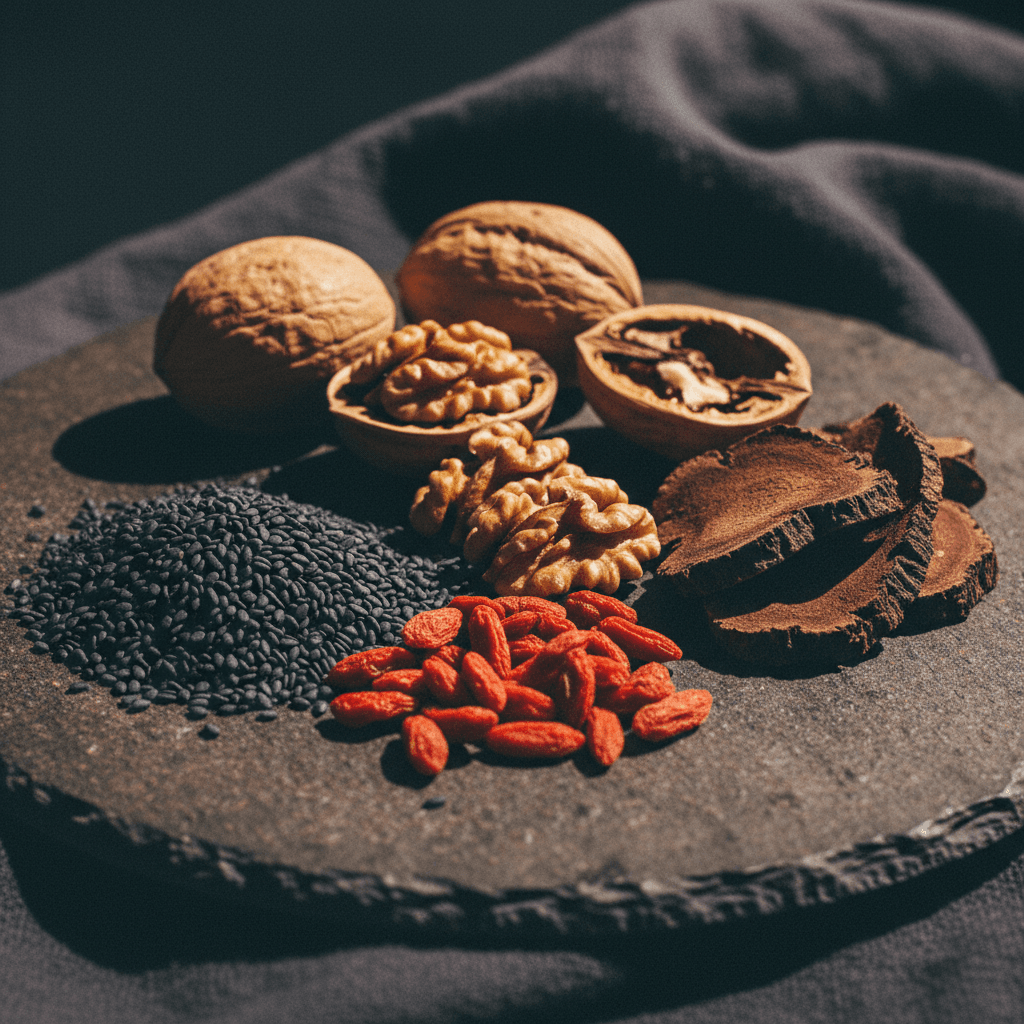
Imagine a vibrant, ancient tree, its roots reaching deep into the earth, drawing up life-giving essence to nourish every branch and leaf. In Traditional Chinese Medicine (TCM), this powerful image resonates deeply with the concept of the 'Kidney' system—not just the anatomical organ, but a profound energetic reservoir that fuels our very existence.
When I speak with patients, many are surprised to learn that TCM views the Kidneys as the root of our vitality, influencing everything from our energy levels and bone strength to our reproductive health and even our mental clarity. This is where the profound practice of Bǔ Shèn comes into play.
Bǔ Shèn (补肾/护肾), also known as Kidney Tonification or Kidney Protection, is a foundational principle in Traditional Chinese Medicine (TCM) focused on nourishing and strengthening this vital 'Kidney' system for overall vitality and longevity. It's a therapeutic approach that taps into centuries of accumulated wisdom, aiming to restore balance and replenish what time and modern stressors often deplete.
My journey from Beijing University of Chinese Medicine to an integrative medicine residency in the US has shown me time and again how these ancient concepts offer a holistic lens to understand modern health challenges. Bǔ Shèn isn't about popping a single herb; it's a comprehensive strategy, often involving a blend of specific herbs tailored to an individual's unique needs, alongside mindful lifestyle choices.
What Makes Bǔ Shèn So Special in TCM?
In Western medicine, the kidneys are filtration organs, essential for waste removal and fluid balance. In TCM, however, the 'Kidney' system is a much broader concept, encompassing not only the physical organs but also the adrenal glands, reproductive organs, bones, brain, spinal cord, and even our ears. It's considered the root of Jing (Essence), our inherited vital substance that governs growth, development, reproduction, and the aging process. Think of Jing as your body's deep, constitutional battery pack.
When this battery runs low, we experience symptoms of 'Kidney' deficiency.
Bǔ Shèn focuses on replenishing this precious Jing and balancing the two fundamental energies of the 'Kidney' system: Kidney Yin and Kidney Yang. Kidney Yin is cooling, moistening, and nourishing—think of it as the fluid and substance that prevents overheating and dryness. Kidney Yang is warming, activating, and transformative—your body's internal furnace that drives metabolic processes and provides warmth. Imbalances in these can lead to a cascade of symptoms.
Herbs commonly used in Bǔ Shèn therapy are often warming and nourishing, targeting the Kidney and Liver meridians. For instance, herbs like 熟地黄 (Rehmannia glutinosa), a cornerstone of many Bǔ Shèn formulas, is sweet and slightly warm, enriching Yin and blood. 《本草纲目》 (Compendium of Materia Medica) notes that 熟地黄 "fills the bone marrow, strengthens muscles. Long-term use lightens the body, prevents aging, brightens eyes and ears, and darkens hair and beard.
" This perfectly illustrates the holistic, anti-aging perspective of Bǔ Shèn. Other herbs like 枸杞子 (Lycium barbarum or Goji berry) are sweet and neutral, nourishing both Yin and Jing, while 菟丝子 (Cuscuta seed) is sweet and warm, a gentle Yang tonic. This combination of properties makes Bǔ Shèn a versatile and deeply restorative approach.
Top Benefits of Bǔ Shèn
For Energy & Combating Chronic Fatigue
Many of my patients come to me complaining of persistent tiredness, a feeling of being 'run down' no matter how much they sleep. In TCM, this often points to a depletion of 'Kidney' Jing or Kidney Yang. Bǔ Shèn herbs work to replenish this fundamental energy, helping to rebuild resilience from the inside out. One patient, a busy executive named Sarah, struggled with inexplicable fatigue and brain fog for years.
After a personalized Bǔ Shèn regimen, she reported a gradual but profound return of her mental clarity and physical stamina. This isn't just about a quick energy boost; it's about nourishing the body's deep reserves, which Western functional medicine aligns with supporting adrenal health and mitochondrial function.
For Cardiovascular Health & Blood Pressure Support
The TCM 'Kidney' system is intricately linked to fluid metabolism and vascular health, making Bǔ Shèn relevant for cardiovascular well-being. Researchers at Beijing University of Chinese Medicine, Dongfang Hospital, including Zhuoran Tang and Haibin Zhao, have published protocols for systematic reviews to examine the effectiveness of tonifying kidney therapy in treating hypertensive patients, noting 'kidney deficiency as a main mechanism of hypertension.
' This suggests a direct connection between 'Kidney' health and blood pressure regulation, a concept that resonates with Western understanding of the kidney's role in the renin-angiotensin system and fluid balance. When we support the 'Kidneys' in TCM, we are often influencing these underlying physiological pathways.
For Respiratory Resilience & Chronic Lung Conditions
It might seem counterintuitive to link 'Kidney' tonification to lung health, but in TCM, the Kidneys 'grasp the Qi' (energy) from the Lungs. This means strong Kidneys are essential for deep breathing and preventing conditions like chronic cough or shortness of breath. Gao Zhen and Liu Yingying from Fudan University's Institutes of Integrative Medicine have investigated Bǔ Shèn's role in stable Chronic Obstructive Pulmonary Disease (COPD).
Their work explores how strengthening the 'Kidney' system can support respiratory function, a fascinating bridge between ancient wisdom and a modern chronic illness.
For Healthy Aging & Bone Density
As we age, a natural decline in 'Kidney' Jing is expected. This can manifest as weakened bones, memory decline, hearing loss, and premature greying of hair. Bǔ Shèn therapies are often central to anti-aging strategies in TCM, aiming to slow this decline. 《神农本草经》 (Shennong Ben Cao Jing) describes枸杞子 (Goji berry) as a herb that, with prolonged use, "strengthens sinews and bones, lightens the body, prevents aging, and makes one resistant to cold and heat.
" This echoes modern research into how certain herbs might support bone mineral density and cognitive function, crucial aspects of graceful aging.
What the Science Says
While Bǔ Shèn has been a cornerstone of TCM for millennia, modern science is increasingly seeking to validate its mechanisms and efficacy. The challenge lies in studying a holistic therapeutic principle that often involves complex herbal formulas, rather than a single isolated compound. However, promising research is emerging.
A significant meta-analysis published in Frontiers in Cardiovascular Medicine in 2022 by Qingqing Wang and colleagues (including researchers from Guang'anmen Hospital, China Academy of Chinese Medical Sciences) reviewed 18 studies involving 2,024 patients. Their findings demonstrated that tonifying kidney therapy, when combined with routine Western treatment for hypertension, was superior to routine treatment alone. It showed significant improvements in lowering blood pressure, reducing blood lipids, enhancing vascular endothelial function, and alleviating TCM symptoms, all without obvious adverse reactions.
This suggests a quantifiable benefit for cardiovascular health.
Beyond hypertension, protocols for systematic reviews are actively being developed to evaluate Bǔ Shèn's role in other chronic conditions. Gao Zhen, Liu Yingying, and Dong Jingcheng from Fudan University initiated a protocol in 2018 for a systematic review and meta-analysis focusing on Bǔ Shèn therapy for stable Chronic Obstructive Pulmonary Disease (COPD). Preliminary data from the Wang et al. meta-analysis, in a subset of COPD patients, indicated significant improvements in effectiveness rates (RR = 1.37, 95% CI 1.
22 to 1.53, P < 0.00001) and 6-minute walk distance (MD 11.92, 95% CI 3.52 to 20.32, P = 0.005), suggesting enhanced respiratory capacity and quality of life.
Further research, such as the 2024 work by Zheng Xin and colleagues, highlights the potential of Bǔ Shèn Chinese medicine combined with Western medicine to significantly lower serum creatinine levels in patients with chronic renal failure, showing a reduction from 901.2 μmol/L to 485 μmol/L. Similarly, Wang Wenru et al.'s 2024 study explores Bǔ Shèn's role in treating aplastic anemia, noting its potential to increase platelet and reticulocyte counts.
These studies underscore the growing interest in scientifically validating the profound effects observed in traditional practice.
How to Use Bǔ Shèn Herbs
Because Bǔ Shèn is a principle, it’s not a single herb but a category of herbs and formulas. Your practitioner will select the most appropriate ones based on your specific 'Kidney' pattern (e.g., Yin, Yang, or Essence deficiency). However, here are common ways that individual Bǔ Shèn herbs or formulas are typically prepared and consumed:
Traditional Decoctions (Teas)
This is the classic method for Chinese herbal medicine. For common Bǔ Shèn herbs like 熟地黄 (Shu Di Huang), 枸杞子 (Gou Qi Zi), and 菟丝子 (Tu Si Zi), you might simmer a combination in water. As noted by Tong Xiaolin in 2025, specific dosages like 熟地黄 (15-60g), 枸杞子 (9-30g), and 菟丝子 (9-15g) are used.
Typically, you'd combine the prescribed amounts of dried herbs, add 3-4 cups of water, bring it to a boil, then reduce to a simmer for 30-45 minutes until the liquid reduces. Strain and drink the warm liquid, often twice daily.
Granules or Powders
Many traditional formulas are now available as concentrated granules. These are convenient: simply dissolve 1-2 scoops (as directed by your practitioner or product label) in a cup of hot water and drink. This method offers similar efficacy to decoctions but with much greater ease of preparation. For individual herb powders, a common dose might be 3-9g mixed into warm water, 1-2 times daily.
Pills or Capsules
Pre-made patent formulas, such as Liuwei Dihuang Wan (Six-Ingredient Rehmannia Pill) or Qiju Dihuang Wan (Lycium Fruit, Chrysanthemum and Rehmannia Pill), are widely available as small pills. These are standardized and easy to take. Dosages vary, but commonly involve taking 6-8 pills, 2-3 times per day with warm water. Always adhere to the specific instructions on the product packaging or your practitioner's guidance.
Safety & Who Should Avoid Bǔ Shèn
As an integrative physician, I cannot stress enough the importance of professional guidance when considering any herbal therapy, especially Bǔ Shèn. These are potent medicines, not mere supplements. While Bǔ Shèn therapies are generally considered safe when properly prescribed, there are critical considerations:
Contraindications
Individuals with acute infections, fever, or severe inflammation should generally avoid tonifying herbs, as they can sometimes trap pathogens. If you have significant digestive issues like acute diarrhea, severe bloating, or indigestion, rich tonifying herbs might worsen these symptoms. It is also crucial to avoid Bǔ Shèn without proper diagnosis; taking a 'Kidney Yin' tonic when you have 'Kidney Yang' deficiency, or vice-versa, can create new imbalances.
Drug Interactions
Bǔ Shèn herbs can interact with Western medications. For instance, some herbs might affect blood pressure, requiring careful monitoring if you are on antihypertensive drugs. Other herbs could influence blood sugar levels, impacting diabetic medication. It is imperative to consult both your Western medical doctor and your licensed TCM practitioner before starting Bǔ Shèn therapy if you are on any prescription medications, to avoid potential adverse interactions.
Pregnancy and Breastfeeding
While some Bǔ Shèn herbs are traditionally used to support fertility, their use during pregnancy and breastfeeding must be approached with extreme caution and only under the direct supervision of a qualified practitioner. Some herbs are contraindicated during pregnancy due to potential effects on uterine contractions or fetal development. Self-medicating during these sensitive periods is strongly discouraged.
A Holistic Path to Vitality
Bǔ Shèn offers us a profound invitation to reconnect with our body's deepest wellspring of vitality. It's more than just addressing symptoms; it's about honoring the intricate interplay of our energetic systems, recognizing that true health emerges from balance and deep nourishment. As we continue to bridge the wisdom of ancient traditions with the rigor of modern science, Bǔ Shèn stands as a testament to the enduring power of holistic healing.
It reminds us that sometimes, the most effective path to future well-being is to gently replenish the fundamental essence within us, much like nurturing the roots of that ancient tree to ensure its vibrant longevity.
References
- Gao Zhen, Liu Yingying, Dong Jingcheng (Institutes of Integrative Medicine, Fudan University). Protocol for a systematic review and meta-analysis to evaluate the efficacy and safety of tonifying kidney therapy (Bushen, TK) for stable Chronic Obstructive Pulmonary Disease (COPD).
- Zhuoran Tang, Yize Sun, Chao Wang, Xiang Liu, Xin Qi, Di Ma, Haibin Zhao (Beijing University of Chinese Medicine, Dongfang Hospital). Protocol for a systematic review and meta-analysis to examine the effectiveness and safety of tonifying kidney therapy (TKT) in treating hypertensive patients, noting kidney deficiency as a main mechanism of hypertension.
- Qingqing Wang, Jian-Shui Lin, Kui-wu Yao et al. (Frontiers in Cardiovascular Medicine). Meta-analysis showed that tonifying kidney (TK) combined with routine treatment was superior to routine treatment alone in lowering blood pressure, blood lipids, improving vascular endothelial functions, and alleviating TCM symptoms in hypertension patients, with no obvious adverse reactions.
- 郑新等, 国医大师郑新治疗慢性肾衰竭
- 王文儒等, 补肾中药治疗再生障碍性贫血
- Google Search: time in CN