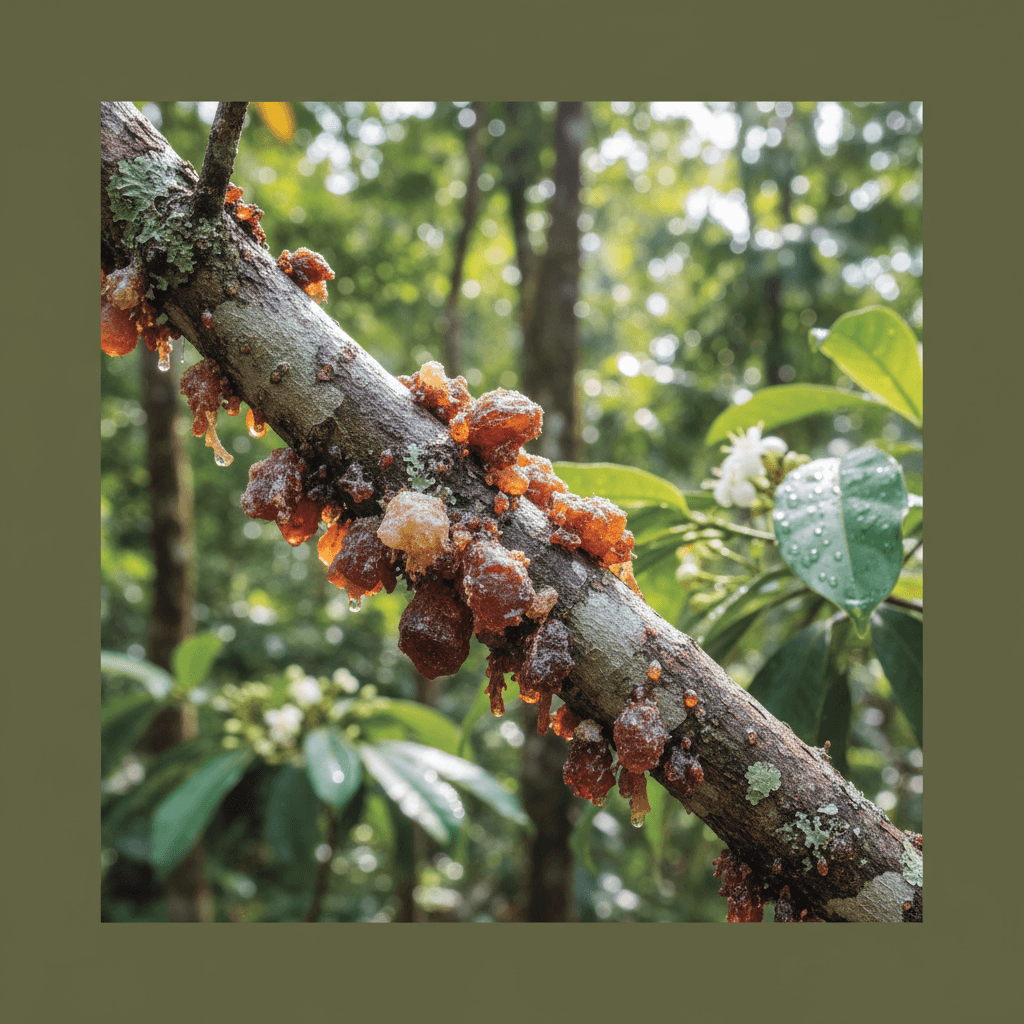
Imagine a fragrance so profound it was believed to awaken the very essence of life, a resin carried across ancient trade routes, valued as much for its spiritual resonance as its medicinal might. This is the story of An Xi Xiang (安息香), known in the West as Benzoin (Latin: Benzoinum).
This exquisite resin, harvested from Styrax trees, has been a cornerstone of Traditional Chinese Medicine (TCM) for millennia, revered for its profound ability to open the orifices, invigorate blood, and alleviate pain.
My journey through both Beijing University of Chinese Medicine and my integrative medicine residency in the US has shown me how these ancient botanical treasures, like Benzoin, offer a deep wisdom that modern science is only beginning to unravel.
It’s a bridge between the historical insights of texts like 《神农本草经》 (The Divine Farmer’s Materia Medica), which lists An Xi Xiang as a superior herb for 'heart and abdominal evil Qi and ghost vexation,' and the intricate chemical analyses we perform today.
This isn't just about folklore; it’s about understanding a complex botanical agent through a dual lens. Researchers like Sun Yuanyuan and colleagues (2023) at institutions across China are actively engaged in clarifying the botanical origins of An Xi Xiang, confirming that while Styrax tonkinensis is the prevalent source today, Styrax benzoin also holds significant medicinal value. This continuous re-evaluation of our materia medica ensures that we uphold tradition while embracing scientific rigor.
What Makes Benzoin Special? A TCM Perspective
In TCM, every herb has a unique energetic signature, a profile that guides its use. An Xi Xiang is described as having a neutral nature, meaning it doesn't dramatically heat or cool the body. Its acrid flavor signifies its ability to move and disperse, to penetrate and open. The bitter flavor points to its capacity to clear and drain, to dry dampness and resolve phlegm. Together, these properties make it a potent agent for addressing stagnation and obstruction.
When we look at its meridian tropism, An Xi Xiang targets the heart, liver, spleen, lung, and stomach meridians. This wide range isn't accidental; it speaks to the herb's holistic impact. Think of the heart as the emperor of the body, governing the spirit and blood circulation. The liver manages the smooth flow of Qi and blood. The spleen transforms and transports nutrients. The lungs govern Qi and regulate water passages. The stomach processes food.
An Xi Xiang, by influencing these vital systems, orchestrates a comprehensive clearing and revitalizing effect.
Its most renowned action, 'opening the orifices,' is a powerful concept in TCM. The 'orifices' refer not just to our sensory organs but also to the energetic pathways that allow the spirit (Shen) to connect with the external world and maintain clarity. When these pathways are obstructed, we might experience mental fogginess, disorientation, or a feeling of being 'stuck.
' An Xi Xiang, with its pungent, aromatic nature, literally helps to clear these blockages, allowing for greater mental sharpness and spiritual awakening. It's like a gentle, aromatic wind clearing away mental cobwebs, bringing fresh perspective.
Top Benefits: Bridging Ancient Wisdom and Modern Wellness
An Xi Xiang's actions translate into several key benefits that resonate with many of the health challenges we face today.
For Mental Clarity and Focus (Awakening the Spirit)
In TCM, when the heart's orifices are blocked by phlegm or turbid substances, it can lead to symptoms like confusion, lethargy, or a sense of detachment. This is where An Xi Xiang shines. Its ability to 'open the orifices' and 'awaken the spirit' is traditionally employed for conditions that manifest as mental fogginess, emotional overwhelm, or even sudden loss of consciousness due to internal imbalances.
While we're not talking about a cure for neurological disorders, it’s about supporting the body's innate capacity for clear thought and emotional resilience. I've had patients, like a young student struggling with intense test anxiety and a feeling of being 'scattered,' who found that a carefully formulated blend including a small amount of An Xi Xiang helped her regain a sense of centeredness and focus during stressful periods. It wasn't a sedative, but an energetic 'reset.
For Pain Relief and Circulation (Invigorating Blood, Moving Qi)
A fundamental principle in TCM is that 'where there is stagnation, there is pain.' An Xi Xiang is a powerful herb for invigorating the blood and promoting the movement of Qi. This means it helps to break up blockages that can cause pain anywhere in the body. Whether it's the dull ache of muscle stiffness, the sharp twinge of an acute injury, or the discomfort of poor circulation, Benzoin helps to get things flowing again.
Its influence on the liver meridian, which governs the smooth flow of Qi, is particularly relevant here. For chronic aches that Western medicine sometimes struggles to pin down, approaching the issue as 'Qi and Blood stagnation' through the lens of An Xi Xiang can be incredibly insightful.
For Respiratory Comfort (Resolving Phlegm and Unblocking Channels)
With its bitter and acrid flavors, An Xi Xiang also has a role in resolving phlegm, particularly when phlegm obstructs the lung or stomach meridians. This isn't just about a productive cough; in TCM, 'phlegm' can be both physical and energetic, contributing to a sense of heaviness or sluggishness throughout the body. By helping to clear these internal 'damp-phlegm' accumulations, it supports clearer breathing and overall energetic lightness.
It’s part of a broader strategy to ensure the body's internal environment is free-flowing and unburdened.
What the Science Says: Modern Insights into an Ancient Resin
While An Xi Xiang’s primary evidence base remains its extensive traditional use, modern research is steadily catching up, revealing the fascinating biochemistry behind its ancient applications. The resin is rich in active compounds, primarily benzoic acid derivatives and volatile essential oils, that offer compelling hints at its pharmacological mechanisms.
A significant study by Liu Yangyang's team, published in World Science and Technology-Modernization of Traditional Chinese Medicine in 2021, conducted a GC-TOF/MS analysis of An Xi Xiang's volatile components. They identified benzyl benzoate (25.52%) and benzoic acid (23.12%) as major constituents. Crucially, their findings indicated that these compounds possess anti-inflammatory and antipyretic (fever-reducing) properties. Even more intriguing, the research suggested a potential role in blood-brain barrier protection.
This offers a scientific grounding for An Xi Xiang's traditional use in 'opening the orifices' and 'awakening the spirit' — suggesting a neuroprotective or cognitive-supportive action at a cellular level.
Beyond identifying active compounds, researchers are also working to ensure the quality and consistency of this precious herb. Wang Feng and colleagues, writing in Chemical Analysis and Metrology in 2013, demonstrated how principal component projection analysis could effectively differentiate the quality of various batches of benzoin paste. Their work established a database of 24 volatile components, highlighting key quality markers like benzyl benzoate and cinnamyl cinnamate.
This kind of research is critical for standardizing herbal medicine, bridging the gap between historical efficacy and modern pharmaceutical quality control, ensuring that practitioners and patients receive consistently potent and authentic products.
While these studies provide compelling preliminary evidence, it's important to remember that most are laboratory-based or involve chemical analyses. We look forward to more extensive human clinical trials that directly validate An Xi Xiang's traditional efficacy in a modern clinical setting, similar to the rigorous studies championed by integrative medicine leaders like Dr. Helene Langevin at NIH NCCIH or Dr. Brent Bauer at Mayo Clinic.
How to Use An Xi Xiang (Benzoin)
An Xi Xiang is a potent herb, and its usage requires careful consideration, often as part of a larger formula. One crucial note from the materia medica is that it should not be decocted (boiled in water) because its active volatile components are easily lost through heat. Instead, it’s typically used in powdered form or as a tincture.
Pills and Powders: For internal use, An Xi Xiang is commonly ground into a fine powder. The recommended dosage for powders is typically 0.3-1.5 grams. This powder can be mixed with water, honey, or integrated into a prepared pill formula. I once had a patient, a quiet librarian who found herself overwhelmed by unexpected grief.
We worked with a gentle formula including An Xi Xiang powder, taken in small, precise doses, to help her navigate the emotional turbulence and regain a sense of presence.
Tinctures: An alcohol-based extract can also be used. The typical dosage range for a tincture is 0.2-1.5 ml. Tinctures offer a convenient way to administer the herb while preserving its delicate aromatic compounds. They should usually be diluted in a small amount of water before consumption.
Topical and Aromatic Use: Beyond internal consumption, Benzoin resin or its essential oil is widely used in aromatherapy for its calming and grounding scent. It can be diffused, inhaled directly, or diluted in a carrier oil for topical application (e.g., for minor skin irritations or to soothe tense muscles, though always test on a small skin patch first).
Remember, however, that aromatic use, while beneficial for mood and relaxation, does not replace the specific internal therapeutic actions of the herb as prescribed in TCM.
Always consult with a qualified TCM practitioner or integrative physician before incorporating An Xi Xiang into your regimen, especially given its potent nature and specific preparation requirements.
Safety & Who Should Avoid An Xi Xiang
As an integrative medicine physician, I cannot stress enough the importance of understanding who should and should not use potent herbs like An Xi Xiang. While powerful for certain conditions, it is not for everyone. Always discuss your health history with a knowledgeable practitioner before use.
Contraindications and Cautions:
Pregnancy: Due to its strong ability to invigorate blood and promote Qi movement, An Xi Xiang is strictly contraindicated during pregnancy. It could potentially stimulate uterine contractions or affect fetal development. Avoid it entirely.
Yin Deficiency Fire: Individuals with Yin Deficiency Fire (symptoms like night sweats, dry mouth, hot flashes, irritability) should use caution. An Xi Xiang’s moving nature might exacerbate these internal heat signs.
Excess Fire Conditions: Those with acute inflammatory conditions, high fever, or other signs of Excess Fire should also use caution. Its acrid, moving nature could potentially intensify these conditions.
Qi Deficiency: If you have significant Qi Deficiency (marked by chronic fatigue, weakness, weak digestion, shortness of breath), An Xi Xiang should be used with extreme caution, if at all. Its strong moving action could further deplete an already weakened system.
Drug Interactions: While specific drug interactions for An Xi Xiang are not extensively documented in Western literature, its ability to invigorate blood suggests potential interactions with blood-thinning medications (anticoagulants or antiplatelets). Always consult your physician or pharmacist if you are taking any prescription medications, especially those affecting blood clotting or the central nervous system, before using An Xi Xiang.
This is a powerful herb. Its targeted effects demand respect and professional guidance. Never self-prescribe, especially for serious conditions.
A Final Reflection
An Xi Xiang, or Benzoin, is more than just a resin; it's a testament to the enduring power of nature and the profound insights of Traditional Chinese Medicine. From its ancient origins as a treasured aromatic on the Silk Road to its modern chemical analysis, it represents a continuous dialogue between centuries of empirical observation and contemporary scientific inquiry.
As we continue to navigate the complexities of modern health, herbs like An Xi Xiang remind us that true healing often lies in understanding the subtle, interconnected energies of the body, and in carefully chosen interventions that harmonize with our deepest nature. It’s about unlocking that inner radiance, one well-understood herb at a time.
References
- 刘洋洋团队,《安息香挥发性化学成分GC-TOF/MS分析及药理活性研究》, 世界科学技术-中医药现代化, 2021